The GAC XT80 has a credible mixed-use engineering proposition: its officially identified China Yue7 reference combines an adjustable five-seat cabin with independent suspension, while four-wheel-drive grades add rear locking hardware and higher grades add variable damping and adjustable ride height. These features explain how city comfort and outdoor capability can coexist. They do not yet establish a measured export XT80 result on every terrain. The strongest assessment names the China grade, tyre package and operating condition behind each claim, then distinguishes those documented provisions from the overseas specification still to be confirmed.
The overseas debut and the domestic specification answer different questions
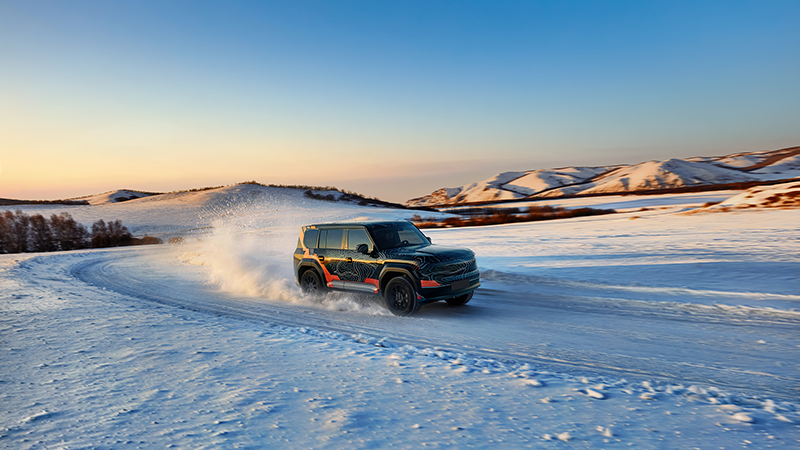
GAC introduced XT80 overseas at the Abu Dhabi International Hunting and Equestrian Exhibition in August 2026. The GAC debut announcement places it in an outdoor setting, while the October Middle East launch and media-drive procurement notice identifies the programme as the international Yue7. That connection makes the China configuration a relevant engineering reference. It does not make every domestic option standard on an overseas car.
The October project describes city, highway and light off-road route requirements. This is useful because it shows that the intended demonstration covers more than one dramatic obstacle. A vehicle used for outdoor recreation will usually spend much of its life on ordinary roads. Its ability to carry people comfortably to the beginning of a track therefore belongs in the same assessment as traction and clearance. The document establishes a planned evaluation setting, not results from a completed comparative test.
For this reason, the analysis below works from mechanisms: which equipment supports rear-seat comfort, what changes on loose ground, and which grade has the hardware needed for a more demanding route. The XT80 city-comfort reference and Yue7 four-wheel-drive hardware analysis provide the underlying detail. Bringing those two uses together produces a more useful answer than treating urban refinement and outdoor capability as unrelated marketing claims. The local XT80 order sheet remains necessary before any domestic feature is promised to an export buyer.
[TENDER]A mixed-terrain vehicle needs the complete grade combination
The China range separates two-wheel-drive versions from four-wheel-drive Max, Ultra and the satellite-communication grade. Those differences are material: the rear differential lock appears on the four-wheel-drive entries, the front lock requires an optional package, and the adjustable spring-and-damper combination is restricted further. A photograph of one highly equipped demonstration car cannot identify the specification of another version.
The official Yue7 configuration table supports the following comparison. It is deliberately organised around jobs rather than prestige: passenger adjustment is broadly available, while traction and clearance hardware depend on the configuration.[YUE]
For city users who occasionally reach a maintained campsite, the full catalogue of outdoor equipment may be unnecessary. For a buyer expecting uneven ground and changing loads, the four-wheel-drive and adjustable-height distinctions become more relevant. The point is not that one grade is always right; it is that the eventual retail car must contain the mechanisms used to justify the recommendation.
| Domestic configuration | Passenger adjustment | Outdoor traction | Ride-height hardware |
|---|---|---|---|
| 2WD Pro / Max | Powered rear position and backrest | Front drive; rear lock not listed | Air springs and SDC not listed |
| 4WD Max | Powered rear position and backrest | Rear lock; optional front lock | 230 mm listed clearance; no air springs |
| 4WD Ultra / satellite | Powered rear position and backrest | Rear lock; optional front lock | Air springs and SDC; 310 mm at highest setting |
City comfort begins with where the passengers can sit
A five-seat cabin can be comfortable for different households only if its available space can be allocated sensibly. The China Yue7 lists powered fore-aft and backrest adjustment in the rear, together with powered folding and restoration. Its 2,900 mm wheelbase describes the platform, while the seat movements describe something the occupants can actually use. A taller rear passenger and a family carrying larger bags may choose different allocations of the same interior.
The published maximum backrest angle is 127 degrees. That is a mechanical adjustment limit, not an instruction to travel at the greatest recline. The supported travelling posture must remain compatible with the seat belt and any fitted child restraint. The useful benefit is the ability to find a suitable position; parked relaxation and occupied-road use are separate situations. The listed second-row i-Size interfaces similarly identify a restraint provision, not universal approval for every seat combination.
This is a concrete part of the XT80 programme’s city proposition. School runs, visits with older relatives and longer suburban trips place different people in the same rear row. Powered adjustment can reduce the effort of changing between those arrangements, while the five-seat layout leaves the vehicle’s full passenger role clear. The Yue7 and Prado passenger-comfort comparison adds context for buyers weighing this arrangement against a vehicle with a different seat count. More adjustment does not create a sixth seating position or eliminate the need to check the actual passengers.
[YUE]Front-seat support, airflow and glazing contribute in different ways
The domestic equipment list combines a six-way powered driver seat with four-way lumbar support and a powered front passenger seat. Heated and ventilated front seats are listed across the range. Position and lumbar adjustment help the driver establish support; heating and ventilation change conditions at the contact surface. A useful cabin assessment considers both instead of assuming that soft trim alone determines comfort over an extended journey.
Front-seat memory adds a repeat-use benefit when two adults share the car. They can return to a previously established position rather than rebuild it each time. The cabin also provides dual-zone automatic climate control, a rear centre air outlet and rear Type-C connections. These features serve different occupants: the driver’s preferred temperature does not necessarily suit the rear passengers, and a rear charging connection reduces dependence on a cable from the dashboard.
Noise management is similarly grade-specific. Acoustic laminated windscreen and first-row glazing are listed, while second-row acoustic glass appears from Max upwards. Ultra and the satellite-communication grade add ENC active noise control. That creates a credible package for occupied urban travel, but it is not a measured decibel lead over a competitor. Tyres, road texture, seals and powertrain state also affect the result. A test of the eventual local car should therefore listen from both rows and in more than one operating state, keeping the documented equipment separate from the passenger’s observed preference.
The cabin provisions can be evaluated in a repeatable way without claiming a formal road test. Start with the vehicle parked after ordinary exposure, set the front seats for the regular drivers, and check whether the rear occupants can reach airflow and power connections without changing those positions. Then compare the normal driving posture with the luggage arrangement still in place. This isolates the daily benefit of the adjustment and climate hardware. It also avoids allowing a promotional image of an empty cabin to stand in for the occupied configuration that the owner will actually use.
[YUE]Independent suspension provides the foundation; adjustable hardware changes the tools
Yue7 uses a double-wishbone front arrangement and five-link independent rear suspension. This describes how the wheels are located and can move relative to the body. Springs support the load and dampers resist motion; these components work with the geometry rather than replacing it. On city roads, the relevant outcome is how the body responds after a sharp edge or a sequence of undulations, particularly with occupants and luggage aboard.
Four-wheel-drive Ultra and the satellite-communication grade add closed dual-chamber air springs and SDC continuously variable dampers. Four-wheel-drive Max does not list those two components. This is an important distinction because height adjustment and damping adjustment address different parts of the task. The former changes the vehicle’s position within its permitted settings; the latter changes resistance to movement. Neither can be inferred merely from the fact that a vehicle is four-wheel drive.
The published air-height span is 150 mm, extending 70 mm below and 80 mm above the standard position. It is not a measurement of wheel travel. The domestic table also marks a preview function as a future OTA item, which is excluded from this present-equipment assessment. The credible comfort argument is that the higher grades provide additional adjustment tools. A judgement that they ride better than a particular rival still requires comparable tyres, loads and routes, with the actual settings recorded.
[YUE]On gravel, tyres and torque delivery must be read together
Loose surfaces change the relationship between available grip and the torque requested at the wheels. The China four-wheel-drive versions provide an electric four-wheel-drive arrangement, whereas the two-wheel-drive grades do not. That architecture supplies a reason to examine the four-wheel-drive car for mixed surfaces. It does not mean every acceleration request will be transmitted without wheel slip, because the surface and tyre contact still impose limits.
The tyre choice is consequently part of the vehicle being assessed. Four-wheel-drive Yue7 lists 265/65 R18 road tyres as standard, an optional 18-inch off-road tyre package and an alternative 275/55 R20 road package. The two optional packages are mutually exclusive in the domestic notes. Describing a demonstration on off-road tyres as the standard car would conceal an important variable. The 18-inch size has a nominal sidewall of about 172 mm, compared with about 151 mm for the listed 20-inch size; those are size-code calculations, not stiffness measurements.
For a gravel access road, the useful question is how the chosen tyre, speed and load work with the control system, rather than whether a single terrain label appears on a screen. The tyre construction, tread and inflation influence the response. All listed four-wheel-drive grades include a full-size spare, which is another practical outdoor provision. Confirming compatibility with the selected wheels completes the equipment assessment and avoids presenting appearance or rim diameter as a substitute for a route-specific choice.
[YUE]Uneven traction is where the locking hardware becomes relevant
The four-wheel-drive configuration lists a rear differential lock. Its significance appears when the two wheels on that axle do not have the same grip: locking changes their relationship, instead of allowing the less-supported wheel’s condition to define the entire axle response in the same way as an unlocked differential. This is a specific mechanism behind the outdoor case, rather than a general claim that electronics can solve every traction problem.
The front differential lock is optional through the off-road package. It should therefore be identified separately whenever a demonstration relies on it. A model-family claim that all versions have the same set of locks would be inaccurate. The appropriate procedure and permitted conditions belong to the vehicle’s instructions; a list of hardware is not a recommendation to engage every function on every surface.
Terrain modes coordinate control choices but do not alter the ground beneath the car. Their contribution depends on the hardware, tyres and operating conditions with which they are used. A maintained gravel road, a cross-axle section and a loose incline are different tasks. A meaningful evaluation records which task was attempted and which configuration completed it. This allows the Yue7 reference to support an outdoor capability case without converting a planned XT80 media event into a completed test. Our XT80 and Prado energy comparison adds the battery and fuel considerations that accompany repeated outdoor use.
[YUE]Clearance and body angles explain different possible contact points
The China four-wheel-drive Max specification lists 230 mm minimum ground clearance. The air-suspension grades list 230 mm in the standard position and 310 mm at their highest setting. The raised value is conditional: it belongs to the adjustable grades in a particular position. It should not be presented as the permanent clearance of every Yue7 or the already confirmed specification of an overseas XT80.
GAC’s table gives standard approach and departure angles of 30 and 33 degrees for the four-wheel-drive reference, rising to 34.5 and 36.2 degrees at the highest air setting. The breakover figure describes the crest between the axles, while approach and departure concern the front and rear. A route can challenge any of these relationships. Additional clearance beneath one part of the vehicle does not ensure that every other contact point is clear.
The practical advantage of adjustable height is the ability to alter the geometry within the permitted operating envelope. That can be relevant when changing from paved travel to a more uneven section, but the local manual must establish usable speeds, loads and settings. The numbers explain why a higher grade may be worth investigating for such use; they do not certify an unknown trail. Keeping the setting attached to the figure makes the capability claim more useful and more credible than quoting only the largest value.
[YUE]Water, cold and battery validation are separate evidence categories
The domestic table lists a 700 mm maximum wading depth for four-wheel-drive Max and 780 mm for Ultra and the satellite-communication grade. Those figures describe specified China configurations. They do not establish that unknown water below a given depth is suitable, because flow, substrate, hidden variation and the prescribed procedure remain material. Nor should they be relabelled as confirmed export XT80 limits before a local specification is available.
GAC’s September development account reports battery immersion work and a 1,000-joule underside impact test. Component validation is relevant to the design effort, but a battery test and a moving whole-vehicle water crossing are different events. The latter involves additional systems and operating conditions. Treating the first as proof of the second would overstate the evidence.
The April Yue7 presentation also describes manufacturer validation at minus 40 degrees Celsius. That supports a discussion of the development environment, not an unlimited operating-temperature promise for every export vehicle. The sensible positive conclusion is that the domestic programme reports work on several demanding conditions. The remaining requirement is to connect the actual overseas vehicle, its instructions and its approved configuration to the intended local use.
[DEVELOP]Endurance work matters because outdoor demands are repeated
An isolated photograph of a vehicle on a rough surface is weak evidence of long-term suitability. Repeated loads, temperature changes and wear are part of the engineering problem. GAC reports that the Yue7 programme used 685 test vehicles over three years, spanning two winters and two summers. It also reports equivalent 500,000 km vehicle endurance work and 500,000 air-spring bench cycles. These are manufacturer-reported development statements, not independent XT80 customer results.
The distinction between whole-vehicle and component work matters. An air spring cycling on a bench addresses a defined component task; an endurance programme exercises a broader vehicle system. Neither figure should be casually rewritten as the mileage of every individual test car. Their value is the stated scale and repetition of the development effort, with the original scope retained.
The October Canton Fair announcement reinforces XT80’s camping and outdoor positioning, but a display setting does not establish a measured durability outcome or transfer every showcased technology to the vehicle. For a buyer, the stronger narrative joins the published development record to the grade-specific hardware and then to local service support. This is more substantial than a generic claim of toughness while remaining clear about what the available evidence has and has not demonstrated.
Repeated validation also gives a useful question for the eventual local ownership discussion: which service procedures apply after the kinds of conditions the owner expects to encounter? A vehicle can contain suitable hardware while still requiring inspection or maintenance appropriate to its use. The relevant schedule should come from the local instructions and support organisation. No special interval is invented here; the point is to connect the capability being purchased with the care needed to keep the actual vehicle in that condition.
[DEVELOP]The combined city-and-outdoor case is strongest when its configuration is visible
For ordinary roads, the Yue7 reference supplies a concrete comfort case through powered rear-seat adjustment, front-seat support, airflow, glazing and independent suspension. For more varied surfaces, four-wheel drive, rear locking hardware, tyre options and grade-specific adjustable height provide distinct additional tools. These mechanisms explain how the XT80 programme can target both daily passenger use and outdoor recreation without relying on a single vague description of versatility.
The strongest prospective configuration depends on the recurring journey. A buyer mainly travelling on paved roads should give passenger fit and normal-height behaviour substantial weight. A buyer regularly using uneven access roads should also identify the complete traction, tyre and spare-wheel package. Choosing air suspension adds a geometry and damping proposition; it does not automatically establish a superior result on every surface or turn optional front locking into standard equipment.
On the evidence presently reviewed, the justified conclusion is a substantial mixed-use engineering proposition supported by the China Yue7 specification and official XT80 programme documents. A final export performance verdict still needs the local grade sheet and an observed route result. That remaining distinction protects the credibility of the positive case: the documented equipment is meaningful, its mechanisms are explainable, and its limitations remain visible rather than being filled with assumed test results.
[TENDER]Sources & references
- [YUE] China Yue7 grade-specific configurationGAC Trumpchi · Live public configuration service get_car_type_info, id 919, re-read 6 November 2026. China grades only; future OTA-marked features excluded.
- [TENDER] XT80(越7国际版)中东上市活动及媒体试驾项目GAC International procurement platform · 8 October 2026 project. Public page API re-read 6 November 2026; international-Yue7 identification and planned city, highway and light off-road route.
- [DEBUT] GAC XT80 makes its overseas debut at ADIHEX 2026GAC, distributed by PR Newswire · 31 August 2026 announcement of the 28 August Abu Dhabi debut; positioning only, not a completed terrain test.
- [DESIGN] 广汽全球化战略升级,锚定2030年销量100万辆目标GAC Group · 28 April 2026. Names Yue7, integrated structural reinforcement, digital chassis and manufacturer-reported minus 40°C validation; not export operating limits.
- [DEVELOP] 广汽坚决不造“速成车”,只下“笨功夫”GAC Group · 8 September 2026. Manufacturer-reported Yue7 development: 685 test vehicles, three years, two winters and two summers, equivalent 500,000 km vehicle endurance and 500,000 air-spring bench cycles. Not independent XT80 results.
- [FAIR] GAC showcases multiple models at Canton FairGAC, distributed by PR Newswire · 17 October 2026 release. XT80 display and camping/sports setting; does not establish every displayed technology as XT80 equipment.
This is a source-based editorial guide, not a first-hand road test. Equipment, prices, warranties and availability can change by market and version. See our editorial approach for how we handle specifications and uncertainty.