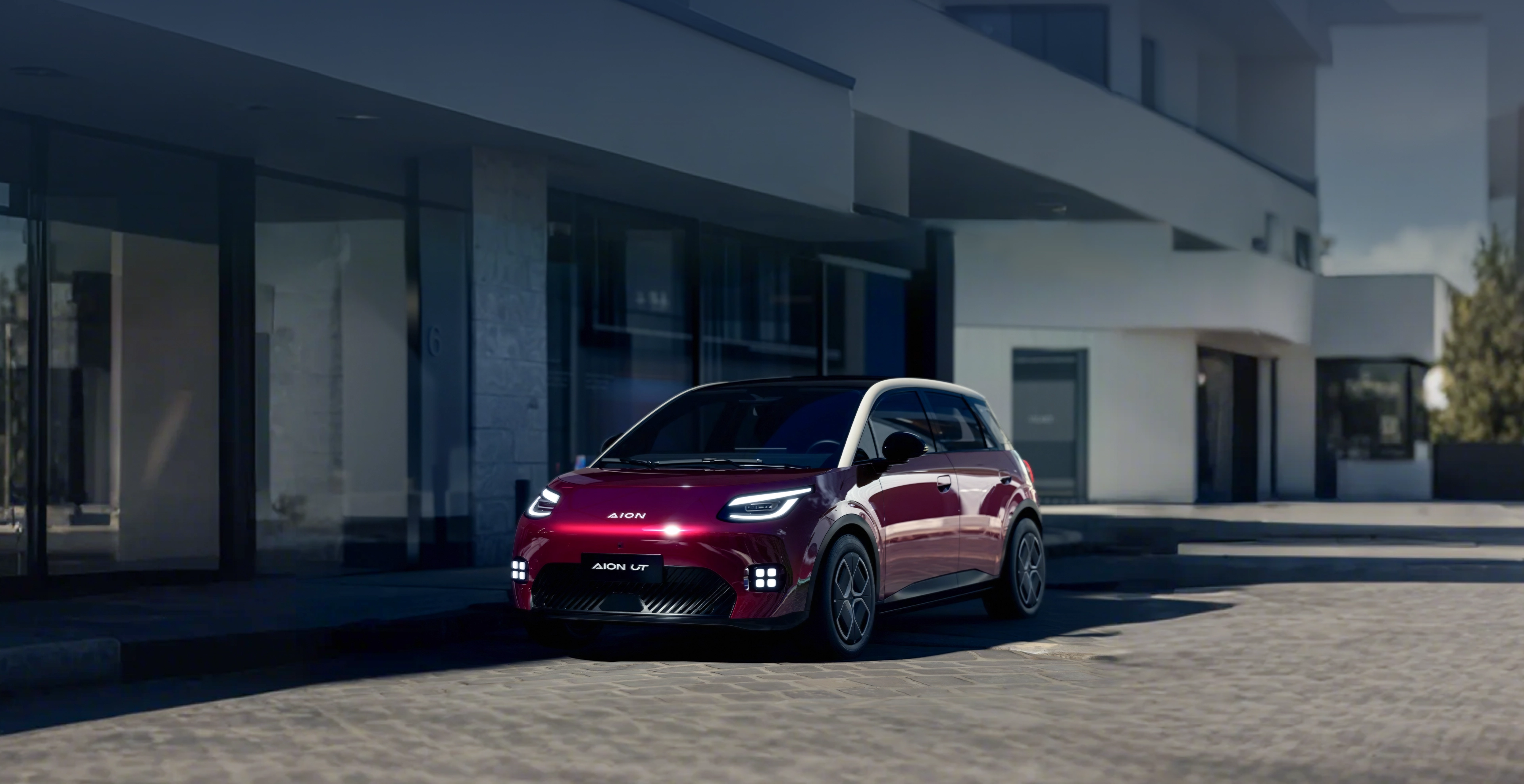
The AION UT offers a promising passenger-space package for a 4.27-metre hatchback: official European dimensions include a 2,750 mm wheelbase, and GAC publishes 440 litres of luggage capacity with the rear seats up. That boot number needs its measurement method and local equipment context; it is not directly interchangeable with every rival's quoted figure.
A compact length with a substantial wheelbase
The French specification lists the AION UT at 4,270 mm long, 1,575 mm high and 2,750 mm between the axles. It lists width as 1,850 mm with mirrors folded and 2,073 mm with mirrors deployed. These numbers describe different practical constraints: overall length affects parking, open-mirror width affects a narrow entrance, and wheelbase contributes to how the interior can be packaged.
Its wheelbase is about 64% of its overall length, calculated from those published measurements. That is a useful way to understand the proportions, not a direct measurement of passenger legroom. Dashboard depth, seat shape and the positions used to measure legroom still affect the space people experience.
What rear passengers can reasonably expect
GAC's Pakistan model presentation publishes 905 mm of rear legroom and promotes accommodation for three adults. Treat that as the manufacturer's packaging claim, rather than our own measurement or a guarantee that every three-adult combination will be comfortable.
Our interpretation is that the UT is worth considering for a small household that wants a compact exterior without automatically accepting a cramped rear row. Its relevance is strongest for ordinary commuting, school trips and carrying friends. Buyers who frequently carry three large adults should give shoulder space and the centre seating position at least as much attention as knee room.
A rear-facing child seat creates a different test. Its shell may limit how far the front passenger can move back even when an adult sitting behind that passenger has plenty of legroom. Bring the seat that will actually be used; a showroom impression of empty seats does not settle this question.
Why the 440-litre boot needs a label
GAC France identifies its seats-up luggage figure as 440 litres using the SAE method. The Hong Kong specification also quotes 440 litres but labels the method as water displacement. We retain those source labels rather than silently presenting a single globally standardised measurement.
The distinction is material when comparing cars. Liquid-volume measurements can include spaces that a rigid suitcase cannot occupy; block-based measurements and different loading boundaries can produce another number. A larger published litre value does not by itself prove that one vehicle holds a larger pushchair or more airport luggage.
There is also a real equipment difference in some markets. GAC Colombia's model page states that Elite and Premium versions fitted with a spare wheel have 340 litres. That is a reason to use the specification for the car being sold locally, not to assume the international headline applies unchanged.
Passenger room and luggage room are separate decisions
For two adults and one child, the important cargo question may be whether a folded stroller can sit beside shopping bags while all the required seats remain available. For four adults travelling to an airport, suitcase shape and the height of the luggage cover become more important. Neither use case can be settled by wheelbase alone.
Measure the largest item first, including its wheels and handles, then compare its length, width and height with the opening and usable floor. This is more decisive than filling the boot with small shopping bags. A usable rectangular space often matters more than inaccessible recesses included in a volume claim.
Who should shortlist the UT for space?
Our editorial conclusion is that the UT is a credible option for buyers seeking a compact everyday EV with a strong emphasis on passenger accommodation. Its published dimensions support that positioning. We would be more cautious about declaring it sufficient for a luggage-heavy holiday car, three child seats or regular five-adult travel without a physical fit assessment.
The right conclusion is therefore specific: promising cabin packaging, useful advertised storage, and a boot comparison that must preserve the local trim and measurement method.
Sources & references
- AION UT French specificationsGAC France · Source checked 12 Oct 2026
- AION UT cabin presentationGAC Pakistan · Source checked 12 Oct 2026
- AION UT Hong Kong specificationsGAC Hong Kong · Source checked 12 Oct 2026
- AION UT Colombian versions and luggage capacityGAC Colombia · Source checked 12 Oct 2026
This is a synthesis of published sources, not a first-hand road test. Equipment, prices, warranties and availability can change by market and version. See our editorial approach for how we handle specifications and uncertainty.