GAC’s global reputation rests on corporate scale, international operations and measurable responsibilities. Its wider industrial group placed 299th in the 2026 Fortune Global 500, while the listed company’s 2025 ESG report provides environmental and social indicators: Scope 1 and 2 emissions fell 31% year on year, and reported labour-contract and safety-training coverage reached 100%. Overseas manufacturing and service facilities show how the industrial footprint develops; the ESG measures identify responsibilities that can be tracked alongside it.
Responsibility adds measurable substance to corporate reputation
A company’s revenue position and its responsibilities answer different questions. Scale describes the resources and activity of a business. Environmental and social reporting describes how defined operations are managed and what they report over a completed period. Reading both together gives a more useful view of an international manufacturer than treating a ranking as the complete reputation assessment.
| Responsibility area | Published evidence | Reporting boundary |
|---|---|---|
| Operational climate impact | 2025 Scope 1 and 2 emissions of 845,259.77 tonnes CO₂e, down 31% year on year | GAC Group ESG report; stated operational scope |
| Employment and training | 100% labour-contract signing rate and 100% safety-training coverage in 2025 | The report’s employee and occupational-safety indicators |
| Supply-chain governance | Supplier admission, recurring assessment and exit controls, with ESG risks included | The supplier-management framework described in the 2025 report |
| Usable EV infrastructure | 30,835 self-operated charging piles at 2,471 stations across 232 Chinese city-level areas | GAC Energy disclosure dated 17 September 2026 |
The 2025 ESG filing gives readers measures that can be revisited in the next reporting cycle. Its emissions total concerns direct operations and purchased energy within the disclosed scope. Its employment and training indicators address the organisation’s responsibilities to people. Supplier controls extend the discussion to the commercial relationships through which materials, components and services enter the business.
These measures provide an accountability structure. A future reader can compare the same indicator, period and boundary rather than rely on a changing collection of general commitments. That is particularly relevant when a manufacturer expands internationally: new facilities and partners create additional responsibilities, and completed-period reporting establishes a basis for following progress.
The positive conclusion is specific: GAC discloses a substantial reduction in operational emissions and broad employee-protection coverage, together with a process for managing supplier responsibilities. The report supplies evidence about those subjects; the Fortune position remains the separate measure of corporate revenue scale.
Charging and circular operations connect responsibility with vehicle use
Environmental responsibility becomes tangible when it addresses a vehicle’s surrounding system. The September charging-network disclosure identifies locations and equipment already operating in China. Its 30,835 self-operated piles include 21,324 supporting a 1,000 V platform and direct-current power above 180 kW. Geography and power capability are different measures, but both describe infrastructure that can support the use of electric vehicles.
For the driver, the useful connection is between an electric car and an energy service that fits a journey. A vehicle’s range has practical value when the household can replenish its battery at suitable places and times. An operating charging network therefore adds an infrastructure dimension to the manufacturer’s product responsibilities. The stated Chinese coverage remains attached to that country rather than transferred to overseas markets.
A separate circular-economy disclosure describes GAC and Upower activities across vehicle recovery, dismantling, battery use and materials recovery. These operations concern the later stages of a product’s life. They make the environmental discussion broader than tailpipe emissions by identifying work around components and materials after their first use.
The three subjects form a coherent responsibility account: operational emissions concern how the enterprise works; charging concerns the energy system around vehicle use; and circular activities concern what happens to products and materials later. Their practical significance comes from identifiable operations and measurable indicators. Together with the global-ranking and reputation overview, they explain why GAC’s international standing should include ESG action as well as enterprise size.
A global reputation needs scale, local operations and accountability
For an overseas buyer, GAC's reputation is not explained completely by its position in a corporate ranking. The ranking can establish that the wider business has substantial industrial scale. Confidence in a local purchase also depends on the operations that connect that scale with the customer's market and on how the organisation reports its responsibilities.
Three evidence streams are therefore useful. Fortune supplies a defined revenue-based corporate ranking. Manufacturing partners and regional subsidiaries identify completed production, distribution and support functions. The listed company's ESG reporting describes governance and environmental and social performance. These streams should reinforce one another without being treated as interchangeable measures of product quality.
The GAC international operations analysis follows individual facilities, while the ESG evidence review examines responsibility in detail. This article combines those subjects into a practical assessment: what has GAC actually established, what results has it disclosed and how might those commitments matter to an overseas customer? The emphasis is on named operations and reporting periods rather than future ambition alone.
That approach can support a positive conclusion without overlooking qualifications. A revenue ranking may fall even while the company remains large. A newly opened facility may have capacity that has not yet been fully used. A safety programme may report investment alongside injuries. Preserving those distinctions makes the achievements more credible and gives the next update something concrete to demonstrate.
Fortune establishes corporate scale at a specific reporting boundary
The 2026 Fortune Global 500 vehicle-industry table lists Guangzhou Automobile Industry Group at number 299, with revenue of USD 51,836.5 million. Its prior-year ranking is shown as 252. GAC's July 2026 account of the listing states that this was the fourteenth consecutive appearance in the Global 500.
These facts support two conclusions at the same time. The consecutive appearances demonstrate sustained inclusion among very large global enterprises. The change from 252 to 299 means that the latest rank is lower, so it should not be described as a year-on-year ranking improvement. A useful reputation account does not need to turn every number into an upward movement.
The company name in the table should also remain visible. Fortune's Guangzhou Automobile Industry Group entry and the listed Guangzhou Automobile Group Co., Ltd. are related corporate references with different reporting labels. Silently merging those labels can create confusion when a reader compares the ranking with a financial or ESG filing.
For a vehicle buyer, industrial scale is relevant because developing products, sustaining overseas operations and organising supply require resources over time. It is still a corporate indicator, not a crash score, a reliability survey or a direct measure of local dealer satisfaction. The ranking is best used as the first layer of the assessment; the operating evidence below shows what the international organisation has put in place.
The footprint becomes useful when each operating function is identified
GAC's 5 October 2026 international update reports a presence in 118 countries and regions, more than 796 sales-and-service locations, seven production plants outside China and nine international parts warehouses. These are different categories of activity. A market presence identifies reach, a production operation identifies industrial capability and a warehouse supports the movement of components or service parts.
The combined sales-and-service location figure should not be relabelled as 796 fully equipped repair workshops. Some locations may perform different functions. Likewise, a production-plant count does not disclose annual output or the exact models supplied by each facility. The categories remain useful when their original definitions are preserved.
The customer connection is easiest to see as a sequence. A local sales operation presents and supplies the vehicle. A service organisation supports maintenance and repairs. A parts route can help that service organisation obtain the required component. A regional factory may provide an additional supply base. Confidence comes from the functions working together, not simply from a high total in one category.
The same October update provides a local commercial example in Mexico: 16,500 vehicles marketed from the start of operations in November 2023 through August 2026. That is a country-specific cumulative statement, separate from the group's export totals. It shows why the international footprint should be read through local histories as well as a global headline.
Thailand adds a battery-pack capability to the regional production system
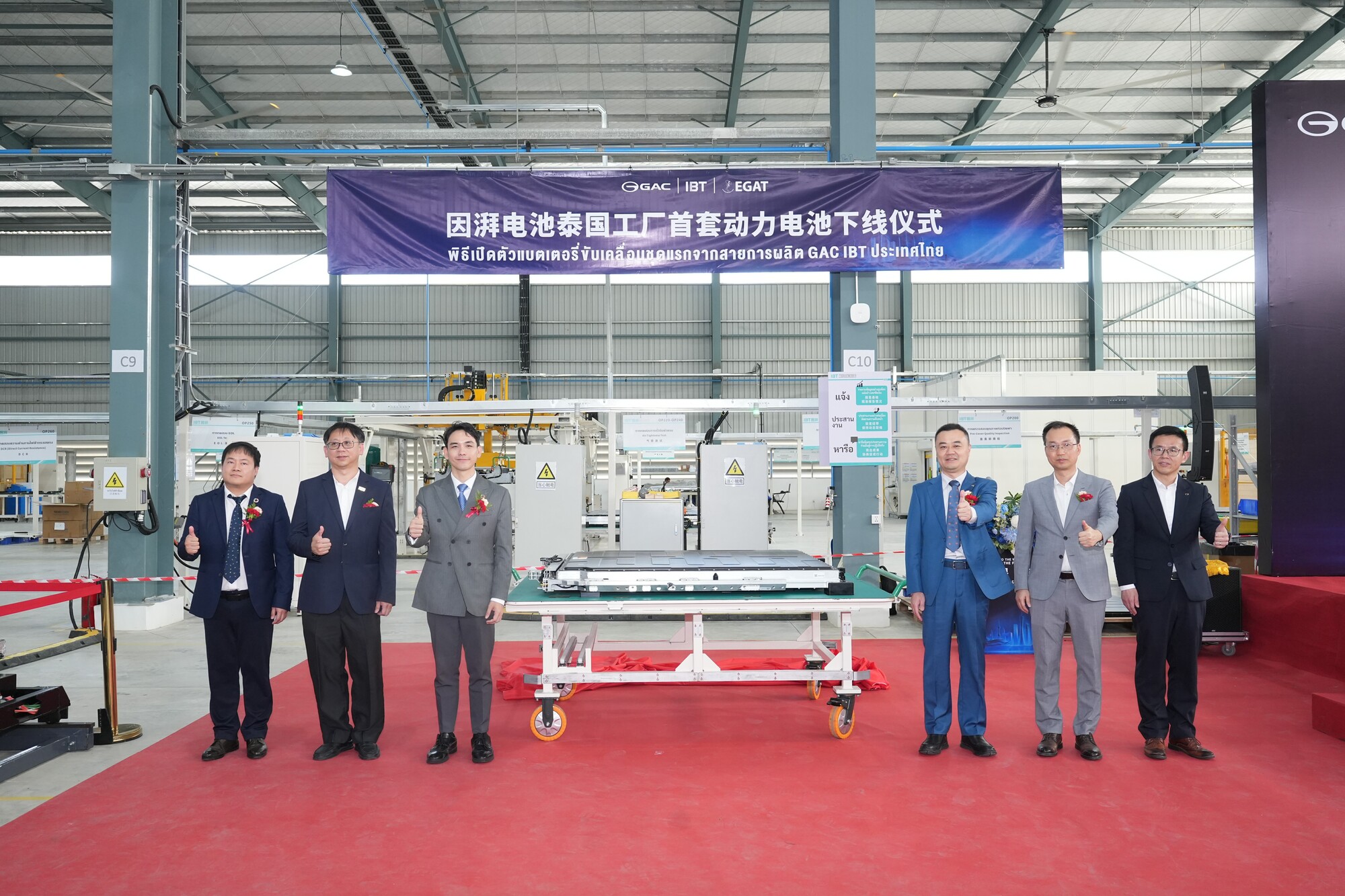
The November 2026 Thailand plant report records the opening of GAC's first overseas independently operated battery-pack factory in Chonburi on 29 October. Its initial role is to supply local AION Y Plus production. That is a concrete industrial link: battery-pack operations sit closer to the vehicle manufacturing programme they support.
A battery pack is an assembled system, not simply a shipment of individual cells. Its production requires coordination of components, assembly processes and validation appropriate to the vehicle programme. The new factory therefore represents a different capability from a vehicle showroom or an import distribution channel. It adds an operational stage within the overseas region.
The release describes a planned first-phase capacity of 7,000 packs per year, with potential expansion to 20,000 after the second phase and ramp-up. Those figures concern planned productive capability. The completed event is the opening and first pack roll-off; they do not prove that 7,000 or 20,000 packs had already been made by the announcement date.
For reputation, the meaningful point is the nature of the commitment. A production operation requires equipment, people and coordination over a longer period than a launch event. The next evidence of performance will be sustained output and its contribution to local supply. The current opening already provides a substantive example of overseas industrial development without needing those future outcomes to be assumed.
Magna provides partner confirmation of European vehicle production
The European production account has an external industrial partner. In its 21 November 2025 announcement, Magna confirmed that AION V serial production was underway at its Graz facility in Austria. This is a partner statement about an actual assembly programme, giving the localisation claim a source beyond GAC's own corporate channels.
The distinction between owned manufacturing and partner assembly is important. Both can establish local vehicle production, but their operating arrangements are different. A partner programme draws on an existing manufacturer's facilities and capabilities. It should not be described as an entirely GAC-owned European factory unless the ownership record supports that wording.
GAC subsequently reported the 18 March 2026 AION UT start-of-production event in Austria, in an announcement published on 25 March. The account links Milan design work with Austrian assembly. Design and manufacturing address different parts of the product process: local design can respond to market expectations, while regional assembly establishes an industrial delivery route.
These programmes make European commitment more concrete than a list of countries receiving imported vehicles. They do not by themselves establish that every local customer receives an Austrian-built car or that every grade has identical specification. The practical value lies in named models, completed production milestones and a known partner. The AION UT model guide examines the vehicle's passenger package separately from this industrial background.
Rotterdam links international expansion with the period after delivery
GAC's European spare-parts centre announcement records the Rotterdam inauguration on 5 September 2025. Parts distribution is less visible than a new-model launch, but it addresses an ownership question that matters after the purchase: how a local repair operation can obtain the components it needs.
A regional parts function creates a place within the supply chain from which orders can be managed and distributed. Its value depends on the relationship between the inventory held, the vehicles in service and the routes used to supply dealers. The existence of a centre does not establish that every part is always available or that every repair will meet one universal waiting-time promise.
It nevertheless changes the substance of the international story. A company investing in vehicle sales and assembly also needs to organise support for cars already on the road. A parts hub is a completed operating function that can contribute to that requirement. Its performance can later be judged through service measures rather than through the opening ceremony alone.
For a buyer, the relevant local question is which authorised service organisation supports the quoted car and how it accesses regional parts. The GAC dealer and parts coverage guide develops that relationship. Corporate scale becomes more useful when it connects to an identifiable support route rather than remaining a distant statistic about the parent group.
ESG reporting identifies who is responsible for progress
The 2025 ESG report filed through HKEXnews covers 1 January to 31 December 2025 and records board approval on 27 March 2026. Its governance description routes annual ESG reporting through management and the Strategy Committee to the board. The board's role includes policy, priority setting and review of progress.
This framework matters because environmental and social responsibilities cross operating departments. Energy use, employee safety, procurement and product development generate different information and require different decisions. A reporting process creates an organisational route through which those issues can be reviewed together and assigned priorities.
A governance description is not itself proof that every outcome is satisfactory. Its value is to make accountability identifiable. Readers can compare the stated process with the goals, measures and subsequent results that the company publishes. An annual report also allows progress to be considered over a completed period, instead of relying only on individual promotional announcements.
The time boundary must remain clear. A 2025 emissions figure and a battery plant opened in October 2026 describe different periods. They can both inform a current reputation assessment, but they should not be combined into a claim that the earlier report measures the later facility's performance. Keeping that chronology intact makes the responsibility account traceable.
Charging infrastructure supplies a measurable environmental service
GAC's September 2026 charging-network disclosure reports 30,835 self-operated charging piles at 2,471 stations across 232 city-level areas in China. It further identifies 21,324 piles supporting a 1,000 V platform and direct-current charging above 180 kW, with a reported equipment online rate of 99.2%.
The practical environmental connection is access to usable energy for electric vehicles. A driver cannot use an EV's battery capacity conveniently without suitable charging opportunities. The network figures describe a service infrastructure around the vehicles, while the power-capability information addresses a different question from geographic reach.
The online-rate figure is an availability measure for equipment. It is not equivalent to a guarantee that every driver will find an empty charger or complete every session successfully. Parking access, compatibility, congestion and the vehicle's own charging capability can influence an individual visit. That distinction preserves the value of the operational measure without overextending it.
The same release describes a vehicle-to-grid demonstration delivering 3.72 MW of discharge power and about 12,000 kWh of average daily discharge. This shows a reported example of batteries interacting with the energy system beyond taking a charge. It should not be converted into a carbon-saving total without the necessary energy and emissions methodology. These are China-based network and demonstration facts, rather than claims of identical overseas coverage.
Recycling and operational emissions address different environmental stages
GAC's September 2026 circular-economy account identifies Upower activities covering vehicle recovery, dismantling, battery utilisation, component remanufacturing and materials recycling. These functions concern what happens after a vehicle or component reaches the end of its first use. They add a materials perspective to a discussion that might otherwise stop at electric driving.
Recovery, reuse and recycling are not the same operation. A component may be suitable for another service life, a battery may be evaluated for further use and materials may be recovered through processing. The appropriate route depends on condition and technical requirements. Naming the operating stages makes the responsibility claim more informative than a general promise that a car is environmentally friendly.
The ESG report supplies a separate operational measure: 845,259.77 tonnes of carbon-dioxide equivalent for Scope 1 and Scope 2 greenhouse-gas emissions in 2025, with a reported year-on-year reduction of 31%. That number concerns the reporting scope of the company's operations. It should not be presented as the lifetime footprint of every vehicle or the emissions of customers driving worldwide.
Together, these records describe responsibility at more than one stage: how operations use energy and how products and materials may be handled later. A complete vehicle life-cycle comparison would require additional information, but the disclosed programmes already provide specific actions and measured results that can be followed.
Worker safety is assessed through outcomes as well as investment
The 2026 Fortune China ESG profile reports more than RMB 3.2 billion invested in production safety. Investment identifies resources committed to a responsibility area, while the ESG report's occupational table identifies reported outcomes. For 2025, it lists zero work-related fatalities, three work-related injuries and 196 lost workdays.
These measures should be presented together. Saying that there were no fatalities is accurate within the reported scope; saying that there were no work-related injuries would contradict the same table. The absence of a fatality is an important positive result, but the recorded injuries remain part of the evidence and the reason for continued improvement.
For an industrial company, workplace safety is relevant to reputation because manufacturing depends on people carrying out tasks around machinery, materials and energy systems. Training, equipment and procedures can reduce hazards, while reporting helps make the remaining outcomes visible. A financial commitment alone cannot prove that every hazard has been controlled.
The value of this disclosure is the possibility of tracking responsibility over time. Readers can look for changes in outcomes, explanations of incidents and the company's response. It creates a more credible social-performance account than a universal claim of a flawless workplace. That credibility complements the product and market evidence rather than replacing it.
Community investment is most informative when the project is identifiable
Corporate responsibility also includes how the company participates in communities around its operations. GAC's July 2026 rural-development report names work in Dongshi in Meizhou, Heyun in Qingyuan and the fragrance industry in Lizi village. Naming places and activities provides a more concrete account than a general statement that the company supports society.
The report describes a portfolio of 55 products and cumulative sales exceeding RMB35 million. Those figures belong to the reported community-development activities. They should not be interpreted as GAC vehicle revenue, a global community-investment total or a measured increase in every participating household's income.
The project offers a practical example of how an industrial company's purchasing, commercial connections and organisational support can assist local economic activity. Its significance is the connection between a named initiative and a reported commercial outcome. A fuller assessment would also examine how benefits were distributed and whether the activity remained viable over time.
For a reputation overview, this evidence sits alongside emissions reporting, employee safety and battery-recycling work. It adds a social dimension with identifiable beneficiaries and activity, while keeping the assessment grounded in what the company actually disclosed. It does not convert one domestic project into proof of uniform social performance across every overseas operation.
The combined record supports a substantive international position
| Question | Evidence available | Practical meaning |
|---|---|---|
| Is GAC an established industrial business? | Fortune scale and repeated inclusion | A substantial corporate background |
| Does international expansion have operational depth? | Thailand battery production, Magna assembly, Rotterdam parts | Completed regional functions beyond sales promotion |
| Are responsibilities described concretely? | Governance, charging, recycling, emissions and workplace results | Actions and outcomes that can be tracked |
The supported conclusion is that GAC combines established scale with an increasingly defined overseas operating structure and published responsibility measures. These are credible reasons to take its international development seriously. None needs to be stretched into a claim that every market has reached the same level of maturity.
The customer-level assessment remains local: identify the vehicle, the authorised sales and service organisation, the relevant terms and the support route. The overseas owner-evidence analysis supplies that complementary perspective. Corporate reputation becomes most useful when the global record and the local ownership offer can be connected through identifiable operations and evidence.
Sources & references
- [A6_F1] 2026 Fortune Global 500: motor vehicles and partsFortune China · 28 July 2026; Guangzhou Automobile Industry Group ranked 299, revenue USD 51,836.5 million.
- [A6_F2] GAC records 14 consecutive Fortune Global 500 appearancesGAC Mexico · 30 July 2026; manufacturer statement about consecutive appearances.
- [A6_F3] GAC 2026 international expansion and Mexico operationsGAC Mexico · 5 October 2026; group export/footprint figures and separately scoped Mexico sales.
- [A6_F4] GAC opens its first overseas independently operated battery-pack factoryGAC Group · 3 November 2026; 29 October opening in Chonburi Thailand; 7000/20000 pack capacity figures are plans.
- [A6_F5] GAC accelerates European EV strategy with Magna assembly programmeMagna · 21 November 2025; partner confirms AION V serial production in Graz Austria.
- [A6_F6] AION UT start of production in AustriaGAC Global · 25 March 2026 report of 18 March start of production; Milan design/Austrian assembly.
- [A6_F7] European spare-parts distribution centre opens in RotterdamGAC Europe · 8 September 2025 report of 5 September opening; future network expansion identified as plan.
- [A6_F8] 2025 Environmental, Social and Governance ReportGAC Group / HKEXnews · Reporting year 2025; board approved 27 March 2026; pages 35, 40, 61, 66,122,135 referenced.
- [A6_F9] GAC Group 2026 China ESG Impact List profileFortune China · 2026 profile; charging, workplace-safety investment and reported outcomes; company-supplied information.
- [A7_F10] GAC self-operated charging network exceeds 30000 charging pilesGAC Group · 17 September 2026; China network counts, charging-power mix and V2G demonstration.
- [A7_F12] GAC vehicle-recycling carbon methodology and circular economyGAC Group · 22 September 2026; Upower vehicle-recycling operations and Guangzhou methodology development.
- [A7_F11] GAC reports 2025 rural-development projectsGAC Group · 3 July 2026; Dongshi/Heyun projects and Li Zi village fragrance-industry case; company-reported cumulative figures.
This is a source-based editorial guide, not a first-hand road test. Equipment, prices, warranties and availability can change by market and version. See our editorial approach for how we handle specifications and uncertainty.