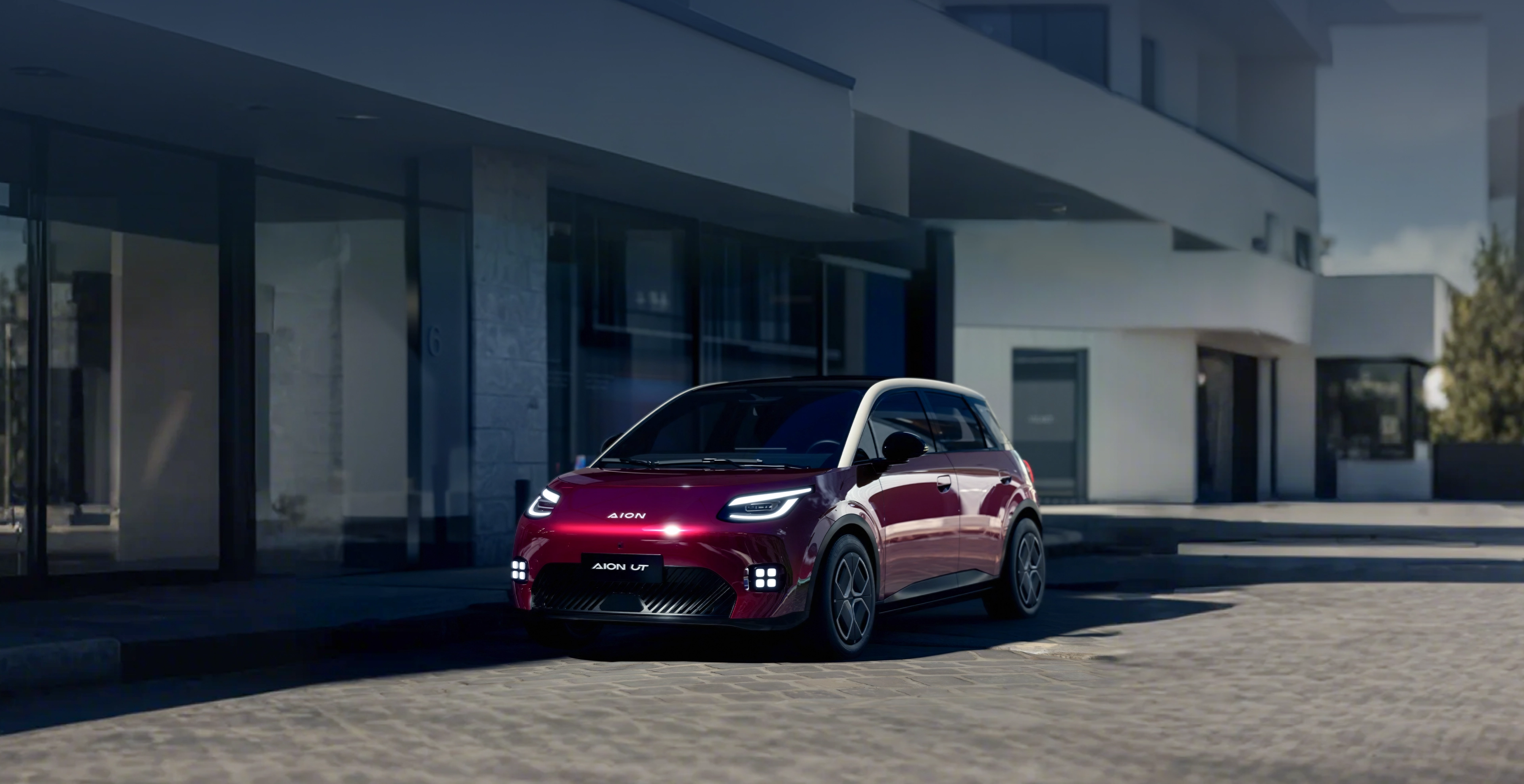
Yes: the European GAC AION UT offers a convincing amount of space for a four-person household in a compact hatchback. Its 2,750 mm wheelbase and 440-litre seats-up boot support that conclusion. The strongest case is two adults and two children travelling with their rear seats still available, rather than an empty cabin photographed with every backrest folded. The analysis below separates passenger fit, luggage shape and permissible load, then compares the published European dimensions with the BYD DOLPHIN. [UT_EU]
Start with the European AION UT and the seats in use
The figures here come from the GAC Europe Premium and Luxury specification, checked on 6 November 2026. Both grades list the same passenger count and luggage volumes. That makes the space assessment relevant to either grade, although equipment and weight differ. It also avoids combining a European boot figure with a dimension taken from an unrelated market. GAC’s March 2026 production announcement connects this regional programme to design work in Milan and assembly at Magna in Austria; it reports the start of production on 18 March. [UT_EU][UT_AUSTRIA]
A family car has to accommodate several things simultaneously: the driver’s normal posture, the front passenger, the rear occupants, and objects that cannot be left at home. A large folded-seat number answers a different question. Keeping those uses separate reveals where the UT is particularly promising: it offers substantial published luggage volume before a family has to surrender a rear seating position.
| Measure | Published figure | What it helps assess |
|---|---|---|
| Length / wheelbase | 4,270 / 2,750 mm | Exterior footprint and cabin packaging |
| Width, mirrors folded / unfolded | 1,850 / 2,073 mm | Parking and narrow access |
| Height | 1,575 mm | Overall body envelope |
| Seats / boot, seats upright | 5 / 440 litres | People and luggage together |
| Boot, rear seats folded | 1,600 litres | Occasional cargo configuration |
These measurements establish the starting proposition; they do not describe the dimensions of a particular pushchair. For a broader introduction to the model’s packaging, the AION UT compact-hatchback space guide explains why exterior size and usable interior room should be considered together.
Why the wheelbase helps, and where the rear-seat measurements fit
GAC’s global AION UT cabin presentation adds manufacturer measurements of 905 mm rear legroom and 1,385 mm rear-row width. Those are useful indications of the design’s passenger emphasis. GAC does not provide a common cross-brand measuring protocol on that page, so the numbers should not be ranked directly against another manufacturer’s differently defined knee room or shoulder room. The published wheelbase is easier to compare because it measures the distance between the axles. [UT_GLOBAL]
Dividing 2,750 by 4,270 gives approximately 64.4 percent: nearly two thirds of the car’s overall length lies between its axles. That is a packaging ratio calculated from the published dimensions, not a measurement of cabin length. Seats, crash structures, wheel housings and luggage space still have to share the vehicle’s envelope. The ratio nevertheless explains why a relatively short hatchback can offer a substantial passenger compartment.
For two adults in the rear, knee clearance is only one part of comfort. Feet need somewhere natural to rest; the cushion should support the thighs; the roof and door opening should permit normal entry. A passenger who can sit without touching the front seat may still dislike an upright knee position on a long journey. Conversely, a cabin that feels visually airy can make short trips pleasant without having the largest measured shoulder room.
The useful seating demonstration starts with the front occupants in their actual driving and riding positions. The rear passengers then sit behind them, wearing the shoes and outer clothing they normally use. This produces a meaningful occupied-cabin assessment. Our school-run and occupied-cabin guide develops that specific front-to-rear relationship, including the difference between an empty display vehicle and a family’s normal seating arrangement.
A dated European comparison with the BYD DOLPHIN
The closest useful comparison here is another European electric hatchback. The BYD DOLPHIN European brochure marked 2025 0625-BPS-EN-V2 covers Comfort and Design grades. It supplies dimensions and seats-up/seats-down boot figures together, allowing a defined comparison with the UT. These are manufacturer specifications, not a shared physical luggage test. [DOLPHIN_2025]
| Measure | AION UT Premium / Luxury | BYD DOLPHIN Comfort / Design |
|---|---|---|
| Length | 4,270 mm | 4,290 mm |
| Wheelbase | 2,750 mm | 2,700 mm |
| Width with mirrors extended | 2,073 mm | 2,012 mm |
| Boot with rear seats upright | 440 L | 364 L |
| Boot with rear seats folded | 1,600 L | 1,329 L |
On these figures, the UT is 20 mm shorter but has a 50 mm longer wheelbase. Its published seats-up luggage volume is 76 litres greater, approximately 21 percent relative to the DOLPHIN figure. The DOLPHIN is 61 mm narrower with its mirrors extended, which can matter on a narrow driveway. Neither advantage cancels the other: one helps the space available for luggage, while the other helps access through a constrained opening.
The date matters because BYD’s 2023 European launch account quoted 345 and 1,310 litres. Using that older seats-up figure would produce a 95-litre difference and overstate the gap relative to the newer brochure. The comparison above deliberately uses the later 364-litre value. Without matching measurement procedures and physically loading the same objects, the honest conclusion is a larger published UT boot figure, not proof that it accommodates every object better. [DOLPHIN_2023]
Two child seats make the four-person case more specific
For a household with two children, the rear row needs to work as installed equipment rather than as an empty bench. The European UT specification identifies ISOFIX / i-Size mounting points on the two outer rear seats. A rear-facing restraint can project towards the front passenger’s seat; a booster can require enough space beside its shell for a child or adult to reach the buckle. These are different packaging demands even though both arrangements occupy one nominal seat.[UT_EU]
A useful demonstration therefore uses the family’s actual restraint models, installed in the positions allowed by both the vehicle and restraint instructions. Set the driver’s seat first. Then check the other front seat with the rear-facing restraint behind it, if that is the intended arrangement. A front passenger should not have to adopt an unsuitable posture merely to make the display look spacious. Any required clearance and support-leg arrangement must follow the specific instructions, rather than a generic rule inferred from a photograph.
There is also independent evidence relevant to the rear occupants. Euro NCAP’s 2026 AION UT assessment, which names a left-hand-drive Premium test car, reports good protection and maximum points for both rear child dummies in the frontal offset test. That is valuable crash-test evidence for the tested configuration. It does not establish that every aftermarket child seat fits every family arrangement. [UT_NCAP]
With two outer restraints installed, the middle position is often the decisive issue when a fifth person joins. Nominal rear width alone does not establish comfortable shoulder room, an accessible buckle or a permitted restraint combination. The AION UT rear-seat and child-restraint guide explains how to assess these overlapping requirements. For four occupants, the family can concentrate on two properly usable rear positions instead of making a routine three-across arrangement the basis of the purchase.
What 440 litres can tell a family about luggage
A boot-volume number describes capacity, while a pushchair has a shape. The European AION UT product page describes a multi-layer luggage area and demonstrates its intended use with a large suitcase. Separate storage layers can be useful because small equipment can occupy a different area from the main bags. The actual floor position and accessible compartments on the delivered car determine how that flexibility works in practice. [UT_PRODUCT]
Consider an illustrative rectangular folded pushchair envelope of 80 × 55 × 30 cm. Multiplying those dimensions gives 132 litres. That calculation does not mean the pushchair consumes exactly 132 litres of the UT’s declared boot volume or that it has been verified to fit. Wheels, handles and curved trim can leave unusable gaps, and the opening can be smaller than the space behind it. The example shows why litres alone cannot settle the question.
A suitcase and a soft overnight bag also behave differently. A hard case needs a suitable continuous space; a soft bag can occupy a remaining gap, although it should not be compressed against fragile equipment. Families who travel with a pushchair usually benefit from establishing its position first, then fitting ordinary bags around it. This reveals whether the main obstacle is floor length, opening height, an intrusive wheel housing, or simply an awkward sequence of loading.
Access after loading matters as well. A charging cable or raincoat that can only be reached by removing every suitcase creates inconvenience at the first stop. A useful boot arrangement leaves frequently needed items accessible and keeps heavier objects secure. The AION UT boot and pushchair guide goes deeper into the difference between seats-up luggage, the loading aperture and an occasional folded-seat load.
Build the weekend around four occupied seats
A realistic weekend demonstration might include two adults, two children, their installed restraints, a folded pushchair, two overnight bags and a small shopping bag collected on the way home. This is a proposed loading scenario, not a report that this exact collection has been physically tested in an AION UT. Its value is that it captures the simultaneous demands hidden by separate photographs of generous legroom and a full cargo area.
Begin with the people in place and leave both rear backrests upright. Load the rigid object first, because it has the least flexibility. Place the ordinary travel bags next and reserve a reachable location for items needed during the journey. Finally, assess the extra shopping bag. A family car that only accommodates the outward journey’s carefully arranged load may become frustrating once coats, snacks or a small purchase join the return trip.
The result should be judged against the household’s normal routine. If the same pushchair and bags fit while everyone retains a comfortable position, the published capacity has become a demonstrated benefit. If one unusually large item prevents the tailgate from closing, the family has identified a specific constraint rather than disproved the entire space proposition. Changing the orientation or choosing a more compact travel item may resolve it, but the decision should be clear before purchase.
The European equipment list also specifies rear air vents, rear reading lights and remote climate pre-conditioning on both grades. Those features make occupied space more useful: air can be directed towards the rear passengers, a child can read without relying on the front lamps, and the cabin can be prepared before everyone boards. They do not change the 440-litre boot, but they address the experience of travelling with that boot loaded and the family inside. A four-person assessment therefore includes both physical fit and the functions available to the rear occupants.[UT_EU]
Folded-seat capacity is a second operating mode
The UT’s split rear backrest creates flexibility, but any occupied seat must remain available and correctly secured. The European table specifies a 40/60 split. With two child restraints on the outer positions, folding one side may remove a seating position the family needs; the 1,600-litre maximum consequently belongs to a different journey. It is especially useful when one or two people transport bulky equipment.[UT_EU]
Examples include collecting a boxed household item, moving a disassembled desk or carrying sports equipment that cannot fit behind upright seats. Each task requires the dimensions of the object and the continuous loading path into the car. A tall box may fit the theoretical volume but fail at the tailgate opening. A long item may enter diagonally but interfere with the front seating position needed for the journey.
The partial-fold arrangement can be useful when fewer passengers travel, provided the remaining seating and restraint positions are suitable. Its benefit is not just a higher litre figure: it allows one vehicle to change its balance between people and objects. The practical limit is the arrangement of the particular load, not the temptation to describe every configuration as a five-person family trip.
That distinction helps households choose vehicle size sensibly. A bulky collection once every few months does not necessarily justify driving a larger vehicle every day if the hatchback can handle that job with fewer passengers. Conversely, a household that routinely needs all seats and unusually large equipment should evaluate a larger model with those seats still occupied. The AION Y Plus passenger-and-luggage guide offers a useful next comparison for that recurring requirement.
Enough volume must also mean an acceptable loaded mass
Space and weight are separate constraints. An empty luggage area can contain a dense object that is too heavy, while a boot full of lightweight bedding can have modest mass. GAC Europe lists 465 kg load capacity for Premium and 435 kg for Luxury, with the same 2,110 kg maximum permissible vehicle weight. It also publishes separate kerb and running-order masses. Those labels should be reconciled with the delivered vehicle’s documents before treating an advertised payload as a personal baggage allowance.[UT_EU]
An illustrative family budget makes the issue visible. Two adults at 80 kg each, two children at 25 kg each, two restraints totalling 20 kg, a 12 kg pushchair and 48 kg of luggage total 290 kg. These are example masses chosen for arithmetic, not typical-person claims or measured UT test loads. The calculation simply turns a vague family journey into an inventory that can be weighed and adjusted.
Do not add a driver twice if the applicable vehicle mass definition already includes one, or assume that accessories have no effect. The correct calculation starts with the mass basis for that specific vehicle, then accounts for occupants and equipment on the same basis. Maximum axle loads also matter when heavy items are concentrated at one end. A dealer can reconcile the registration and vehicle-label values with the planned use.
The 30 kg difference between the two advertised trim load capacities is another reason to choose by actual requirements. Extra equipment can be worthwhile, but it can coexist with a lower carrying allowance. The AION UT payload and market-specification guide explains how to separate luggage volume from load accounting. The buying benefit is a clear margin for the family’s journey, rather than discovering a limitation after packing.
The exterior saves length while still asking for parking width
A compact car must also work where its passengers get in. The UT’s short overall length can help in a restricted garage or parking space, but its width deserves independent attention. The folded-mirror and extended-mirror dimensions describe different conditions; neither includes the sweep of an open door. A space through which a car can pass is not automatically a space in which an adult can comfortably secure a child.
For illustration, imagine a straight opening exactly 2,400 mm wide. Subtracting the UT’s published 2,073 mm extended-mirror width leaves 327 mm, or about 164 mm on each side if perfectly centred. The corresponding DOLPHIN calculation leaves 388 mm, approximately 194 mm per side. This is static clearance arithmetic for an assumed opening, not a recommendation to drive through one or a claim about standard parking-bay dimensions.
The comparison shows the trade-off clearly. The DOLPHIN’s narrower mirror span can help with a tight entrance, while the UT’s published luggage capacity offers an advantage after parking. A household should assess the home driveway, the place where restraints are buckled and the usual supermarket bay separately. Folding mirrors may help passage, but it does not create extra door-opening space once the vehicle is parked.
GAC lists a 10.7 m turning diameter for the European UT. That offers a useful manoeuvring reference, though a wall-to-wall space and a kerb-to-kerb measurement need not be equivalent. The AION UT parking and door-access guide connects exterior dimensions to these daily tasks. The best space package is one that accommodates the household both inside the car and during entry and exit.
The strongest conclusion is a well-packaged four-person hatchback
The European evidence supports a positive answer. The UT combines a long wheelbase for its overall length with a substantial published seats-up luggage compartment. Against the dated European DOLPHIN brochure used here, it provides a larger stated boot while remaining slightly shorter. That is a meaningful combination for a household seeking passenger room and everyday carrying capacity without moving to a longer vehicle.
The remaining judgment is specific rather than abstract: can the usual front occupants sit normally, can the two child restraints be installed correctly, and can the normal luggage travel with the rear seats upright? Those three demonstrations connect the manufacturer’s measurements to the family’s actual use. A fourth check, loaded mass, confirms that an apparently spacious arrangement remains within the relevant vehicle limits.
Premium and Luxury share the principal published space figures, so a household does not need to infer that the higher grade automatically buys more luggage room. Differences such as equipment and carrying allowance deserve their own comparison. Similarly, a five-star safety assessment provides important independent crash evidence, while the comfort of a particular passenger and the fit of a particular pushchair remain questions for the actual car.
For two adults and two children, the AION UT therefore deserves a serious place on the shortlist. Its space argument is strongest when the family can keep the rear seats in use and still carry the things that make the journey possible. Occasional folded-seat versatility then becomes an additional benefit, rather than the capacity on which every ordinary family trip depends.
Sources & references
- [UT_EU] AION UT European Premium and Luxury specificationsGAC Europe · Checked 6 November 2026. Dimensions, luggage volumes, seats, restraint mounts, trim load capacities and turning diameter.
- [UT_GLOBAL] AION UT global product presentationGAC Global · Checked 6 November 2026. Manufacturer cabin figures of 905 mm rear legroom and 1,385 mm rear-row width; measurement protocol not supplied.
- [UT_PRODUCT] AION UT European product presentationGAC Europe · Checked 6 November 2026. Multi-layer luggage-area description and European design presentation.
- [DOLPHIN_2025] BYD DOLPHIN European technical data and specificationBYD Europe · Brochure identifier 2025 0625-BPS-EN-V 2; Comfort and Design. Uses newer 364/1,329 L boot figures.
- [DOLPHIN_2023] BYD DOLPHIN: Agile and VersatileBYD Europe · 2023 European launch account; historical 345/1,310 L values distinguished from the newer brochure.
- [UT_NCAP] AION UT 2026 safety assessmentEuro NCAP · 2026 rating, released September 2026. Premium LHD tested; child-dummy frontal-offset result and five-star rating.
- [UT_AUSTRIA] GAC Marks SOP and AION UT Roll-Off in AustriaGAC Global · 25 March 2026 publication reporting 18 March start of production at Magna in Austria and Milan design involvement.
This is a source-based editorial guide, not a first-hand road test. Equipment, prices, warranties and availability can change by market and version. See our editorial approach for how we handle specifications and uncertainty.