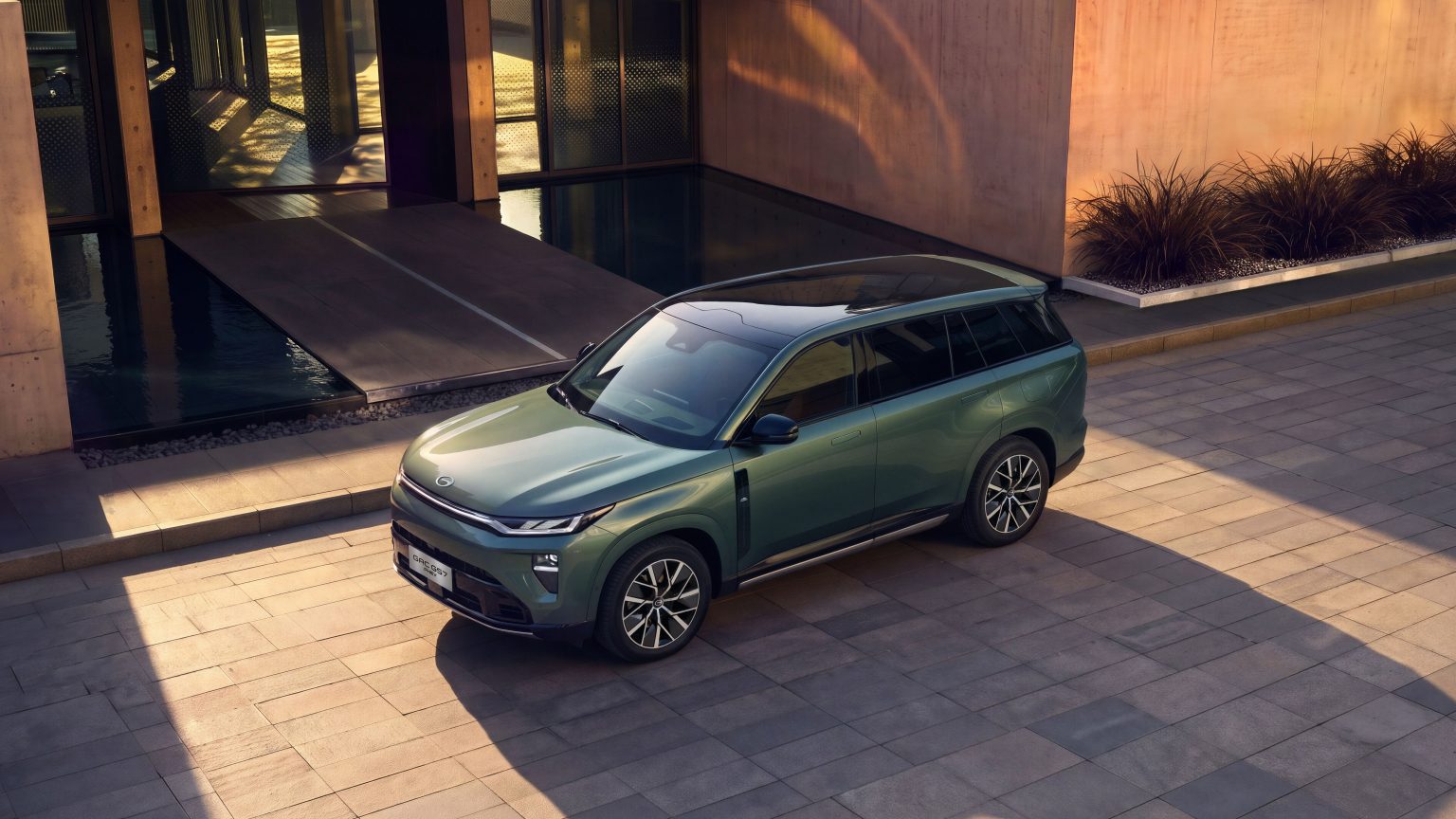
For the UAE vehicles specified here, the GAC GS7 PHEV has several documented cabin-equipment advantages over the 2026 Toyota RAV4 Hybrid VXR: a larger central screen, more listed speakers, wireless smartphone projection and advertised seat massage. The comparison also recognises features both cars provide, including front-seat ventilation and heating. The value of each difference depends on how it is used, so this analysis connects the specification to ordinary cabin tasks.
Set one UAE comparison before drawing any equipment conclusion
A useful GAC GS7 configuration vs Toyota RAV4 comparison starts with two vehicles a UAE buyer can identify: the GS7 PHEV package advertised by Gargash and the 2026 RAV4 2.5-litre Hybrid VXR in Al-Futtaim's March 2026 specification sheet. This is a comparison of those local offers. It is not a ranking of every GS7, S7 or RAV4 sold internationally.
That choice matters because the equipment changes with both market and grade. GAC's global S7 presentation lists a different speaker count from Gargash's UAE page. Toyota's VXR also carries equipment that is absent from some lower RAV4 grades. Substituting either lower specification would manufacture an easier victory for the GS7 while failing to answer the buyer's actual question.
The Gargash GS7 PHEV page establishes the local GAC equipment. The Toyota UAE 2026 RAV4 Hybrid specification identifies the Toyota grade and its standard features. Although the PDF address contains 25, its visible heading says 2026 and its footer dates the information to March 2026. The document itself, rather than the filename fragment, defines this reference.
The question is then specific: which listed features add something tangible for the person using the cabin? The GS7 has several defensible equipment advantages, but each should be tied to a function rather than converted into a claim that every aspect of the vehicle is better.
Three immediately visible differences establish the equipment case
The clearest differences concern the central display, audio hardware and smartphone connection. Gargash advertises a 15.6-inch central display, 22 speakers and wireless Apple CarPlay and Android Auto. The Toyota VXR sheet lists a 12.9-inch central display with navigation, six speakers and wired phone projection. These are direct, documented differences in the selected UAE specifications.
| Cabin item | Gargash UAE GS7 PHEV | Toyota UAE 2026 RAV4 Hybrid VXR | Supported conclusion |
|---|---|---|---|
| Central display | 15.6 inches | 12.9 inches with navigation | GS7 has the larger listed central display |
| Audio speakers | 22 | 6 | GS7 has a more extensive listed speaker installation |
| Apple CarPlay / Android Auto | Wireless | Wired | GS7 removes the cable requirement for supported projection |
| Front-seat ventilation and heating | Advertised | Listed for VXR | These features are shared, not exclusive GS7 advantages |
| Seat massage | Advertised | Not listed in the VXR sheet | GS7 lists an additional comfort function |
A comparison table is most useful when its conclusion column is restrained and precise. More speakers establish a hardware difference, not a measured listening score. A larger display establishes a size advantage, not automatically a better interface. Wireless projection establishes a connection advantage for compatible phones, not universal reliability with every device.
The UAE screen, audio and comfort comparison supplies a wider equipment context. Here the table creates a clear starting point: the GS7 leads in several identifiable cabin features before any subjective assessment is added.
Display size becomes useful through information layout
The GS7's larger central screen can be valuable when a driver and passenger use different information simultaneously. A map, a media control and a vehicle setting compete for visible space. A larger display gives the interface designer more room to make those elements legible without forcing every task into the same small area. Whether the software uses that opportunity well remains a practical question for the demonstration vehicle.
Diagonal measurements should not be confused with display area or with the size of the driver's instrument cluster. Toyota's VXR has a separate 12.3-inch instrument display. Comparing the GS7's central screen to that instrument panel would mix two different components. The proper central-screen comparison here is 15.6 versus 12.9 inches, a 2.7-inch difference in the listed diagonal.
A useful demonstration uses familiar tasks rather than a promotional animation. Enter an ordinary destination, enlarge the map, change the audio source and return to the navigation view. Observe whether frequently used controls remain reachable and whether the passenger can make a change without obscuring information the driver needs. These checks examine the value of the GS7's larger hardware, rather than merely confirming that the screen looks impressive while parked.
Our GS7 and RAV4 shared-display analysis follows this driver-passenger interaction. The stronger GS7 argument is that the larger listed display provides more scope for readable, shared cabin interaction. It should be paired with a demonstration of the actual local software, because menu organisation and response are not established by screen dimensions alone.
The separate instrument displays provide a useful example of why the comparison should remain component-specific. GAC’s UAE GS7 presentation identifies an 8.88-inch instrument cluster, while the Toyota VXR sheet lists a 12.3-inch multi-information display. The GS7’s larger central display therefore does not mean that every screen is larger. Different information is assigned to the central display, instrument cluster and head-up display. A driver should judge the combined layout from the driving position, particularly the visibility of speed and essential warnings, rather than adding screen diagonals into an artificial total. This preserves the clear central-screen advantage while recognising Toyota’s larger listed instrument display.
The audio comparison should follow sound through both seating rows
Gargash lists 22 speakers for the UAE GS7, compared with six in the Toyota VXR specification. The GS7 therefore has a much more extensive listed installation. That is a straightforward hardware advantage, but its practical significance depends on how the sound is distributed among the people using the cabin.
A household in which rear passengers regularly listen to music has a different requirement from a solo driver who mainly plays spoken navigation instructions. More installed speakers give an audio system designer additional positions from which to distribute sound. They do not, on their own, establish better frequency response, lower distortion or more natural voices. Those outcomes depend on the speakers, amplification, tuning and cabin acoustics working together.
A useful comparison can follow two ordinary listening tasks. First play a familiar spoken recording at a comfortable volume, listening for clear speech from both rows. Then use a familiar music track and compare how the balance changes when moving from the driver seat to an outer rear seat. Keep the recording and approximate volume consistent so that a louder demonstration is not mistaken for a more convincing system. This is a proposed listening exercise, not a claimed test result.
The local specification is essential here. The global S7 product page lists a different audio package; it cannot replace the UAE 22-speaker claim. The strongest conclusion is precise: the specified GS7 gives buyers additional audio hardware and a more ambitious passenger-listening proposition. The household can then decide whether the actual tuning makes that hardware an advantage it values.
Wireless projection simplifies repeated short journeys
A phone is often the interface a driver already knows. Navigation favourites, music accounts and familiar communication tools can make smartphone projection more useful than a long list of built-in applications. In this UAE comparison, the GS7's wireless Apple CarPlay and Android Auto support provides a concrete convenience advantage over the wired projection listed for the RAV4 VXR.
The difference becomes noticeable in repeated short trips. A wired system asks the driver to connect a compatible cable before the phone's projected interface is available. A wireless system can remove that physical connection step after pairing, subject to the phone and system behaving as intended. The benefit is reduced handling and fewer cable movements, rather than an abstract claim that wireless technology is always better.
Charging and projection remain separate functions. A wireless charging pad does not prove that a vehicle supports wireless projection, and wireless projection does not guarantee that every phone will charge effectively on the pad. Case thickness, phone alignment and device compatibility can influence charging. This is why the comparison should name the projection capability directly instead of inferring it from a photograph of a charging tray.
A buyer should pair the phone actually used every day, check connection after leaving and returning to the vehicle, and repeat with the second regular driver's phone. The GS7's equipment advantage is strongest when it reduces the household's real departure routine. Our UAE GS7 and RAV4 ownership comparison considers how this convenience fits alongside the larger difference between plug-in and conventional hybrid use.
Seat comfort contains both an additional GS7 function and shared features
Gargash advertises Nappa leather seating with ten-layer cushioning, ventilation, heating and an eight-point massage function. The Toyota VXR sheet specifies synthetic leather and suede upholstery, heated and ventilated front seats, powered front seats and driver memory. The comparison therefore supports massage as an advertised GS7 addition, but it does not support a claim that the Toyota lacks front-seat cooling or power adjustment. Those functions are clearly included in the selected VXR grade.
Massage can add a changing pressure sensation during a journey or a stationary rest. Its potential value is different from the static support supplied by seat shape and adjustment. A seat with more functions is not automatically a better fit for every body, and upholstery descriptions do not establish durability over years of use. The strongest way to interpret the equipment is to identify which functions the occupants expect to use and then assess whether the particular seat supports them comfortably.
Driver memory deserves separate credit on the Toyota side. In a shared vehicle, restoring a regular position can reduce setup effort after another driver has used the car. The GS7's product page should not be treated as a complete negative list: if it does not clearly allocate a function, that is a point for the local grade sheet rather than proof of absence. This produces a more useful decision. The GS7 offers an advertised richer massage package; the VXR already covers several of the comfort functions that a family may consider essential.
Voice zones and head-up information offer additional interaction routes
Gargash advertises four voice-recognition zones and a 27-inch head-up display for the GS7. These features add ways to interact with the vehicle beyond reaching for the central screen. Voice zones can distinguish where a request originates, while a head-up display can place selected information nearer the driver's forward view. Those are identifiable functions, rather than a generic claim that the car is intelligent.
The useful question for voice control is whether it handles the household's normal requests. Ask for a navigation destination, a media change or another supported function from the relevant seating positions. Try the languages and pronunciations the occupants actually use. Four zones describe the system's spatial organisation; they do not establish recognition accuracy for every accent or prove that every vehicle function is voice-controlled.
A head-up display deserves a separate check. Seat height, seating position and personal eyewear can affect how clearly the projected information is seen. The advertised virtual-image size is not equivalent to a physical tablet mounted on the windscreen. Its value lies in the information presented and its legibility from the actual driving position.
Toyota's listed steering-wheel audio, voice and telephone controls also matter. The comparison should recognise those established interaction routes rather than imply that the RAV4 forces every task onto its screen. The GS7 adds a broader advertised interaction package, but the benefit is best explained through a specific task. This keeps the positive equipment judgment useful to a buyer instead of turning the word intelligent into an unsupported overall ranking.
Parking systems require comparison by function, not camera branding
Gargash advertises a 540-degree camera presentation and automated parking for the GS7. Toyota's VXR specification lists a panoramic-view monitor with a 3D view, front and rear parking sensors, parking-support braking and intelligent parking assistance. It would be incorrect to describe this comparison as a camera-equipped GAC against a Toyota without parking support. Both sources identify multiple tools; their names and presentation differ.
A camera display supports orientation around the body, while sensors can warn about proximity and an assistance system may help execute parts of a manoeuvre. A numerical camera label does not establish that the driver can see every object at every instant. Composite images can use processed or previously captured views, and the operator still needs direct observation. The useful comparison is whether the system clearly shows a kerb, a corner or a nearby obstacle in the situations the owner repeatedly encounters.
The NHTSA guide to driver-assistance technologies distinguishes driver warnings and intervention functions. It provides a framework for interpreting equipment names, not a performance ranking of these two SUVs. The Toyota VXR also lists dynamic radar cruise control and Toyota Safety Sense 4 functions, so no blanket GS7 intelligence lead follows from the equipment count. A credible advantage must identify a supported function and its use. The GS7's locally advertised camera and parking package is a reason to evaluate it closely alongside Toyota's named VXR systems. [S4]
The powertrain difference changes the value of cabin equipment
A well-equipped cabin is only part of the purchase. The GS7 is a plug-in hybrid, while the selected RAV4 VXR is a conventional hybrid. The distinction matters because the owner interacts with energy supply differently. The GS7 can use electricity obtained from an external charger; the RAV4 does not require a plug-in routine for its ordinary operation.
The U.S. Department of Energy explanation of plug-in hybrids describes this general architecture. It helps explain why a household with convenient charging might value the GS7's combination of electric operation and a petrol engine. It does not establish the exact electric range of the UAE GS7, the share of journeys that a particular owner will complete electrically or a guaranteed running-cost advantage.
Gargash lists a 36.3 kWh battery and up to 1,020 km combined range under CLTC. That combined figure should remain labelled; it is not a promise of all-electric travel. The global S7 presentation separately labels its electric and combined range figures and also illustrates why global cabin equipment must not be substituted for the UAE offer.
Our GS7 charging-week and family-journey analysis develops this ownership question. The practical conclusion is that the GS7's equipment advantages become more persuasive when its plug-in routine also fits the household. A larger screen and more speakers cannot compensate for choosing an energy arrangement that the owner cannot conveniently use.
Choose the additional equipment that improves an ordinary day
The GS7 has a credible multi-feature advantage in this defined UAE comparison: a larger central display, a substantially higher listed speaker count, wireless rather than wired smartphone projection, and advertised massage functionality beyond the features listed in the RAV4 VXR sheet. These are tangible differences with identifiable sources. They provide a much stronger buying argument than a broad claim that the GS7 simply has more technology.
The Toyota remains a well-equipped comparison vehicle. Its VXR specification includes front-seat ventilation and heating, powered front seats with driver memory, a panoramic roof, parking assistance and Toyota Safety Sense 4 functions. Recognising these features is necessary to identify what the GS7 actually adds. An advantage that disappears when the correct Toyota grade is used is not an advantage worth presenting to a buyer.
The final assessment should give more weight to equipment used repeatedly. Wireless projection can simplify every departure; an interface that is easier for both drivers to understand can improve every journey. Audio hardware may matter greatly to a music-focused household, while a passenger who rarely uses massage may assign that feature little value. The correct choice depends on which improvements have practical relevance, not on the longest feature list.
A focused demonstration can establish that relevance. Use the local GS7 and the local VXR, pair the regular phones, adjust the front seats, sit in the rear and test the ordinary navigation and parking tasks. The published evidence already supports several clear GS7 configuration advantages. The demonstration then determines how much those advantages matter to the people who will live with the vehicle.
Sources & references
- [S1] GS7 PHEV UAE equipment and starting priceGargash GAC Motor · Checked 6 November 2026. Page model year not stated; 15.6-inch display, 22 speakers and local advertised package.
- [S2] 2026 RAV4 2.5L Hybrid UAE specificationToyota UAE / Al-Futtaim · Document headed 2026, dated March 2026; VXR column visually checked. URL wording does not define model year.
- [S3] S7 global presentationGAC Global · Global 12-speaker specification distinguished from UAE 22-speaker advertising; range cycles explicitly labelled.
- [S4] Driver Assistance TechnologiesNHTSA · General warning/intervention distinctions; no model intelligence ranking inferred.
- [S5] How Do Plug-In Hybrid Electric Cars Work?U.S. Department of Energy · General explanation of externally charged hybrid operation.
- [GS7_UAE] GAC UAE GS7 product presentationGAC UAE · Checked6November2026. UAE instrument display and cabin features.
This is a source-based editorial guide, not a first-hand road test. Equipment, prices, warranties and availability can change by market and version. See our editorial approach for how we handle specifications and uncertainty.