The Australian AION V combines family passenger space, 510 km WLTP range and useful cabin intelligence. Both Premium and Luxury list four-zone voice control, front-seat and exterior-mirror position memory, online navigation and phone-based remote vehicle control. These are concrete conveniences for a shared family car. Against ATTO 3 EVO Dynamic the published WLTP range lead is 90 km; against EVO Premium the rated distance is equal. The strongest GAC case therefore connects its rear-passenger arrangement with the digital functions occupants use repeatedly, while retaining the exact BYD grade in each comparison.
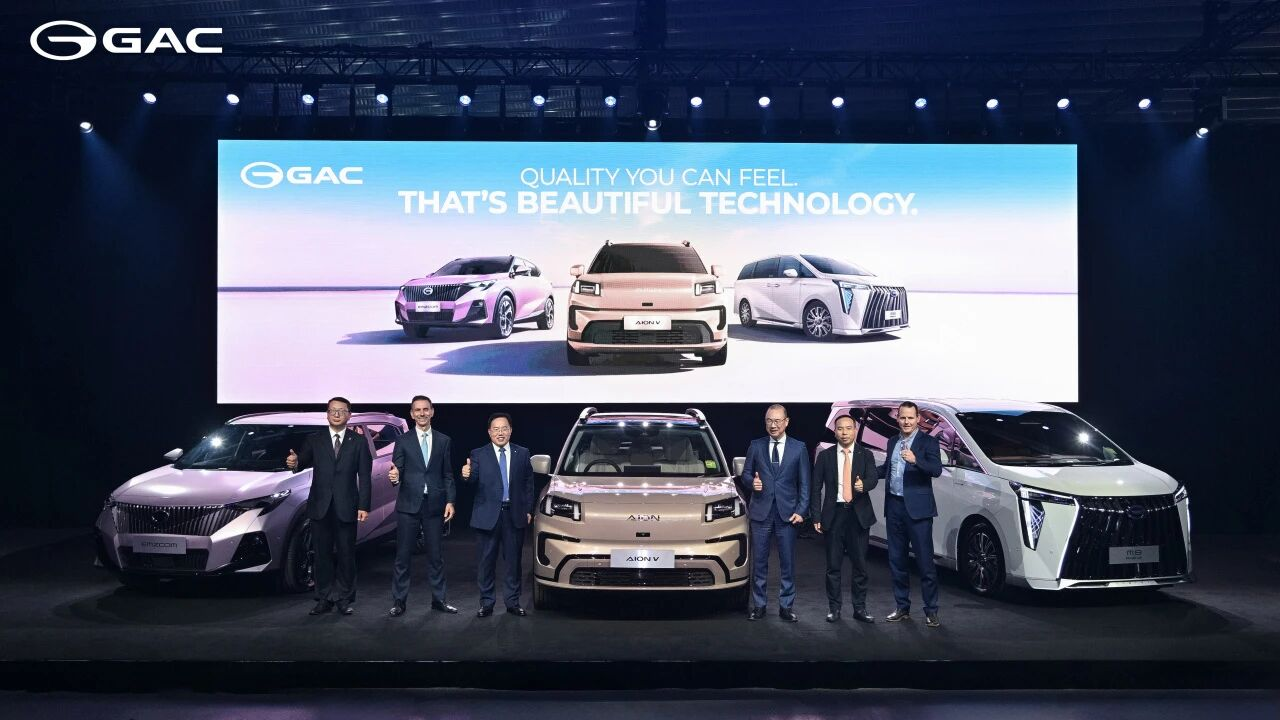
AION V intelligence: passenger voice control and remembered driving positions
Cabin intelligence becomes useful when it reduces a task the family repeats. The GAC Australia specification lists the following provisions in both AION V Premium and Luxury. They give the passenger-space and range discussion a more complete everyday context.
| AION V function | Recurring family use |
|---|---|
| Four-zone voice control | Lets occupants try supported requests from their seating zones |
| Front-seat and exterior-mirror position memory | Helps restore saved settings when drivers change |
| Online navigation and remote vehicle control | Connects journey preparation and supported phone-based actions |
| 14.6-inch centre display and 8.88-inch instrument display | Provides separate central interaction and driver-information areas |
A straightforward demonstration starts while stationary. Save a normal driving position, change it and recall it. Let the usual passengers try the voice commands they expect to use, then check navigation and the enabled remote functions. This makes the benefit observable without claiming that a screen diagonal or software brand proves a universal intelligence advantage.
Keep the intelligent-cabin comparison attached to the exact EVO grade
The current BYD Australia EVO page identifies Dynamic and Premium separately. It also documents a 15.6-inch centre screen, wireless Apple CarPlay and Android Auto, and app functions such as checking charge, locking and preheating. Voice and connected convenience therefore exist on both sides of the comparison; a useful assessment asks which functions best fit the occupants.
For AION V, the particularly clear proposition is the combination of saved seat-and-mirror positions with passenger-oriented four-zone voice control. A household with two regular drivers can assess the saved-position workflow, while rear occupants can evaluate supported voice requests from the seats they normally use. The range comparison then stays beside this cabin assessment: AION V’s 510 km WLTP figure exceeds EVO Dynamic’s 420 km and matches EVO Premium’s 510 km.
Identify the actual car on the quotation before reusing an older comparison. Original ATTO 3 specifications and EVO specifications describe different offerings. Likewise, an update notice published for another region should be matched to the local vehicle and installed software before it is treated as an Australian feature. The decision becomes clearer when space, rated range and repeat-use digital conveniences all describe the same purchasable grade.
Current Australian grades change the answer to the comparison
The Australian AION V Premium and Luxury share the same battery, motor and headline charging specifications. BYD’s current ATTO 3 EVO Dynamic and Premium differ more substantially: battery size, driven wheels, output and charging capability all change. A comparison based on an earlier ATTO 3 specification can therefore produce the wrong conclusion about the car now offered. The word Premium also describes different roles in the two line-ups and should not be treated as a common equipment standard.
The GAC Australia configuration table and current Australian BYD EVO brochure provide the appropriate common-market references. They allow range, cabin dimensions and functions to be compared without mixing a China-only grade into an Australian purchase. They also show where a positive GAC conclusion should be limited to Dynamic rather than extended automatically to Premium.
The useful question is not whether GAC can accumulate the greatest number of favourable labels. It is whether its range reserve, passenger arrangement and repeat-use technology fit the same family’s routine. Our AION V and EVO smart-cabin comparison and range-and-space comparison examine those topics separately. This assessment brings them into one purchase argument, with the competitor’s actual strengths retained so that the result remains specific enough to guide a decision.
[S4]Battery capacity and charging access explain the everyday energy value
AION V lists 75.26 kWh battery capacity, compared with 60.48 kWh in EVO Dynamic and 74.88 kWh in Premium. These capacities help explain why the two BYD grades occupy different places in the range comparison. They should not be treated as usable-energy measurements under every condition, and battery capacity alone does not establish efficiency. Vehicle demand and control choices remain part of the result.
For AC replenishment, GAC lists an 11 kW maximum, while Dynamic lists 7 kW and Premium 11 kW. The AION V therefore has a higher published AC input limit than Dynamic when the electrical installation and charger can supply it. A household using a lower-powered source may see little difference from that particular advantage. The useful question is whether the car can recover the next day’s expected use during the time it normally remains parked.
This creates a coherent GAC case for a household with suitable charging: a larger battery and longer rating than Dynamic, together with a higher AC ceiling. It is less useful to describe the number without the installation. Charging power is constrained by the vehicle, charger and available supply, not by the car alone. The AION V ownership and charging guide connects replenishment with everyday use. Before deciding, the household should consider the actual parking location and charging window, then judge whether additional capability changes its routine.
[S1]DC peaks and charging intervals must be kept separate
AION V publishes a maximum DC input of 180 kW. EVO Dynamic lists 110 kW, while Premium lists 220 kW. GAC therefore leads Dynamic on the published peak but trails Premium. Peak power is one part of a charging curve: it does not specify the average throughout the session or guarantee that the charger and battery will reach that value on every stop.
The stated time windows also differ. GAC quotes 24 minutes from 10 to 80 per cent; BYD lists 41 minutes for Dynamic and 30 minutes for Premium from 0 to 80 per cent. Those are not matching intervals. Comparing the minute values alone would attribute part of the starting-charge difference to the vehicle’s charging performance. A meaningful session comparison would use the same window and record battery temperature, charger capability and any relevant conditions.
The practical implication is still useful. Against Dynamic, GAC combines a higher DC ceiling with a larger rated range, which gives a buyer a clear reason to investigate its longer-trip convenience. Against Premium, the equal WLTP rating and BYD’s higher peak prevent a simple GAC charging victory. A family should evaluate the energy needed for its next leg rather than trying to charge to the highest possible percentage at every stop. This keeps the benefit connected to the journey and avoids claiming a measured time advantage from mismatched headline figures.
[S4]Passenger space is the stronger GAC packaging argument
AION V is 4,605 mm long, 1,854 mm wide and 1,686 mm high, with a 2,775 mm wheelbase. EVO is 4,455 mm long, 1,875 mm wide and 1,615 mm high, with a 2,720 mm wheelbase. The GAC is therefore 150 mm longer, 71 mm taller and 55 mm longer between the axles, while BYD is 21 mm wider. These figures describe different packaging choices, not a universal interior-space result.
The AION V rear backrest is adjustable up to a published 137 degrees, providing a separate passenger-comfort feature beyond external dimensions. It allows the occupant’s posture to be adjusted within the instructions for safe use. The maximum parked angle should not be assumed to be the appropriate travelling position. The relevant demonstration uses the actual driver position, the usual rear passengers and any required child restraints.
This is where GAC’s larger body can become a meaningful advantage: if the extra packaging room and rear adjustment produce a more suitable occupied cabin. Wheelbase alone cannot prove a precise knee-room difference, because seat thickness and row position also matter. Nor does external height directly measure headroom. The evidence supports a strong reason to investigate AION V for passenger accommodation; the family’s fit establishes how valuable that advantage is. A good comparison preserves the normal seating arrangement rather than pushing a front seat forward to improve a rear-seat photograph.
[S1]Cargo and manoeuvring prevent a blanket claim of more space
GAC lists rear cargo capacity from 427 to 978 litres, depending on seat configuration. BYD lists 434 litres behind the rear seats in Dynamic and 490 litres in Premium, with larger folded-seat totals and a 101-litre front compartment in Premium. These published figures do not support a claim that AION V has the larger luggage capacity in every useful arrangement. Passenger accommodation and cargo volume should remain distinct parts of the decision.
A front compartment can also separate charging equipment or suitable small items from the main luggage area. Its litres are not one continuous extension of the rear boot, so the physical objects still determine how useful it is. A pushchair, a rigid suitcase and a long folded item can create different loading constraints. Comparing them with the required seats still occupied is more informative than considering maximum volume after every passenger position has been folded away.
Manoeuvring reflects another trade-off. AION V’s listed turning radius is 5.6 m, compared with 5.35 m for Dynamic and 5.45 m for Premium. Both cars provide surround-view assistance and parking sensors, but a camera cannot shorten the wheelbase or change the space needed to turn. The credible GAC argument is a larger passenger-oriented package with adjustable seating, while EVO offers documented storage and manoeuvring benefits. Recognising those boundaries makes the space assessment more useful to a household choosing for a particular garage and luggage load.
[S4]Seat and mirror memory make the intelligence claim concrete
Both Australian AION V grades list memory for the front seats and exterior-mirror positions. This is a specific repeat-use function: powered adjustment moves a component, while memory helps return it to a previously chosen position. For two drivers of different heights, that can reduce the repeated work of restoring a comfortable relationship to the wheel, pedals and mirrors after each handover.
The current EVO brochure also lists powered front seats. Its driver seat is six-way in both grades; Premium adds driver lumbar adjustment and gives the front passenger six-way rather than Dynamic’s four-way power adjustment. Those are real BYD benefits. However, the reviewed local brochure does not establish the same seat-and-mirror memory package. An omission is not proof that a function is impossible; it identifies a feature requiring explicit demonstration or confirmation on the delivered car.
The strongest GAC smart-cabin point is consequently the documented ability to restore positions, rather than an unsupported assertion that its software is more advanced in every respect. A buyer can test the relevant sequence while stationary: establish a normal driving position, save it, change the settings and recall the saved position. This produces an observable benefit that matters on repeated shared-car use. It also distinguishes useful intelligence from the mere size of a screen, which may attract attention without reducing the same everyday task.
[S1]Four-zone voice control addresses passengers as well as the driver
GAC lists four-zone voice control in both AION V grades. That gives the cabin a defined passenger-oriented technology proposition: requests can originate from several seating zones instead of every simple action having to pass through the driver. The specification supports the architecture, while the actual supported commands, language handling and responses need to be experienced in the delivered system.
BYD also provides a voice interface. The EVO Premium owner’s handbook describes BYD Assistant, activation methods and actions involving navigation, media, calls and vehicle functions. The comparison is therefore not voice control versus no voice control. It is a comparison of the available functions, how occupants invoke them and how clearly the system confirms the requested action.
AION V’s four-zone description makes a useful demonstration straightforward: let the normal passengers try familiar requests from their own seats while the car is parked. Record whether the intended function is reached and whether the result is clear. This is more informative than assuming a universal recognition advantage from the label alone. The detailed cabin-control guide also separates voice operation from app features and driver assistance. These systems may share a screen, but they solve different problems and should not be combined into an unqualified claim that one car is smarter.
[S3]Screens, phones and connected access show genuine BYD strengths too
AION V uses a 14.6-inch central display and an 8.88-inch driver display; EVO lists 15.6 and 8.8 inches respectively. BYD has the larger central diagonal, while the driver displays are similar in nominal size. A diagonal does not measure menu simplicity or response, but the hardware difference should be stated accurately. GAC’s memory and voice benefits do not require its screen to be the largest.
The BYD brochure explicitly lists wired and wireless Apple CarPlay and Android Auto, with USB-A and USB-C provision in both rows and a 50 W wireless charger. The GAC table lists Apple CarPlay and its own wired ports and wireless charging, but does not establish identical Android projection detail. An Android household should obtain a demonstration of the supplied AION V rather than assuming equivalence. Wireless charging and wireless projection are also different functions; one does not automatically provide the other.
BYD’s Australian EVO page describes app actions including checking charge, locking, preheating and digital-key use. GAC lists remote vehicle control and online services, whose enabled functions and ongoing terms should be confirmed locally. These details matter to daily ownership. A balanced conclusion can favour AION V’s recorded-position and passenger-control provisions while acknowledging that BYD documents several connectivity and access functions particularly clearly. That is a stronger recommendation than treating every digital feature as a GAC advantage.
[S4]Comfort equipment and independent safety evidence strengthen the family case
Both AION V grades list heated and ventilated front seats, heated rear seats, a heated steering wheel, dual-zone climate control and rear outlets. Luxury adds eight-point massage for both front occupants, rear tray tables and a refrigerator. The current EVO also lists heated and ventilated front seats, so those shared items do not create a unique GAC advantage. The clearer GAC passenger proposition is the combination of rear heating, adjustable rear backrests and the additional Luxury equipment.
These features have specific uses. Memory shortens repeated setup; seat climate changes the contact environment; massage provides an additional front-seat comfort function; and passenger accessories support suitable uses within their instructions. A family that rarely carries rear passengers may value the package differently from one that regularly travels with children or older relatives. Equipment should earn its place through recurring use rather than simply increasing the length of the list.
The ANCAP AION V assessment adds independent evidence for the assessed Australian and New Zealand variants, including 88 per cent adult protection, 87 per cent child protection and 79 per cent safety assist. The technical report records full installation points for the typical restraints examined but does not assess simultaneous fit of multiple restraints. Those limits matter: a longer body is not proof that a particular three-seat arrangement fits, and an equipment list alone is not a comparative crash-test result.
[S6]Choose the GAC advantages that survive the exact grade comparison
Against EVO Dynamic, AION V’s strongest combined case is longer WLTP range, a larger battery, higher maximum charging inputs and a passenger-oriented body with adjustable rear seating. Its front-seat and mirror memory and four-zone voice control add concrete everyday technology benefits. These points connect directly to distance between charges, shared-driver setup and the experience of people sitting behind the driver.
Against EVO Premium, rated range is equal and BYD has the higher DC peak, a stronger performance package and substantial storage provision. The AION V case therefore shifts toward passenger adjustment, memory and the specific comfort equipment supplied by Premium or Luxury. It should not continue to claim a range lead that the current figures do not support. Nor does GAC’s longer wheelbase establish superior cargo volume or a measured ride-comfort result.
The most useful decision is to compare the household’s actual routine in the named grades: occupied seating, regular luggage, charging access, shared-driver changes and the phones in use. GAC has meaningful, documented strengths in all three requested areas when they are framed precisely: range against Dynamic, passenger accommodation through its body and rear adjustment, and cabin intelligence through repeatable functions. The current EVO remains a serious alternative, and retaining its advantages makes the final GAC recommendation more credible and easier to verify.
The GAC CARE and CARE+ service analysis adds another practical dimension to the choice: support arrangements are local and should be confirmed for the vehicle being purchased. A reassuring ownership recommendation combines a suitable car with the service coverage available to its owner. The range, seating and memory advantages are strongest when they work alongside that ordinary support, rather than being used as a substitute for checking it.
[S1]Sources & references
- [S1] Australian AION V Premium and Luxury specificationsGAC Australia · Checked 6 November 2026; standard and Luxury-only equipment distinguished.
- [S2] Australian BYD ATTO 3 EVO rangeBYD Australia · Checked 6 November 2026; Dynamic and Premium, with WLTP kept distinct from NEDC figures.
- [S3] BYD ATTO 3 EVO Premium Owner’s HandbookBYD Australia · Checked 6 November 2026; operation and limitations. Optional handbook items are not proof of Australian standard equipment.
- [S4] BYD ATTO 3 EVO Australian brochureBYD Australia · Specification table visually verified on 6 November 2026; embedded font encoding prevents reliable plain-text extraction.
- [S5] GAC AION V ANCAP safety assessmentANCAP · 2025 assessment; Australian and New Zealand variants, builds July 2025 onward.
- [S6] GAC AION V ANCAP technical reportANCAP · 2025 technical assessment; child-restraint and assistance detail, accessed 6 November 2026.
- [W6_7] Australian AION V Premium and Luxury specificationsGAC Australia · Re-read 11 November 2026. Both grades: four-zone voice, seat/mirror memory, 14.6/8.88-inch displays and remote-control listing.
- [W6_8] Australian BYD ATTO 3 EVO rangeBYD Australia · Re-read 11 November 2026. Dynamic/Premium WLTP, screen and connectivity descriptions retained by variant.
This is a source-based editorial guide, not a first-hand road test. Equipment, prices, warranties and availability can change by market and version. See our editorial approach for how we handle specifications and uncertainty.