GAC’s safety record has three complementary elements: Starship Body structural engineering, demanding development validation, and model-specific independent assessments. GAC reports more than 3,000 hours of bench durability testing and one million kilometres of all-terrain testing for the Starship programme. Separately, AION V has five-star Euro NCAP and ANCAP results, while the earlier China-market AION V Plus earned five stars under C-NCAP. Each result belongs to its named vehicle and assessment year.
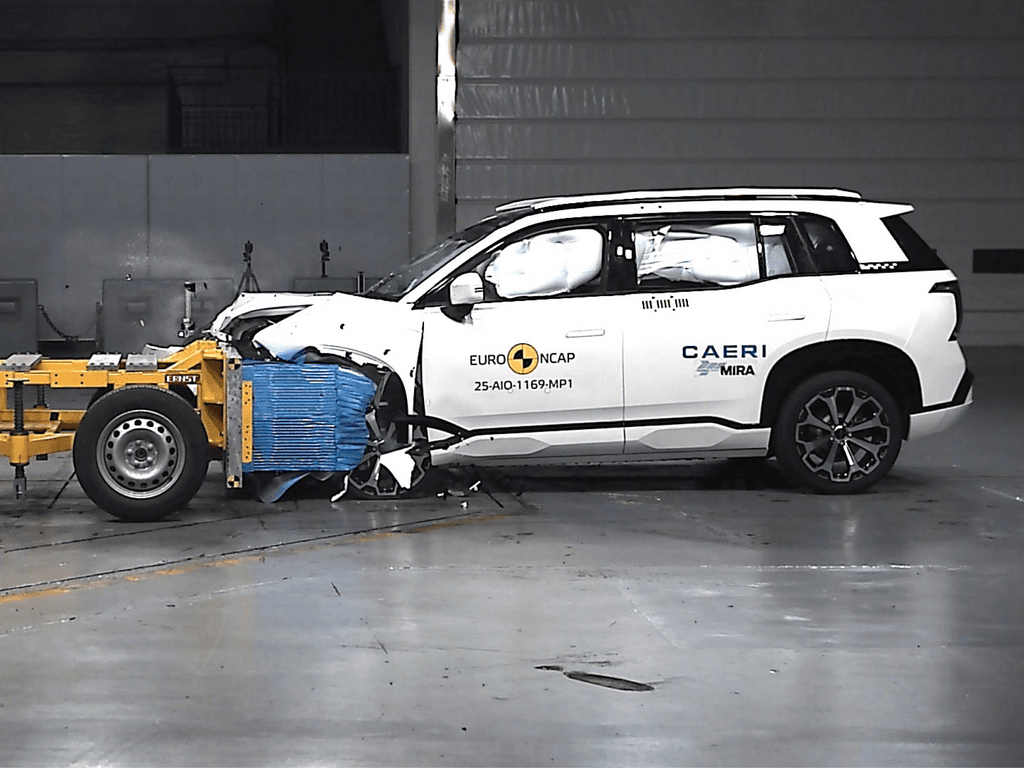
Starship Body, validation and independent ratings
A complete safety explanation connects the structure being developed, the conditions under which it is exercised and the vehicle assessed by an external programme. Each contributes a different kind of information. The structure explains how the manufacturer intends to protect a passenger space. Durability work investigates repeated loading. A consumer assessment records the performance of a defined vehicle under a published protocol.
| Evidence layer | Concrete GAC example | What it establishes |
|---|---|---|
| Structural development | Starship Body: embedded frame and multi-ring enclosure, including five longitudinal and thirteen transverse members | An identified body-engineering arrangement |
| Development validation | More than 3,000 bench-test hours and one million all-terrain kilometres reported for Starship | A dated manufacturer account of durability work |
| European and Australasian assessment | Five-star AION V assessments published by Euro NCAP and ANCAP | Independent results with model and market applicability |
| Chinese assessment | 2021 AION V Plus 70 Zhi Xiang Technology grade; 84.7% overall; five-star result announced January 2022 | A specific historical C-NCAP result under the 2018 protocol |
GAC’s Starship Body disclosure describes an embedded frame working with connected protective rings around the passenger enclosure. The arrangement concerns the route through which forces pass across the structure. A longitudinal member, cross-member and joint must work together; the useful engineering story is the organisation of the assembly rather than the strength of one piece of steel.
The same programme’s reported bench and road work gives the phrase strict validation a defined meaning. Controlled repeated loads and whole-vehicle terrain exposure investigate different aspects of an assembly’s behaviour. The two forms of work complement one another: repeatability helps isolate a response, while an integrated vehicle encounters combinations of vibration, temperature and loading. These are development measures reported for Starship, kept separate from the crash-test certificates below.
A/C/E-NCAP results become clearer with the exact vehicle
C-NCAP supplies a useful named example from an earlier AION generation. Its 14 January 2022 result announcement identifies the AION V Plus 70 Zhi Xiang Technology grade, assessed in 2021 under the 2018 rules. The overall score was 84.7%, meeting that programme’s five-star threshold. The announcement also states that the post-crash electrical-safety performance met the applicable C-NCAP requirements.
That electrical-safety finding is relevant to an EV because the assessment continues beyond the initial impact. Occupant protection and the condition of the high-voltage system address connected parts of the same safety event. Naming the tested grade preserves the value of the result and allows a reader to distinguish it from later cars with similar model names.
The more recent AION V assessments provide a separate international layer. Euro NCAP and ANCAP publish their own tested-model and applicability information, including the relevant year. The reader can therefore connect a five-star claim with a documented result for the vehicle being considered. A programme’s test year is part of the evidence because assessment methods develop over time.
The resulting positive case is stronger than a single brand-wide star claim: GAC publishes a structural-development programme, identifies substantial validation work and has vehicles with independently documented five-star results across different assessment systems. The GAC safety overview brings the model records together. Starship Body and the named AION assessments sit alongside one another as complementary evidence; their coexistence alone is not a model-fitment declaration.
What the five-star record does for a buyer
GAC's strongest safety claim is a set of identifiable vehicle results. A buyer can open a test-agency report, find the model and examine what happened to occupants in prescribed scenarios. That is more substantial than a generic statement that a manufacturer values safety. The evidence also gives a family a way to distinguish physical protection from assistance features and post-collision functions.
The overseas AION V supplies the main current SUV example. Its ANCAP rating entry covers Australia and New Zealand, while Euro NCAP's AION V assessment describes the European test vehicle. Both awarded five stars in 2025, but their detailed scores are not identical. The earlier AION V Plus has a separate Chinese C-NCAP record, and the AION UT adds a newer European result under the changed 2026 framework.
Alongside those assessments, GAC's Starship Body programme describes an approach to the load-bearing structure and its development validation. The distinction is useful: an architecture explains design intentions and engineering properties; a vehicle assessment measures the complete product in a defined configuration. This article brings those strands together while keeping the connection honest. The guide to AION V, V Plus and UT assessments provides further detail on the different rating programmes.
Starship Body connects the frame with the passenger enclosure
GAC's 14 April 2026 Starship Body release describes an embedded frame and a multi-ring passenger structure. Its specified arrangement includes five longitudinal members and thirteen transverse members. The design proposition is that forces can be carried through an organised network of connected elements around the protected space, rather than relying on an isolated strong component.
Longitudinal members run along the vehicle; transverse members link the structure across it. Their geometry and joints influence how the assembly responds to bending, twisting and impact. In general structural engineering, load paths matter because force introduced at one location must be transferred through the surrounding structure. An individual high-strength part contributes little if its connections or neighbouring members cannot perform their intended role.
The multi-ring description addresses this system-level requirement. It gives the announcement more technical substance than a claim about steel content alone. A continuous protective arrangement can distribute loads and support the integrity of the passenger space, subject to the actual geometry, material properties and manufacturing execution. These explanations describe the engineering purpose of the published arrangement, not an additional crash score.
The release does not establish that the independently tested AION V or UT uses this architecture. Their test results are valuable on their own. Linking Starship Body to a particular retail model requires a model-specific technical disclosure; it should not be inferred from the fact that both appear in the same manufacturer's safety story.
Stiffness and durability answer different engineering questions
The Starship disclosure gives torsional stiffness of 38,000 N·m per degree and bending stiffness of 42,000 N/mm. These measurements describe resistance to different forms of deformation. The first concerns twisting under an applied moment; the second concerns bending under force. They should therefore retain their units rather than be reduced to a single claim that the body is stronger by an unspecified amount.
A stiff structure can help provide a stable foundation for suspension and body-mounted components. It can also influence the way doors, seals and interior interfaces behave as the vehicle encounters uneven surfaces. Those are useful engineering reasons to pursue stiffness. They do not make the largest stiffness number an automatic measure of crash protection, ride comfort or the effectiveness of restraint systems.
Crash management includes controlled deformation as well as preservation of occupied space. Energy must be managed through the vehicle while belts, airbags and seats control the movement of people inside it. The development challenge is therefore a coordinated structure, not simply maximum rigidity everywhere. A design number helps explain one aspect of that work; a complete collision assessment examines its outcome alongside the other systems.
That is why the Starship Body engineering analysis should be read together with agency reports. The two sources answer complementary questions: what the manufacturer has designed and disclosed, and what a specified production vehicle demonstrated under independent assessment.
Strict validation becomes meaningful when the test programme is named
GAC reports more than 3,000 hours of bench durability work and one million kilometres of all-terrain vehicle testing for the Starship programme. The value of these figures is that they identify two forms of development work. Bench testing can apply repeatable loads to a component or assembly, while road testing exposes an integrated vehicle to a wider combination of conditions.
Repetition is important because a component may survive one demanding event yet deteriorate after many smaller events. Temperature, vibration and changing loads can affect materials, seals and joints over time. Conversely, a controlled bench cycle may not reproduce every interaction that occurs when a whole vehicle is driven. Using both types of work is a way to investigate different failure mechanisms.
A separate September 2026 Yue7 development account provides a named-model example: 685 road-test vehicles over three years, spanning two winters and two summers. The same account describes 500,000 high- and low-temperature bench cycles for its dual-chamber air-spring system. These are company-reported programme and component details, not totals to be added to Starship's figures.
They make the phrase strict validation concrete by describing what was exercised, over what duration and in which temperature contexts. They remain China Yue7 programme evidence. They do not establish the specification or achieved durability of an unspecified export XT80, nor do they replace the publicly available crash results for the AION models considered here.
The rating map preserves the model and the protocol
| Vehicle | Programme and date | Published result | Scope |
|---|---|---|---|
| AION V | ANCAP, 2025 | Five stars; 88% adult, 87% child, 79% vulnerable road users, 79% assistance | Australia/New Zealand covered variants |
| AION V | Euro NCAP, 2025 | Five stars; 88%, 85%, 79%, 78% in the corresponding four categories | European Premium LHD assessment |
| AION V Plus | C-NCAP, 2021 evaluation | Five stars; 84.7% overall | China 70 Zhi Xiang Technology; 2018 protocol |
| AION UT | Euro NCAP, 2026 | Five stars; 68% Safe Driving, 74% Crash Avoidance, 90% Crash Protection, 88% Post-Crash Safety | European Premium LHD assessment |
This is a map of assessments, not a ranking of the four vehicles against one common test. The UT's category names are different because the framework changed. An overall Chinese percentage also cannot be directly compared with one European category percentage. Keeping the original headings allows a reader to find the underlying result without inventing a harmonised score that no agency published.
The table nevertheless establishes a clear positive fact: the safety discussion includes several high-rated production vehicles across named assessment programmes. That is a more useful global picture than assigning a single universal rating to the whole GAC brand.
ANCAP connects the AION V result to Australian and New Zealand cars
ANCAP's entry states that the AION V rating applies to its listed variants, with build dates beginning in July 2025 and local on-sale dates beginning in November 2025. Those dates tell a purchaser which regional vehicle the assessment concerns. The 2025 datestamp identifies the rating period; it is not simply the year in which an advertisement happens to be viewed.
The published result supports a positive assessment of occupant protection. ANCAP specifically highlights strong side-impact and far-side performance in its December 2025 release. The vehicle also has a standard centre airbag, alongside the frontal, side-chest and side-head protection described on the rating page. These are concrete elements behind the star outcome.
The technical report supplies necessary detail beyond the headline. It records marginal driver-neck protection in the full-width test and notes that the doors did not automatically unlock after the frontal-offset test. A fitted child-presence feature did not satisfy the programme's reward requirements. These findings do not erase the five-star result; they show which parts of the protection package performed less strongly under the specified conditions.
For a family comparing cars, that level of detail is useful. It allows a meaningful question about an installed function and its assessed performance, rather than assuming that every item listed in a brochure has earned the same test credit.
Euro NCAP adds the European AION V assessment
The European AION V report concerns a Premium left-hand-drive test car. Euro NCAP records a stable passenger compartment in the frontal-offset assessment, an important finding because the occupant space provides the environment in which seats, belts and airbags must work. It also reports its own category scores rather than reproducing ANCAP's figures.
That separation matters when information travels between markets. A reader researching an Australian vehicle should start with the applicable ANCAP material; a European reader should follow the European report and local specification. Similar model names and shared engineering can make the reports relevant to one another, but the applicability statements remain the authority for a particular purchase.
The European finding also illustrates why safety is an integrated outcome. A stable compartment is desirable, but the injuries measured by dummies depend on how the occupant interacts with the restraint system. The vehicle's effect on another road user, its ability to detect a developing collision and its response after impact add further tasks. No single body parameter covers them all.
The AION V safety and ownership guide places these findings alongside local warranty and support considerations. That connection can help a household evaluate reassurance as a practical package: assessed protection, usable equipment and an identifiable organisation to support the car after delivery.
C-NCAP records an earlier AION V Plus milestone
The C-NCAP assessment for the AION V Plus identifies the 70 Zhi Xiang Technology grade, evaluated in 2021 under the 2018 rules. Its five-star outcome was announced in January 2022. Stating both dates resolves a common ambiguity between the year of the evaluation and the date on which the result was released.
The published overall score is 84.7%. The component results were 85.30% for occupant protection, 68.41% for pedestrian protection and 98.08% for active safety. Those figures show that the achievement was not a uniform score in every area. The particularly high active-safety result belongs to that protocol and vehicle, while the pedestrian result supplies a different part of the record.
The official result announcement also addresses post-crash electrical safety. For a battery-electric vehicle, protection extends beyond the mechanical impact itself: high-voltage systems and the condition of the battery after a collision are relevant to occupants and responders. The announcement gives a dated basis for discussing that part of the V Plus assessment.
This historical result deserves to be included in GAC's safety record. It should retain its generation and market identity rather than be presented as a current certificate for every vehicle carrying the AION V name. A new generation can require different evidence even when the badge is familiar.
The AION UT result follows the broader 2026 safety sequence
Euro NCAP's 2026 AION UT assessment concerns the Premium left-hand-drive hatchback and awards five stars. The four headings now follow a sequence: Safe Driving, Crash Avoidance, Crash Protection and Post-Crash Safety. The published UT scores are respectively 68%, 74%, 90% and 88%.
The sequence helps explain how vehicle safety extends through a journey. Before a dangerous situation develops, driver information and controls can influence safe operation. If a conflict develops, avoidance systems may reduce the likelihood or severity of an impact. Protection then concerns the people involved in the collision, and post-crash functions influence the period when the car has stopped but assistance may still be needed.
This wider view is relevant to families because real use involves different occupants and many ordinary interactions with the vehicle. A strong crash-protection result is valuable, yet the interface and rescue functions still deserve attention. The category breakdown makes those questions visible instead of hiding them inside a single star symbol.
The UT's 90% Crash Protection figure should not be described as two points better than the V's 88% Adult Occupant result. They are different categories under different frameworks. The justified positive claim is its five-star outcome and the strong specified protection and post-crash scores within its own 2026 assessment.
Protection also concerns people outside the tested car
A collision involves more than the occupants of the vehicle being assessed. In a frontal impact between vehicles, the way one front structure engages with the other can affect the severity of the loads passed across the collision. This is why compatibility appears in the AION V's technical report alongside the assessment of its own occupants.
The ANCAP report records a 1.85-point compatibility penalty out of a possible 8.00 points for the AION V's moving-barrier frontal assessment. ANCAP's same December 2025 release reports the full 8.00-point penalty for the Toyota Hilux and BYD Denza B5 in that category. The AION V result is therefore favourable within this specified measure. It is not a claim that one of these vehicles is superior in every safety category or that vehicles of different sizes can be ranked from that penalty alone.
The distinction is useful because a popular safety discussion often concentrates on occupants inside the larger car. An assessment of compatibility asks how its crash behaviour affects the wider road environment. Pedestrian and cyclist protection, emergency braking and junction detection extend that outward-looking perspective further. They examine situations in which the person at risk may not be protected by the car's passenger compartment at all.
The AION V's published vulnerable-road-user score supplies a separate outcome for that area. It should be read alongside the equipment descriptions and detailed test findings, rather than assumed from the presence of cameras or radar. A detection system needs to recognise and respond to defined scenarios; hardware presence is only part of the story.
For families, this creates a useful way to compare vehicles beyond a familiar star headline. Ask how the car protects its occupants, how it responds to people around it and what happens when an impact cannot be avoided. Those detailed findings can guide a useful discussion with the local dealer. The combination gives a fuller picture of safety responsibility than any one structural claim, and it keeps the positive AION V findings attached to the specific tasks the agency measured.
A complete safety case has an evidence chain
A clear chain begins with the named engineering concept, continues through development validation and ends with the applicable production-vehicle assessment. Starship Body contributes architecture and reported test effort. The AION V, V Plus and UT provide separate independently assessed outcomes. The evidence is strongest when the links are explicit rather than implied by proximity on a webpage.
Euro NCAP's announcement of its 2026 protocol changes explains why a safety record must also evolve. Broader occupant considerations and post-crash requirements ask more of a vehicle than a historical test may have asked. A manufacturer can therefore have a meaningful earlier achievement while still needing to demonstrate performance under newer rules.
For an individual purchaser, the most useful final check is the car on the quotation: market, model generation, grade, build date and equipment. The AION UT family-space guide considers everyday passenger use, while the test reports answer questions that cannot safely be investigated on a normal demonstration drive. Together they support a fuller decision.
GAC's record supports serious consideration on safety. Several named vehicles have high independent ratings, and its published structural work gives an identifiable development direction. The remaining task is precise attribution, especially for Starship Body fitment. Keeping that boundary clear preserves the credibility of the achievements already demonstrated.
Sources & references
- [A4_S1] Starship Body architecture and development validationGAC Group · 14 April 2026; manufacturer programme disclosure, not an NCAP certificate.
- [A4_S2] GAC AION V safety ratingANCAP · 2025 datestamp; Australia and New Zealand, all listed variants built from July 2025.
- [A4_S3] AION V 2025 assessmentEuro NCAP · 2025 European assessment; findings do not establish Starship Body fitment.
- [A4_S4] AION V Plus 70 Zhi Xiang Technology assessmentC-NCAP / CATARC · 2021 evaluation, 2018 protocol; China-market AION V Plus, 84.7% overall.
- [A4_S5] AION UT 2026 assessmentEuro NCAP · 2026 five-star assessment, tested AION UT Premium LHD; four-stage framework.
- [A4_S6] Euro NCAP announces 2026 protocol changesEuro NCAP · 26 November 2025; new framework effective in 2026.
- [A4_S7] GAC AION V detailed technical reportANCAP · Ten-page report; Premium and Luxury applicability, detailed crash and assistance results.
- [A4_S8] Understanding ANCAP ratings: frequently asked questionsANCAP · Explanation of rating datestamps and the five-star scale; accessed 6 November 2026.
- [A4_S9] AION V Plus C-NCAP result announcementC-NCAP / CATARC · 14 January 2022; official announcement of the 2021 evaluation, five stars and post-crash electrical-safety compliance.
- [A4_S13] GAC vehicle development and durability validationGAC Group · 8 September 2026; China Yue7 programme and component validation, separate from export XT80 specifications.
- [A5_S11] Five highly anticipated models assessedANCAP · 11 December 2025; confirms AION V five-star debut and describes its side-impact strengths.
- [A5_S12] AION V Plus earns five-star C-NCAP ratingGAC Group · 18 January 2022 report of 14 January result; historical test descriptions.
- [A5_S10] The Euro NCAP stars explainedEuro NCAP · Explanation of the consumer star system; accessed 6 November 2026.
- [W6_CNCAP] C-NCAP AION V Plus result announcementC-NCAP / CATARC
This is a source-based editorial guide, not a first-hand road test. Equipment, prices, warranties and availability can change by market and version. See our editorial approach for how we handle specifications and uncertainty.