Climb into an AION V in Europe and the driver is responsible for the journey. Book a ride in an AION V–based robotaxi in Guangzhou and the passenger may start the trip by voice while a dedicated driving system handles the road. The shared nameplate makes the difference unusually revealing. GAC can engineer an electric vehicle for private ownership and supply a production platform for an autonomous fleet. Each application calls for different hardware, software, validation and operating arrangements.
Three AION programmes, three jobs for the technology
The wider answer to the question about GAC’s core technology includes its ADiMOTION electrified powertrains, its work on vehicle intelligence and robotics, and its ability to manufacture key systems overseas. Driving intelligence gives us a way to look inside that answer. On the AION N60, GAC Aion and WeRide brought a trained assistance system to a production passenger car. In Europe, the AION V has a published equipment specification and independently measured braking and lane-support results. On the fleet side, GAC Aion provides the electric vehicle platform for Pony.ai’s AION V robotaxi and co-developed a dedicated vehicle, the R2, with DiDi.
We compared the vehicle specifications, test protocols, manufacturer delivery records and fleet announcements by matching each claim to a particular vehicle and task. The result matters to a buyer asking what a showroom model can do, and to a passenger trying to understand what sits behind the booking screen. The examples also explain a part of vehicle engineering that becomes visible only when the same manufacturer works with several technology partners.
Who controls the vehicle, and what evidence follows it?
| Programme and location | What the technology does | Public evidence |
|---|---|---|
| AION N60, China | WeRide WRD 3.0 assists a driver in urban, highway and parking scenarios. | Joint production vehicle on Qualcomm Snapdragon, recorded in WeRide’s interim filing. |
| AION V Premium, European assessment | Driver assistance includes collision mitigation and lane support. | Euro NCAP published the individual test scores and the tested version. |
| AION V Gen-7 robotaxi, Guangzhou | Pony.ai provides the automated driving system. OnTime manages fleet operations. | GAC documented a delivery of more than 100 vehicles in March 2026. |
| GAC Aion–DiDi R2, China | A purpose-built robotaxi carries passengers on bookable trial trips. | DiDi opened driverless trials in designated parts of Beijing and Guangzhou. |
Read the table across a row. For the European AION V, a motorcyclist braking ahead is a test scenario with a score. For the robotaxi, it is one situation in a driving task the operator must support throughout a route. A strong emergency-braking result tells a private owner something specific about the first vehicle. A fleet order tells a mobility operator something specific about the second. Keeping the evidence attached to its vehicle makes both findings more useful. The supporting records are WeRide’s filing, Euro NCAP’s assessment, GAC’s fleet delivery report and DiDi’s trial announcement.
Inside the N60 development process
Take a turn across the path of oncoming traffic. The vehicle needs to account for more than an object’s current position. A cyclist can continue straight or turn. A car can slow to yield. The space that looks open in a single image might be occupied by the time the vehicle reaches it. This is a useful example of the task that WeRide describes for the AION N60. Its software considers the likely movements of several road users and uses that information when planning a speed and path. WeRide names urban roads, highways and parking among the applications of its WRD 3.0 assisted-driving system.
One of the more informative parts of the N60 engineering release is the account of simulation. WeRide describes four parts of its GENESIS development environment. One generates scenarios, another supplies simulated traffic participants, a third evaluates what the vehicle does and a fourth helps investigate the reasons for a result. Consider running the same turn again with a faster cyclist, then repeating it with the cyclist entering a moment later. In principle an engineer can change one element at a time, inspect the difference in the planned manoeuvre and choose the next variation. That is our illustration of the method. WeRide identifies turns across traffic, cut-ins and obstructions among the situations it uses in development.
The production hardware matters here. WeRide’s half-year filing identifies the N60 as its first jointly developed production passenger car with GAC Aion and its first deployment of this one-stage system on the Qualcomm Snapdragon platform. That connects a training method to a car someone can identify and a computing platform on which the software has to run. For buyers, the useful claim is supervised driving assistance in a particular vehicle. For engineers, it is a public example of a jointly developed model taking a new software implementation into production.
What the European AION V actually did in testing
A European family evaluating the AION V has an unusually practical starting point. GAC’s European specification identifies Level 2 driver assistance and the ADiGO 5.0 cabin system. Euro NCAP’s September 2025 report names the tested variant as the AION V Premium, a five-door, electric, two-wheel-drive SUV. Looking below its five-star overall rating reveals how particular functions performed. The score sheet records 7.5 out of 8 for automatic emergency braking involving cyclists, 6 out of 6 for emergency braking involving motorcyclists, and 3 out of 3 for lane support involving motorcyclists. These are separate test categories under the assessment protocol.
Compare two situations in the score sheet. In the first, a cyclist crosses from behind parked vehicles. In the second, the car changes lane across the path of an overtaking motorcyclist. The first scenario asks how the car responds to a crossing cyclist. The second asks how lane support responds when two paths may converge along the road. An engineer can describe both as assistance for vulnerable road users, but the vehicle has to perceive a different motion and respond through a different function. A family that cycles as well as drives can see why an assessment covers both.
The report also identifies the braking system’s camera and radar, and lists direct eye monitoring for the driver. GAC lists four-zone voice interaction on the same European vehicle. These features serve three separate people-facing purposes. Braking can intervene around another road user, driver monitoring attends to the person at the wheel, and voice interaction gives occupants access to cabin functions. A buyer can ask the dealer to demonstrate cabin controls and the driver’s display, then consult the assessment for the controlled emergency scenarios. That division makes a demonstration more informative and keeps the evidence reproducible.
From an AION V production platform to a Guangzhou taxi fleet
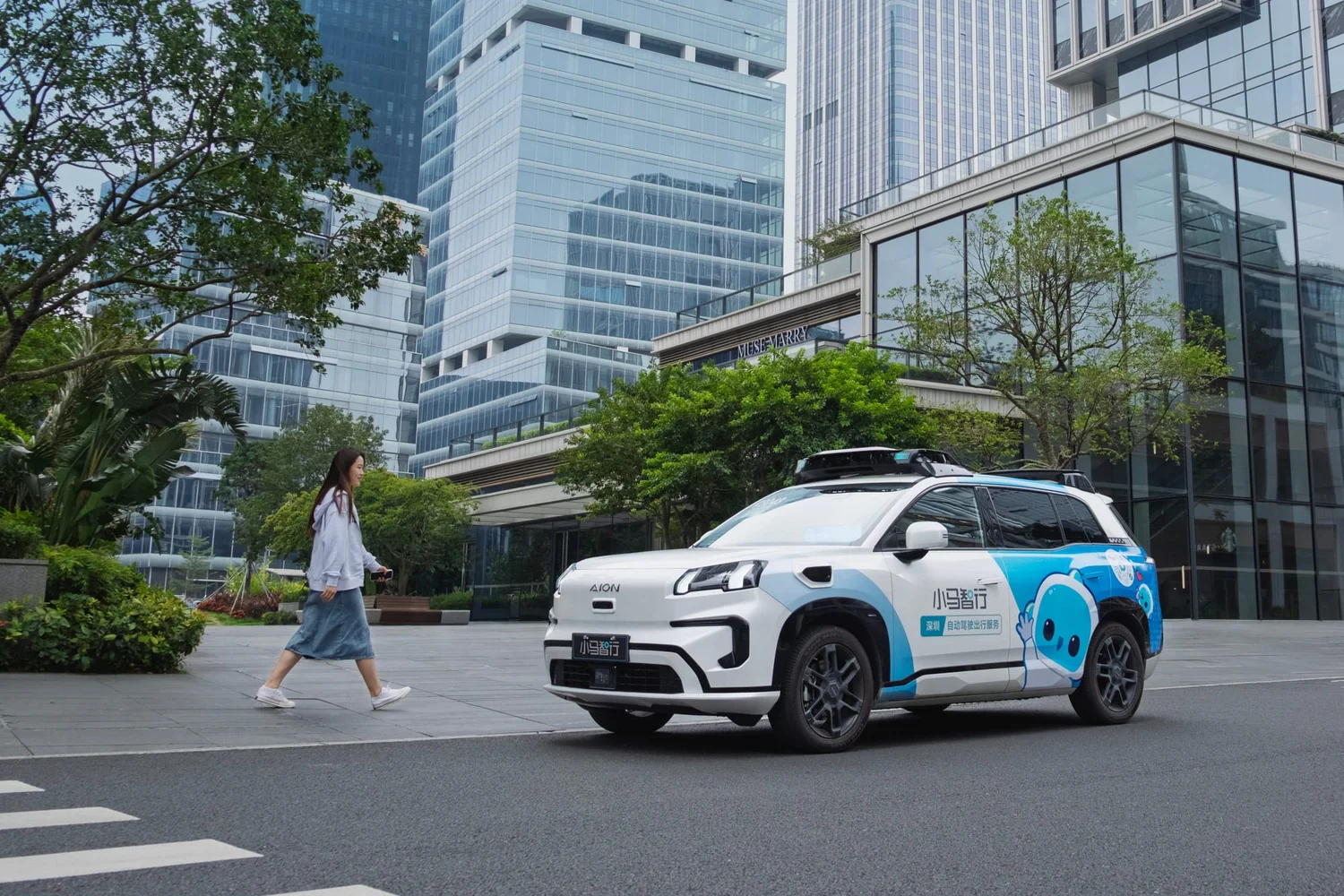
Follow the second-generation AION V into a different setting and the division of engineering work changes. Pony.ai’s production update dates production of its GAC Gen-7 model to June 2025. The company subsequently reported road testing in Guangzhou and Shenzhen. In November it announced driverless commercial operations for its Gen-7 line across Guangzhou, Shenzhen and Beijing. That announcement covered several manufacturer partners. A further milestone can be attributed directly to the GAC vehicle. In March 2026, GAC documented more than 100 AION V–based robotaxis joining the fleet operated by OnTime Mobility in Guangzhou.
This arrangement makes three engineering responsibilities visible. GAC Aion supplies the production electric vehicle and vehicle-manufacturing capability. Pony.ai develops and updates its automated driving system. OnTime manages the vehicles in service, including dispatch, operations and support. A passenger’s request therefore sets several things in motion. The service platform assigns a vehicle, the driving system handles the road within its operating conditions, and the fleet operator looks after a car that has to be ready for another passenger. Pony.ai’s delivery account also identifies fleet ownership and operational safety assurance among its partner’s responsibilities.
Hardware details make the commercial vehicle easier to picture. GAC describes six types of production sensors and an integrated system for cleaning sensors. A clear field of view matters beyond a demonstration drive. A vehicle taking successive bookings can encounter rain or road spray at different points in a shift. A cleaning function is one example of the extra integration involved in building a vehicle to work repeatedly in that setting. The fleet’s pre-trip cabin temperature adjustment and Bluetooth unlocking illustrate the same idea inside the car. A passenger arriving at the pickup point can benefit from work the vehicle and operator have already done before the door opens.
What changes when GAC and DiDi design the taxi from the start?
In the R2, GAC Aion and DiDi took a second route. They designed the vehicle around the passenger service. In January 2026, GAC reported the first factory handover of the R2 and Guangzhou road-testing approvals for the initial vehicles. By August, DiDi was accepting bookings for driverless trial rides in designated areas of Beijing and Guangzhou. The two dates answer different questions about the programme. January identifies a physical product that could begin road testing. August identifies where a member of the public could request a trial ride and how to book one.
Try looking at the design from the back seat. In a conventional taxi, a passenger can give the driver a booking code, ask to start the trip and request a change in cabin temperature. DiDi describes a sequence that the R2 passenger can handle by voice, including PIN verification, starting the trip and adjusting the climate controls. It also describes a 17.3-inch ceiling-mounted screen and high-angle adjustable seats. These details explain why cooperation with a vehicle manufacturer matters. Passenger sightlines, access to controls and the position of the screen are physical design decisions. The app, speech interface and vehicle controls have to complete the same passenger request.
The driving technology has its own documented allocation. DiDi identifies its Level 4 software and hardware, 33 sensors and a central computing platform that combines three domains. Display size describes a passenger amenity. Sensor count describes part of the installation. App bookings in defined demonstration areas establish the use that DiDi had opened to passengers. Looking at the three together is more informative than ranking the vehicle by any one number. Compared with the OnTime delivery, the R2 adds direct evidence of a manufacturer and a mobility operator jointly developing the passenger experience around driverless trips.
The date that ties the fleets together
November 6, 2026 marked a year since Pony.ai announced driverless commercial service for its seventh-generation models in three Chinese cities. What had changed in the GAC record over that interval? The clearest addition was the March handover to OnTime. The November announcement described a generation of automated driving deployed on vehicles from several partners. The March announcement attached an actual batch size, a particular model and a named operating platform to Guangzhou. Someone asking whether GAC supplied cars for this application can now follow the evidence down to the fleet level.
The DiDi sequence runs alongside that history. It took a jointly developed vehicle from January delivery to August passenger trials. Comparing the two programmes gives a clearer answer to a common question about automotive AI. To judge whether a feature has left the laboratory, look for the event appropriate to the product. A new electric vehicle can roll off an assembly line. A driver-assistance function can earn a scenario score. A driverless service can open bookings in specified districts. All three are meaningful achievements, and each tells a reader who can make use of the technology today.
There is a practical consequence for anyone choosing an AION V. Ask the retailer about the equipment and software offered on the local customer vehicle. For a fleet deployment, look up the operating company, service area and booking conditions. For a technology partnership, look for the announcement that identifies who supplied the vehicle, who developed the driving system and who manages a trip. The answers can all feature GAC even when the work being described sits with different teams.
Where powertrain engineering and robotics fit
The same attention to the actual product helps explain GAC’s other core technology. Its April 2026 Tech Day account groups range extension, plug-in hybrid and HEV+ systems within ADiMOTION. There are already specific model examples for range extension. GAC introduced it on the extended-range HYPTEC HL and identifies a new-generation ADiMOTION range-extending system on the AION i60. These examples answer a question about energy supply and propulsion. It is a different engineering decision from selecting who performs the driving task. A vehicle can have a sophisticated powertrain and a distinct set of supervised assistance features suited to its market.
GAC’s research into the sky, robots, homes and vehicles can also be read through tangible examples. The group displayed the GOVY AirCab and demonstrated the GoMate robot at its Hong Kong presentation. GoMate could change between wheeled configurations for different movements. GAC’s World Robot Conference presentation documented GoMove transporting a person up and down steps and GoSide receiving spoken instructions for household tasks. The demonstrations address two distinct needs, moving a person between levels and helping someone complete a task at home. Back in the vehicle, ADiGO voice interaction provides a production example of a person asking a machine to do something in a familiar environment.
For the flying programme, there is a later milestone than the Hong Kong exhibit. GAC reported that its first AirCab came off the Huangpu line in May 2026. For our comparison, that is the point at which an assembly operation and a physical vehicle can be identified together. Describing the exhibit, the factory milestone and the separate robot demonstration in those terms gives a reader a much clearer picture of the breadth and maturity of the work.
What it means to take engineering overseas
An overseas customer can encounter GAC engineering at several points before receiving a car. For the European AION UT, the group identifies local design work in Milan and the start of production with Magna in Austria on March 18, 2026. The designers had a regional brief for the hatchback’s usability and driving experience, while Magna provided an established assembly operation. For the European AION V, independent test results describe a further part of the journey. A market-specific model can be examined under the same published assessment protocol as other cars a buyer is considering.
Thailand offers a closer look inside a vehicle. On October 29, GAC’s battery business marked the first pack off its own overseas pack line in Chonburi. The factory report says the first phase prioritises the locally manufactured AION Y Plus. A pack is an identifiable assembly supplied to the vehicle plant. Building packs near the cars that use them gives the regional operation responsibility for another manufacturing step. The detail that matters here is the specific part and the vehicle it will supply. The report provides planned annual capacity separately from the first unit produced. It names 7,000 packs a year in the first phase and provision for a later expansion to 20,000. A parts planner looking at the first figure would still need the order schedule to know how many vehicles will receive packs in a given month. A buyer interested in industrial capability can already identify the local supplier, the assembly stage and the intended model. Those are three useful findings available from the opening of one plant.
Put these examples alongside Guangzhou’s robotaxi fleet and a buyer can see what travels from one market to another. A manufacturer can put its electric vehicle engineering into a locally designed and assembled hatchback, place a battery-pack process near an overseas vehicle plant, or provide its electric platform to a specialist fleet. Each is evidence of a different capability. The strongest answer to the original question connects a technical name to the person using it: a driver receiving assistance, a passenger starting a robotaxi by voice, or a local manufacturing team building the component its next vehicle needs.
Sources & references
- [1] WeRide and GAC Debut First Co-Developed Vehicle Aion N60 Powered by WRD 3.0ir.weride.ai
- [2] WeRide 2026 Interim Report, filed with the U.S. SECsec.gov
- [3] AION V European specificationsgacgroup.com
- [4] Euro NCAP 2025 AION V assessment datasheetcdn.euroncap.com
- [5] Pony.ai confirms production and road testing of Gen-7 robotaxisir.pony.ai
- [6] Pony.ai launches Gen-7 driverless commercial servicesir.pony.ai
- [7] Pony.ai and Chenqi Mobility announce delivery of over 100 Gen-7 vehiclesblog.pony.ai
- [8] GAC explains the AION, Pony.ai and OnTime Mobility fleet partnershipgacgroup.com
- [9] GAC and DiDi deliver the R2 at the AION factorygacgroup.com
- [10] DiDi announces fully driverless service trials with the R2prnewswire.com
- [11] GAC Tech Day 2026 and the three ADiMOTION powertrain routesgacgroup.com
- [12] GAC launches ADiMOTION range extension in the HYPTEC HLgacgroup.com
- [13] GAC presents the AION i60 and its ADiMOTION range extendergacgroup.com
- [14] GAC reports the first GOVY AirCab off the Huangpu production linegacgroup.com
- [15] GAC Hong Kong shows GOVY AirCab and the GoMate robotgacgroup.com
- [16] GAC presents GoMate, GoMove and GoSide at the World Robot Conferencegacgroup.com
- [17] GAC confirms AION UT production at Magna in Austriagacgroup.com
- [18] GAC reports the first battery pack off its Chonburi linegacgroup.com