Yes, the UAE petrol GS8 has a well-supported seven-seat family proposition: a 2,920 mm wheelbase, a configurable three-row cabin, three-zone climate control and a substantial grade-specific assistance package. Its intelligence is most useful when it helps occupants enter, change seating arrangements, share driving or manage a large vehicle in confined spaces. GT supplies important core functions; GX adds powered third-row operation, driver memory and further assistance. The strongest choice depends on how frequently those extra functions serve the household.
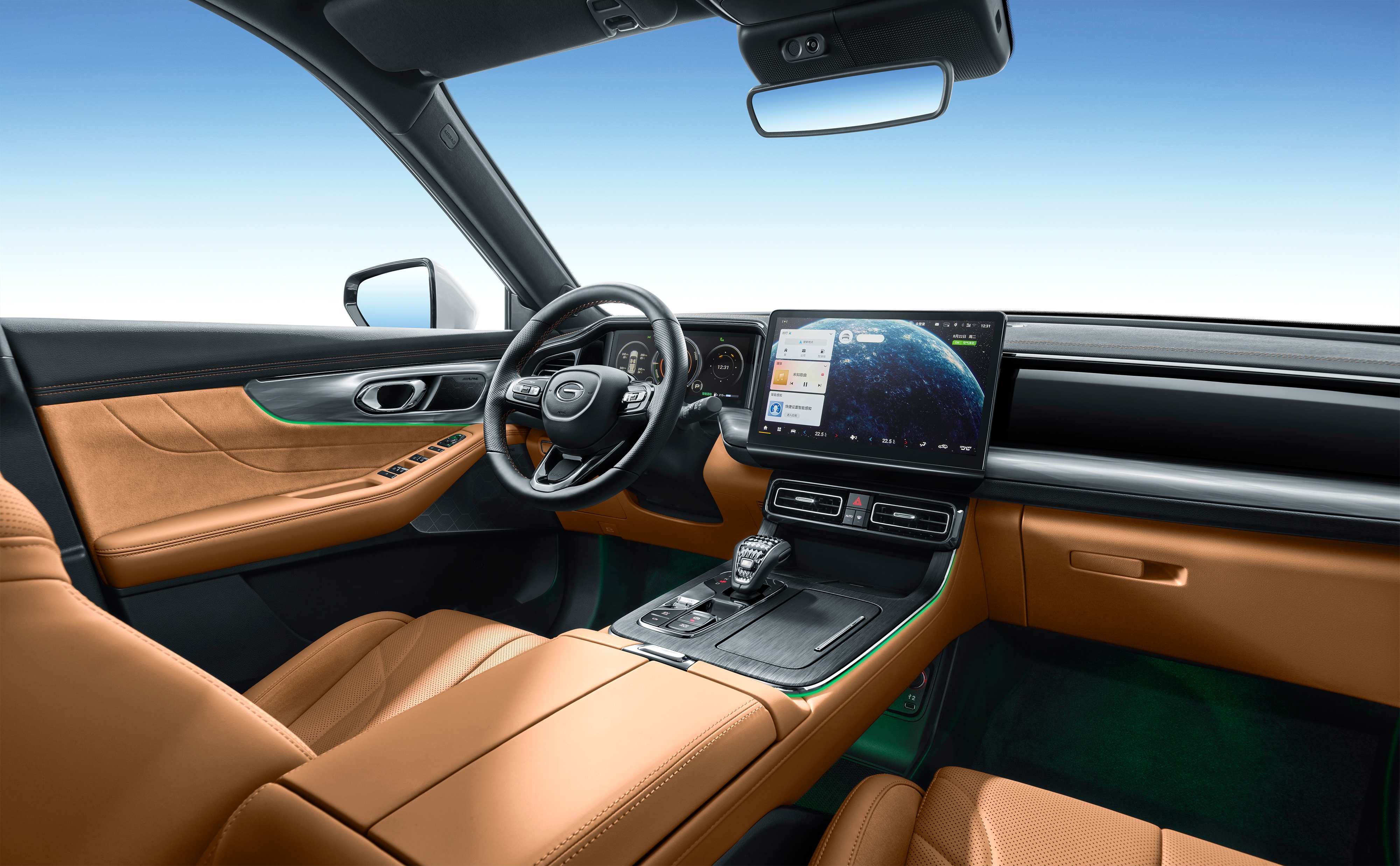
Two questions establish the GS8 family proposition
A good seven-seater needs enough usable space for its actual passengers, while an intelligent SUV needs technology that reduces the work of travelling with them. Those are related but separate tests. A large touchscreen cannot compensate for a difficult boarding route, and an unused third row does not become more valuable because the vehicle has additional assistance functions. The GS8 has a credible answer to both questions, provided the grade and seating arrangement remain visible in the assessment.
The UAE petrol range is a particularly useful case because the manufacturer publishes GL, GT and GX columns with equipment differences. It gives the GS8 a 4,980 mm body, a 1,950 mm width and a 2,920 mm wheelbase. These dimensions create a substantial cabin platform, but the passenger experience still depends on allocation between rows. The seven-seat capacity includes the driver. The published luggage envelope changes from 181 to 1,859 litres as the cabin configuration changes; the upper figure is not storage behind seven occupied seats.
The following assessment begins with equipment that can be checked, then connects it to the work a family performs. Our GS8 seating-change analysis provides the detailed loading background. Here the emphasis is the combined argument: where space, access, climate, controls and assistance reinforce one another, and where a buyer should choose a different grade or a different type of vehicle. It is a specification-based evaluation, not a claim that every passenger or every road has been tested.
[S1]The UAE grade matrix identifies which intelligence is actually supplied
The names GT and GX are useful only when attached to a particular market and powertrain. This article uses the UAE petrol table, whose columns are GL 2WD, GL AWD, GT 2WD, GT AWD and GX AWD. It does not import a Chinese hybrid specification or another country's luxury package. The Gargash GS8 brochure provides a second local reference for the petrol model and its seven-passenger layout. A written quotation should identify the supplied grade against that local specification. [S2]
| Family task | GT 2WD / GT AWD | GX AWD |
|---|---|---|
| Third-row access | Second-row easy entry; electric slide, manual reset | Same listed easy-entry arrangement |
| Change third-row configuration | No powered third-row function listed | Electric lowering and raising listed |
| Swap drivers | Power adjustment; no driver memory listed | Driver memory and mirror memory listed |
| Front-seat cooling | Ventilation listed | Ventilation listed |
The table shows two different upgrade stories. GT supplies much of the equipment that makes the GS8 an intelligent family vehicle. GX concentrates additional convenience around repeated adjustments and broader assistance. That distinction prevents a buyer from paying for the top grade simply because the family needs seven seats: seating capacity itself is shared across the range. Conversely, someone who rearranges the rear cabin repeatedly may find GX's powered operation more valuable than a feature used only on an occasional journey. The GS8 grade-ladder analysis develops that equipment-first approach.
[S1]The strongest space benefit is the ability to allocate it
For a household using five seats most days, the additional row is a reserve capability. With that row folded, the rear portion can carry larger everyday items; with it raised, the same vehicle can take extra passengers on a shorter local trip. This is more useful than treating maximum luggage volume as a standalone selling point. The owner can use the cabin differently as the passenger plan changes, without requiring all seven places to remain occupied on every journey.
That does not make the GS8 a substitute for a large passenger van in every situation. A fully occupied seven-seat trip with large suitcases asks a different packaging question from a school collection with small bags. At full occupancy, the relevant storage space is the portion remaining behind the last row. A demonstration that folds the rear seats before showing luggage capacity does not resolve that full-occupancy case. Seat configuration is part of the measurement, not a minor footnote.
The practical benefit therefore lies in the overlap between capacity and frequency. Two occasional extra passengers may be enough to avoid a second vehicle for a family meal or weekend outing. If every regular journey involves seven adults, access and legroom need to be assessed with that exact group. GAC’s global GS8 presentation highlights its configurable seven-seat layout and storage provision; the UAE table determines which mechanisms are supplied locally. The buyer gains a more reliable conclusion by examining the normal layout and the most demanding layout separately.
[S1]Seven occupied seats require a separate luggage and restraint assessment
The GS8's 181-litre lower cargo endpoint and seven-seat specification make full occupancy its most demanding packaging case. The 1,859-litre upper endpoint requires a different arrangement, so it cannot be credited to a seven-passenger holiday load. Seven people require seven usable seating positions, appropriate restraints, room to enter and leave, and somewhere for every bag. The smallest published luggage figure should prompt an honest packing rehearsal. Seven occupied seats and the maximum cargo figure cannot coexist, because the larger load area depends on releasing cabin space from passengers.
The GS8 matrix lists side-curtain airbags, front side airbags, ISOFIX anchors and a rear-passenger seatbelt warning across all grades; GX additionally lists a driver knee airbag. These are specific restraint provisions that accompany the seven-seat layout. They do not establish that every row has identical child-seat anchorage positions, and the matrix does not identify every permitted installation position. The local manual therefore determines how a child restraint and the access route can coexist. This is especially relevant when a fixed child seat on the second row could affect the movement used to reach the third.
An airport journey exposes the other side of the packaging decision. Seven places may accommodate a family and two visitors, but their large suitcases still compete for the remaining load area. GX's electric folding cannot create additional cargo volume while those same seats remain occupied. It reduces effort when a seat becomes available. A household using seven seats frequently for local trips can gain substantial flexibility, while one routinely moving seven people and substantial luggage may need a larger load envelope. That distinction follows directly from the GS8's configuration-dependent capacity.
[S1]Third-row access is a movement sequence, not just a seating label
The GS8’s useful access feature appears in the UAE GT and GX columns as a second-row easy-entry function with electric slide-out and manual reset. This deserves attention because entering the final row requires more than an empty seat waiting at the end. The passenger needs an opening, a manageable step and a route that remains available with the family’s normal restraints and belongings installed. Powered initial movement helps create that route; restoring the travelling arrangement remains a separate action.
A realistic demonstration should use the intended third-row passenger and the normal second-row position. Moving the middle row far forward can make a photograph look spacious while leaving an unrealistic arrangement for the person in front. A family should instead find a workable allocation between both rows. The same principle applies when a child restraint occupies a second-row seat: its installation may affect which movement is possible and which side provides access.
The NHTSA child-restraint guide supports matching the restraint to the child and vehicle and following their instructions. It is general guidance, not proof that a particular GS8 seating position accepts every restraint. The local manual and actual installation resolve that question. Viewed this way, easy entry is a concrete intelligent convenience: it assists a recurring physical task, while the passenger and restraint determine whether the resulting route works. It can make occasional extra seats substantially more usable without pretending that all occupants have identical mobility or space needs.
[S4]Powered seats are useful intelligence when they shorten a real sequence
GT and GX both list the second-row easy-entry arrangement, described as electric slide-out with manual reset. GX additionally lists powered lowering and raising of the third row. The first function helps a passenger reach the last row; the second changes whether those last seats are available for people or cargo. These functions act at different moments, so describing either as simply electric seats hides its real purpose.
Consider a vehicle used by grandparents as well as parents. Avoiding a repeated reach into the luggage area can be worthwhile even when the owner is physically able to operate a manual seat. Similarly, a powered initial movement can make the route into the third row more predictable, while manual reset still needs to be completed correctly. The value is reduced effort and easier repetition, not extra seat width or an automatic guarantee of comfortable access.
A useful purchasing demonstration should follow the sequence from the loaded arrival state to the departing passenger state. Move belongings away from the mechanism, create the access route, seat the intended passenger, restore the second row and check the travelling position. This reveals whether the controls are placed conveniently and whether the occupant can complete the task without help. The local GS8 brochure establishes the vehicle family being considered; the UAE grade matrix supplies the allocation. GX earns a stronger case when these movements recur often, while GT can remain adequate when the last row changes only occasionally.
[S1]Climate and information controls give intelligence a passenger role
Three-zone automatic air conditioning is listed throughout the UAE petrol GS8 range, while GT and GX add ventilated front seats. Cabin airflow and seat ventilation serve different parts of comfort. The former manages the shared air environment; the latter acts where the front occupants contact the seat. A rear passenger therefore should not be told that front-seat ventilation supplies the same personal cooling benefit to every row.
The 14.6-inch centre touchscreen and 12.3-inch instrument display are also listed across the range. GT and GX add voice control, creating another way to operate supported commands. This combination can reduce the need to move between unrelated information surfaces: driving information remains ahead of the driver, while media or navigation can occupy the centre display. Actual menu clarity and recognition quality still need to be experienced, because screen size alone does not establish either.
GX additionally lists sound-insulating front-door glass. That is a material contribution to the cabin’s acoustic design, not a measured claim that it is quieter than every competing SUV. The DOE and EPA explanation of cooling energy use adds another practical connection: cooling requirements influence operation. Assess the vehicle with the passengers’ normal climate settings rather than presenting a comfortable cabin as separate from the energy and driving experience. The strongest intelligent-cabin case is the coordinated availability of controls, airflow and information that support the people actually travelling.
[S1]The parking package should make a large body easier to manage
At 4,980 mm long and 1,950 mm wide, the GS8 needs a parking assessment that includes doors and passengers as well as painted lines. A vehicle can fit within a bay while still leaving too little room for a child restraint or an older passenger to enter. Cameras and proximity warnings help the driver position the vehicle, but they cannot change the physical space available beside it. The useful outcome is a manageable arrival and departure sequence for the household.
The UAE specification lists front and rear parking sensors across the range. GT has HD Surround Vision; GX uses a separately named FAPA HD Surround Vision row together with Fusion Automatic Parking Assist. This difference in naming matters: a blank in the ordinary surround-view row does not justify saying the GX lacks a camera system. The additional GX reversing-mirror tilt offers another perspective on the kerb rather than duplicating the same visual information.
GX’s driver-seat and mirror memory is useful before the parking manoeuvre begins. Two regular drivers can restore their normal reach and view instead of repeatedly searching for a previous position. They should still check the result, since a stored setting does not assess the surroundings. The GS8 family-changeover guide connects these functions with cabin use. A focused demonstration should include a familiar narrow bay, door opening and a driver swap. The technology earns value when it reduces repeated setup and improves awareness during tasks the owner actually performs.
[S1]Named assistance functions provide a stronger case than an autonomy label
GT and GX include adaptive cruise, lane-related support, traffic-jam assistance and forward-collision warning in the UAE equipment table. These address defined parts of driving rather than transferring responsibility for an entire journey. A warning tells the driver about a situation; an intervention may also change steering or speed within its operating conditions. Understanding that difference is part of using the car’s intelligence effectively.
GX adds blind-spot detection with lane-change assistance, rear cross-traffic alert, door-opening warning and emergency lane-keeping assistance. This allocation is relevant to a family because the functions apply at different moments: joining another lane, reversing past an obstruction, opening a door or responding to an emerging lane-related hazard. They are not interchangeable counts on a feature list. Nor does listing a function establish how well it performs in every road condition.
The NHTSA explanation of driver assistance is useful for understanding warnings, interventions and continuing supervision. It is not a GS8 test or certification. During ordinary familiarisation, the driver should learn where active status is displayed, how to change supported settings and how the car communicates its limits. There is no need to provoke a hazard to demonstrate a feature. The positive GS8 case is the availability of a substantial, grade-specific package that supports real driving tasks, accompanied by clear understanding of its role.
[S3]A loaded family vehicle needs a coherent mechanical package
The petrol GS8’s specified 2.0-litre turbo engine, eight-speed automatic and 400 Nm torque figure describe the mechanical foundation supporting its cabin role. The published peak power is 185 kW. They are useful facts when considering a large vehicle carrying passengers, but they do not constitute a measured acceleration result with seven people aboard. A family assessment should connect the mechanical package with the loads it will actually carry rather than treating an unloaded promotional figure as the entire story.
The torque plateau is listed from 1,750 to 4,000 rpm. In ordinary terms, useful engine torque is available across a band rather than at a single narrow engine speed. The automatic transmission can select among ratios as road speed and demand change. This helps explain why the specification is relevant to merging, inclines and loaded operation, while leaving shift quality, noise and fuel use to a representative drive. A technical explanation is stronger when it describes the mechanism without pretending to have measured the result.
Front-wheel drive and all-wheel drive are separate choices within the UAE range. The GX combination is AWD, so a buyer choosing its powered seating also receives that mechanical configuration. That is part of the purchase decision, even if cabin convenience was the initial reason for moving upward. The GS7 plug-in hybrid journey analysis offers a different energy option for buyers who do not need seven seats. Comparing the actual jobs of the two models is more useful than assuming the newest powertrain or highest grade must be the better family vehicle.
[S1]Which GS8 owner receives the clearest benefit?
The best-supported positive case is a household that regularly needs a spacious five-person cabin, sometimes needs two more places, and will use the access, climate and parking functions supplied by its chosen grade. GT combines important everyday equipment without requiring a buyer to move automatically to GX. GX is more compelling for repeated driver changes, frequent third-row rearrangement and the specific additional assistance shown in the local matrix.
This conclusion joins the two parts of the original question. The GS8 is a substantial, configurable seven-seater, and it has identifiable intelligent functions that can reduce repeated work. The equipment is not merely decorative: memory restores positions, easy entry changes access, cameras and sensors support manoeuvring, and assistance systems address defined driving tasks. None removes the need to check passenger comfort, restraint fit or the driver’s responsibility. The AION V safety and ownership assessment explains why verified protection and usable support should accompany a positive product recommendation.
Before choosing, place the normal occupants and belongings in the vehicle and move through the intended sequence from boarding to parking. Use the same sequence in a competing seven-seater. The result is a decision grounded in repeatable needs: where the GS8 makes daily use easier, which GX functions earn their place, and whether full occupancy still fits the family’s luggage. That is a concrete reason to call it a good intelligent seven-seat SUV, while retaining the limits that make the recommendation useful.
[S1]Sources & references
- [S1] GS8 UAE petrol grade specificationGAC UAE · Official /2024 configuration matrix; checked 6 November 2026. GL/GT/GX grade distinctions retained.
- [S2] All New GS8 UAE brochureGargash GAC Motor · Authorised-distributor petrol GS8 brochure; seven passengers including driver; checked 6 November 2026.
- [S3] Driver Assistance TechnologiesNHTSA · General definitions and driver responsibility; not a GS8 performance test.
- [S4] Car Seats and Booster SeatsNHTSA · General child-restraint selection and installation principles; local vehicle manual governs fitment.
- [S5] Fuel Economy in Hot WeatherU.S. DOE / EPA · General explanation of cooling energy demand; no model-specific percentage inferred.
This is a source-based editorial guide, not a first-hand road test. Equipment, prices, warranties and availability can change by market and version. See our editorial approach for how we handle specifications and uncertainty.