The Relationship Between GAC and Toyota
GAC and Toyota jointly own GAC Toyota, the vehicle company they established in Guangzhou in 2004. Its first Camry ran on an engine built by a second venture the partners had formed in Nansha. Twenty years after that Camry left the line, GAC Toyota built its ten-millionth vehicle, a bZ7 electric sedan developed by GAC, the joint venture and Toyota’s research center in China.
More than 20 years of partnership
One company made engines. Another built and sold cars. Their work met under the bonnet of a Guangzhou-built Camry.
Two companies in Nansha
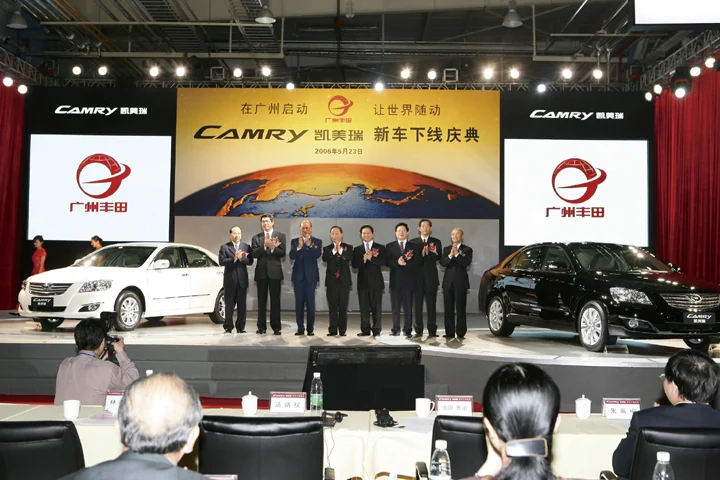
A Camry built in Guangzhou in 2006 carried the work of two companies under one bonnet. Its AZ engine came from a factory in Nansha set up by Guangzhou Automobile Group and Toyota. Another company, owned by the same partners, assembled the car and offered it for sale. The short journey from the engine plant to the vehicle line explains an early decision in the partnership. GAC and Toyota had chosen to make both a Toyota sedan for customers in China and engines that could enter Toyota’s wider supply network. Toyota’s account of the first Guangzhou Camry
Toyota dates the letter of intent for the Guangzhou joint venture to June 2003. The engine company came first. On February 24, 2004, the partners established Guangqi Toyota Engine in Nansha, with Toyota holding 70 percent and Guangzhou Automobile 30 percent. Its original production plan lists camshafts, crankshafts and a 2.4-liter gasoline engine. A camshaft controls when the valves open and close. The crankshaft turns the up-and-down movement of the pistons into rotation. These two components would be among the first things the partners made together. Toyota’s China chronology and the engine company’s founding announcement
On September 1, the partners established Guangzhou Toyota Motor, each taking a 50 percent stake. The partners named the Camry as the first product and identified the supplier of its AZ engine in the founding announcement. The appointments also show how they shared responsibility for the new business. Guangzhou Automobile’s chairman, Zhang Fangyou, was named to chair the venture. Toru Kuzuhara, then a project general manager at Toyota’s Takaoka Plant in Japan, was named as its prospective president. GAC’s Yuan Zhongrong was listed as executive vice president. The two businesses also had different customers. The engine company could supply Toyota operations overseas. The vehicle company was responsible for making and selling cars in China. This second venture is the business that became widely known as GAC Toyota. The founding agreement and initial Camry production plan
A crankshaft before a Camry
Production began with engine components on January 17, 2005. In October, the Nansha engine company started making complete AZ engines. The destination for its first year’s output was Japan. By the time the Guangzhou vehicle plant needed engines for its inaugural Camry, its local supplier had already begun building them for export. The next spring gave the AZ engine a second destination, a Toyota sedan built for Chinese buyers in the same Guangzhou district. The first components leave the line and Toyota’s history of the two Guangzhou plants
Training began on a similar timetable. In January 2005 the vehicle company opened an engineering training center. Staff had more than a year to develop their skills before the first Camry came off the line. At the launch Toyota described quality-control equipment throughout the manufacturing process and measures for treating wastewater, reducing noise and recovering waste materials. The engineering center belongs alongside the engine in this part of the history. One supplied the car with a powertrain. The other gave the people responsible for building it a place to learn their work before series production began. Toyota’s account of training and production in Nansha
On May 23, 2006, suppliers and dealers joined staff and representatives of both parent companies for the Camry line-off ceremony. The Chinese name Kaimeirui appeared in Toyota’s announcement alongside Camry. Orders were due to open that day at prices ranging from 197,800 to 269,800 yuan. The factory employed about 2,100 people at the start of production. For a buyer, the result of three years of agreements, component production and training was now a particular car with a name, a price and a place of manufacture. The May 2006 Camry launch record
A second line and a hybrid
The Yaris joined the Camry in May 2008, giving the first production line a small car alongside the sedan. In September, Guangzhou Toyota Motor changed its name to GAC Toyota Motor. The Guangzhou Toyota that announced the first Camry and the GAC Toyota that subsequently launched the Highlander were the same vehicle company. On May 25, 2009, the joint venture added a third model. The Highlander SUV came off a newly opened second production line in Nansha and went on sale that day. Toyota’s record of the name change and the Highlander line opening
On April 12, 2010, GAC Toyota marked the start of local production and sales of the Camry Hybrid. Buyers already knew the gasoline model. Between its June 2006 market launch and the end of February 2010, more than half a million conventional Camrys had sold in China. GAC Toyota initially offered the hybrid at 107 dealerships. Putting a different powertrain into a familiar sedan gave those dealerships a straightforward way to introduce the technology. Customers could compare two versions of a car whose name had been on the local market for almost four years. The Camry Hybrid rollout and initial dealer network
A fifth model, the E’Z, entered production in June 2011. On August 4, GAC Toyota marked its millionth vehicle at the Guangzhou plant. That count covered every vehicle the joint venture had built since May 2006, across its two production lines. It tells a different part of the story from the half-million Camry sales recorded the previous year. One figure describes demand for a particular sedan. The other records what the partners had learned to build together in five years, from a single Camry with a Nansha engine to small cars, SUVs and hybrids. The Guangzhou plant’s first million vehicles
Quality manufacturing on the factory floor
A hybrid drivetrain, a twenty-day quality inspection and a robot lifting a car body show how work in Nansha changed as the range grew.
The price on a hybrid's windscreen
A young driver shopping for a first car in China in December 2013 could visit a GAC Toyota showroom and find a hatchback built with that purchase in mind. Toyota described the YARiS L as the joint venture's first car designed specifically for young Chinese consumers. At 4,115 millimetres long, it sat between the smaller city cars and larger compact cars that buyers might also consider. A shopper had a choice of 1.3- and 1.5-litre engines. Even in this relatively small body, the range left room for different priorities. Toyota China's YARiS L profile
Two years later the answer for a different set of buyers could be read on a pair of price cards. On October 29, 2015, GAC Toyota unveiled the Levin Hybrid in Shanghai. The entry hybrid carried a suggested retail price of RMB 139,800, exactly the price of the entry 1.8-litre petrol Levin. Three days earlier Toyota had presented the Chinese-made hybrid powertrain in Changshu, Jiangsu. The Levin gave that engineering milestone an immediate meaning in a showroom. A family comparing the two entry models could choose hybrid propulsion without moving up the price list. The showroom arrival was scheduled for mid-December. GAC Toyota's launch and price list
The components behind that price tell a story of their own. Toyota identified four parts made in China for the hybrid programme. They were the traction battery, the motor, the power control unit and the Atkinson-cycle engine. More than 260 Chinese technicians tested the locally produced hybrids under conditions ranging from high-altitude climbs to stop-and-go city traffic. Entry into one particularly sensitive production area, the hybrid transaxle workshop, required a change of clothing and an air shower to keep particles out of the assemblies. Toyota's powertrain announcement
Twenty days at the end of the line
In March 2016, two quality specialists visiting from Japan spent twenty days at the end of final assembly in Nansha. Each day they selected two newly built cars at random. The inspection covered water leaks, paint finish, assembly, chassis and driving performance. Even a grain in the paint with a radius of half a millimetre could count as a defect. Both of GAC Toyota's production lines received a zero-defect rating in that outgoing-quality audit. The evaluation described the sampled vehicles during that round, under standards Toyota periodically revised in response to market feedback. GAC's account of the quality audit
Quality work also gave the people fitting parts a say over the cars moving past them. Workers could pull an andon cord when they found a problem. A separate inspection team within quality assurance examined finished vehicles from a customer's perspective. Its chief inspector explained that a defect led his team to trace cars built immediately before and after the affected vehicle to see whether the problem extended beyond that one example. At the end of the line, an inspector saw an individual car. Its position in the production sequence let the team ask a larger question about the process that had built it. Xinhua's report from the factory
Intelligent manufacturing on the third line
At the Guangzhou auto show in November 2017, buyers encountered Toyota's New Global Architecture, or TNGA, in the eighth generation of a nameplate already familiar to them, the Camry. Two months later, on January 16, 2018, GAC Toyota put a third production line into operation in Nansha. The opening-day account names the smaller YARiS L hatchback and sedan among the models made there. The Camry illustrated what a new vehicle architecture meant for the product range. The new line showed how the joint venture could change the way it built other cars. Toyota's Guangzhou show report · The third line at its opening
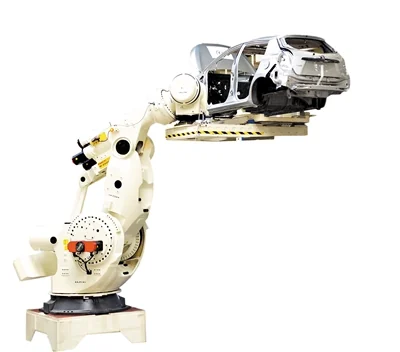
Look at the two-tonne-class handling robot photographed at the opening. Its job was moving heavy loads. Elsewhere, the welding shop used a flexible body line, and the length of the production line could be adjusted to suit changes in model mix or capacity. Equipment and conveyors that would otherwise have hung overhead were brought down to floor level, opening sightlines for the people working there. Together these choices give intelligent manufacturing a physical scale, from the load a robot could carry to what an operator could see across the floor. Guangzhou's contemporary factory report and photograph
When GAC supplied the electric platform
A GAC Toyota sedan at the Chengdu auto show in September 2019 carried a piece of GAC engineering under its body. The iA5 used GAC's second-generation GEP battery-electric platform. Until then, a visitor could follow the partnership's product history through familiar Toyota names such as Camry, Highlander and Levin. Here was a production car that also rewarded looking up the origin of the platform. Later that month, on September 26, the two parent companies signed a framework covering electrification and connected vehicles, including plans to share resources and exchange personnel. The iA5 gives a concrete sense of the engineering GAC could bring to that wider relationship. GAC on the iA5 platform · The September agreement
Hydrogen opened another avenue. On June 5, 2020, GAC and Toyota signed an agreement with FAW, Dongfeng, BAIC and SinoHytec to establish a research venture in Beijing. Its brief was fuel-cell systems for commercial vehicles. All six partners appear in the announcement, which identifies experience with both vehicle production and fuel-cell development as reasons for bringing the companies together. Toyota's six-party announcement
Back in Nansha, the second phase of GAC Toyota's new-energy vehicle expansion started production on December 20, 2022. It brought the joint venture's annual production capacity to one million vehicles. To see what had changed inside, follow a part on its way to an assembly station. Outside the plant, the company monitored supply in real time and used a system to detect and correct errors. Inside, automated guided vehicles moved materials. GAC reported fully unmanned logistics in the designated materials-handling areas of the welding, battery and final-assembly shops. In the paint shop, Toyota's electrostatic application process used electric charge to draw paint onto the surface. GAC put its transfer efficiency at 90 per cent. That figure described the proportion of paint reaching the part, a measure that mattered each time another body passed through the booth. For a partnership that began by supplying engines to an assembly plant, the journey of a part had become an engineering project of its own. GAC's report on the new plant and its logistics
Developing the next Toyota in China
The names on the development credits of two electric cars reveal which decisions the partners had begun making together in China.
Four names on a family SUV
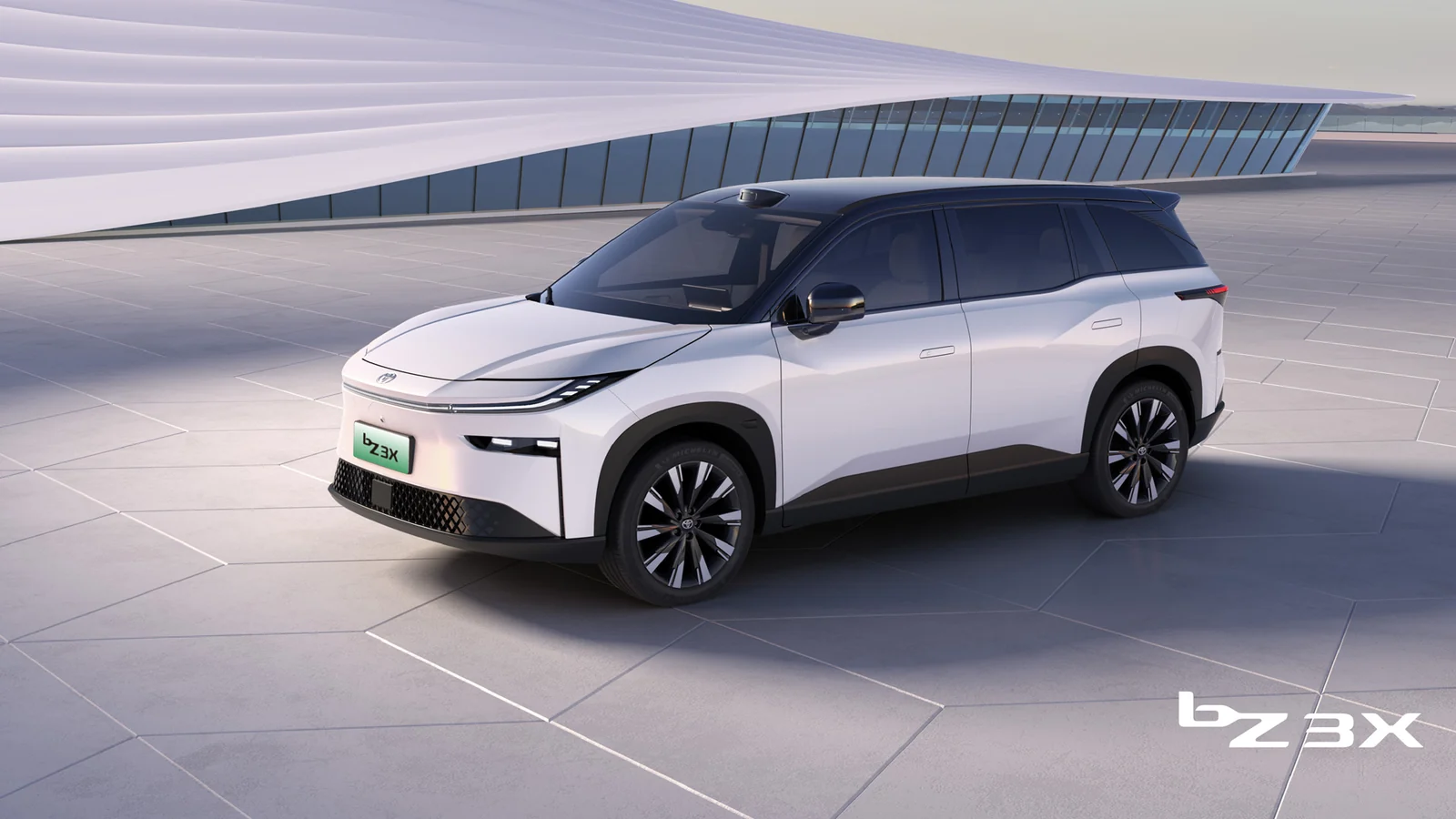
The development credits for the bZ3X occupy a single sentence in Toyota’s announcement for the 2024 Beijing motor show. The sentence names Toyota Motor Corporation, Guangzhou Automobile Group, GAC Toyota Motor and Toyota’s research center in China. Two of those names begin with GAC. One belongs to the Chinese automaker that invested in the joint venture. The other belongs to the vehicle company the partners built together. On this battery-electric family SUV, both companies earned a place in the development credits. Toyota’s Beijing motor show announcement
A change in the way engineers worked had preceded the show. In July 2023, Toyota announced that engineers from GAC Toyota would participate in a project led by its research center in Changshu, alongside colleagues from FAW Toyota research and the BYD-Toyota electric-vehicle venture. The center took the name IEM by TOYOTA on August 1. Toyota owned the center, GAC Toyota contributed engineers, and their brief included cabin design, driving assistance and safety features suited to Chinese roads. Toyota’s local development announcement
In the bZ3X, some of those choices could be seen from the back seat. The cabin had a flat floor and flexible seating. Its voice system could distinguish commands from four seating positions. Toyota says a chief engineer for the China region led the project and that the team incorporated customer feedback from motor shows almost up to the March 2025 launch. For driving assistance, the team worked with technology from local specialist Momenta and examined scenarios in which crashes frequently occur. The company kept listening after the first deliveries. Its integrated report includes a photograph from interviews with bZ3X owners in December 2025. It also describes a retail change for this model, with specialist sales staff helping customers explore the battery-electric car. Toyota’s integrated report, bZ3X development account
Two anniversaries and a ship bound for Hong Kong
Between the Beijing unveiling and the showroom launch came a pair of anniversaries in Guangzhou. On November 12, 2024, the engine venture marked the production of its eight-millionth engine. On November 13, the vehicle venture held its twentieth-anniversary gathering. Together the dates recall a detail easily lost when the companies are referred to simply as GAC Toyota. The partners first formed an engine business, then a separate vehicle business. In 2006 one had supplied the engine for the other’s first Camry. In 2024 the two still kept distinct records of their work. GAC’s 2024 environmental, social and governance report
The bZ3X also left a record outside a factory or a motor show. On November 13, 2025, 164 examples lined up at Nansha’s automobile port ahead of a roll-on/roll-off sailing to Hong Kong. The district commerce authorities identified the vessel as Suigang 01 and the vehicles as locally manufactured GAC Toyota SUVs. The local account also records the work behind the departure. District commerce officials, customs staff and the port arranged advance declarations and coordinated the inspection with the vessel’s arrival. The shipment gives the model’s story a destination. Visitors can follow a vehicle credited to four development partners in Beijing to a production base in Guangzhou, then to a port handling the joint venture’s first export of its own new-energy vehicles to Hong Kong. Nansha’s account of the shipment
What the ten-millionth vehicle tells us
At the Shanghai motor show in April 2025, Toyota introduced another locally developed electric car. This time it was a sedan over five meters long. The bZ7 announcement credited GAC Group, GAC Toyota and IEM by TOYOTA. Reading that list alongside the bZ3X credits shows what the vehicles had in common. On each project, the Chinese shareholder and the manufacturing joint venture both took part in developing the car. The bZ7 went on sale on March 29, 2026. Shanghai premiere · GAC’s 2026 interim report
A different vehicle had already emerged from a dedicated Nansha line on February 9. The first production bZ4X Robotaxi brought GAC Toyota together with autonomous-driving specialist Pony.ai. GAC Toyota used the Toyota Production System and just-in-time methods on the line. Pony.ai supplied its seventh-generation automated-driving system. One set of engineering decisions concerned how to build vehicles repeatedly to a specified standard. Another concerned how an individual vehicle would handle its surroundings in service. Both are visible in the same car, with a named organization behind each. Toyota China’s first production Robotaxi announcement
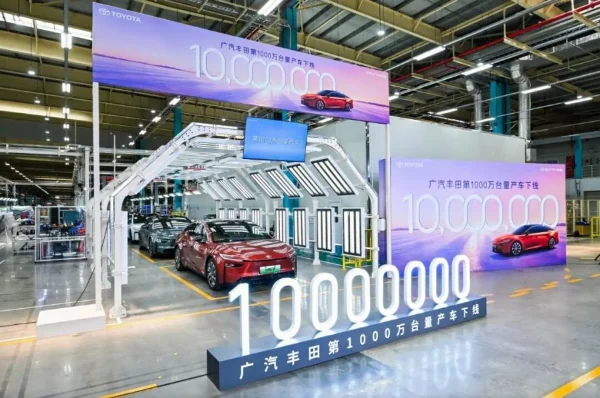
On July 2, a bZ7 rolled off the line as GAC Toyota’s ten-millionth vehicle. The number counts vehicles the joint venture had produced across its history. Park this electric sedan beside the first Nansha Camry of 2006 and the difference becomes tangible. The earlier car carried an AZ engine made by the partners’ neighboring engine venture. The later one carried development credits for the Chinese shareholder, the vehicle venture and Toyota’s local research center. The production count links the cars. Their respective engineering histories show how the work shared by the partners had grown. Guangzhou’s account of the production milestone · Toyota’s first Camry production record
An agreement with a third partner
On October 8, 2026, representatives of FAW, Toyota and GAC met in Guangzhou to sign a strategic alliance framework. Its proposed transaction concerned FAW Toyota, a separate vehicle company. GAC would issue shares to acquire the 50 percent interest held by FAW in FAW Toyota. Upon completion, FAW Toyota would continue operating as an independent entity and FAW would become a strategic shareholder of GAC. The companies also envisaged cooperation between FAW Toyota and GAC Toyota in purchasing, production, sales and research. The three companies’ joint announcement
The signing and the proposed transfer have different places on the timeline. The chairmen of FAW and GAC attended the launch of their joint working group at GAC headquarters on October 22. In its October 30 progress announcement, GAC said audit, valuation and due-diligence work was still underway and described the decisions and approvals still required. By November 11, 2026, the signed framework and the working group belong to the documented history. The proposed share transfer belongs to the next chapter. GAC’s October 22 meeting record · GAC’s October 30 progress announcement
Questions about the partnership
When did GAC and Toyota become partners?
Toyota’s corporate chronology records a letter of intent in June 2003. The companies set up their engine venture in February 2004 and their vehicle manufacturing and sales venture on September 1 of that year. The vehicle venture reached its twentieth anniversary in 2024. [S9] [S10] [S1]
Who owns GAC Toyota?
GAC and Toyota established the vehicle company with a 50 percent interest on each side. The separate engine company began with Toyota holding 70 percent and GAC 30 percent. The October 2026 framework concerns the Chinese stake in FAW Toyota, a different joint venture. [S10] [S1] [S4]
What connects quality manufacturing to intelligent manufacturing?
Both can be observed on the Nansha factory floor. In the March 2016 audit, inspectors took finished vehicles from the line to check paint, assembly and other details. On the third line in 2018, a flexible welding line and a two-tonne-class handling robot gave operators more ways to build different vehicles. At the expanded plant in 2022, automated guided vehicles moved parts through designated logistics areas. [S17] [S19] [S23]
Did GAC help develop the bZ3X and bZ7?
Yes. For the bZ3X, Toyota named four developers: Toyota Motor Corporation, GAC Group, GAC Toyota Motor and IEM by TOYOTA. For the bZ7, it named GAC Group, the vehicle joint venture and IEM by TOYOTA. The listed partners differ by model. [S24] [S26]
Sources & references
- [S1] The Guangzhou Vehicle Joint Venture Is EstablishedToyota Motor Corporation
- [S2] Toyota, Camry production begins in China, May 23, 2006Toyota Motor Corporation
- [S3] Toyota Expands Local Engineering Collaboration in ChinaToyota Motor Corporation
- [S4] FAW, Toyota and GAC Sign a Strategic Alliance FrameworkToyota Motor Corporation
- [S5] Toyota, Toyota Production SystemToyota Motor Corporation
- [S6] Toyota, Quality and ServiceToyota Motor Corporation
- [S7] GAC Toyota, official reporting on its third production lineGAC Toyota
- [S8] GAC Group, corporate development historyGAC official publication
- [S9] Toyota in China: A Historical ChronologyToyota Motor Corporation
- [S10] Breaking Ground for the Nansha Engine VentureToyota Motor Corporation
- [S11] AZ Engine Production Begins in NanshaToyota Motor Corporation
- [S12] The First Camry Comes off the Guangzhou LineToyota Motor Corporation
- [S13] GAC Toyota Builds Its Millionth VehicleToyota Motor Corporation
- [S14] Camry Hybrid Production and Sales Begin in ChinaToyota Motor Corporation
- [S15] The YARiS L and Young Buyers in ChinaToyota China
- [S16] The Levin Hybrid Launch and Price ListGAC Toyota
- [S17] Outgoing Quality Audits on Two Nansha LinesGAC Group
- [S18] The Eighth-Generation Camry at the Guangzhou Auto ShowToyota China
- [S19] Inside GAC Toyota’s Third Production LineGuangzhou Daily, via the Guangzhou Municipal Industry and Information Technology Bureau
- [S20] The iA5 and GAC’s Second-Generation Electric PlatformGAC Group
- [S21] GAC and Toyota’s Electrification and Connectivity FrameworkGAC Group
- [S22] Six Companies Sign a Commercial Fuel-Cell R&D AgreementToyota Motor Corporation
- [S23] Nansha’s Second New-Energy Vehicle Expansion OpensGAC Group
- [S24] The bZ3X and Its Development Partners in BeijingToyota Motor Corporation
- [S25] Integrated Report 2025: Developing the bZ3X in ChinaToyota Motor Corporation
- [S26] The bZ7 Makes Its World Premiere in ShanghaiToyota Motor Corporation
- [S27] Nansha Ships 164 bZ3X SUVs to Hong KongNansha District Commerce Bureau
- [S28] First Production bZ4X Robotaxi Leaves the Nansha LineToyota China
- [S29] 2026 Interim Report: The Launch of the bZ7GAC Group
- [S30] GAC Toyota Builds Its Ten-Millionth VehicleGuangzhou Daily, via the Guangzhou Municipal Science and Technology Bureau
- [S31] Building the Camry in Guangzhou: Toyota’s Corporate HistoryToyota Motor Corporation
- [S32] 2024 ESG Report: Anniversaries of the Two Joint VenturesGAC Group
- [S33] The first components leave the lineToyota Motor Corporation
- [S34] The Highlander line openingToyota Motor Corporation
- [S35] Toyota's powertrain announcementToyota China
- [S36] Xinhua's report from the factoryXinhua
- [S37] GAC’s October 22 meeting recordGAC Group
- [S38] GAC’s October 30 progress announcementGAC Group