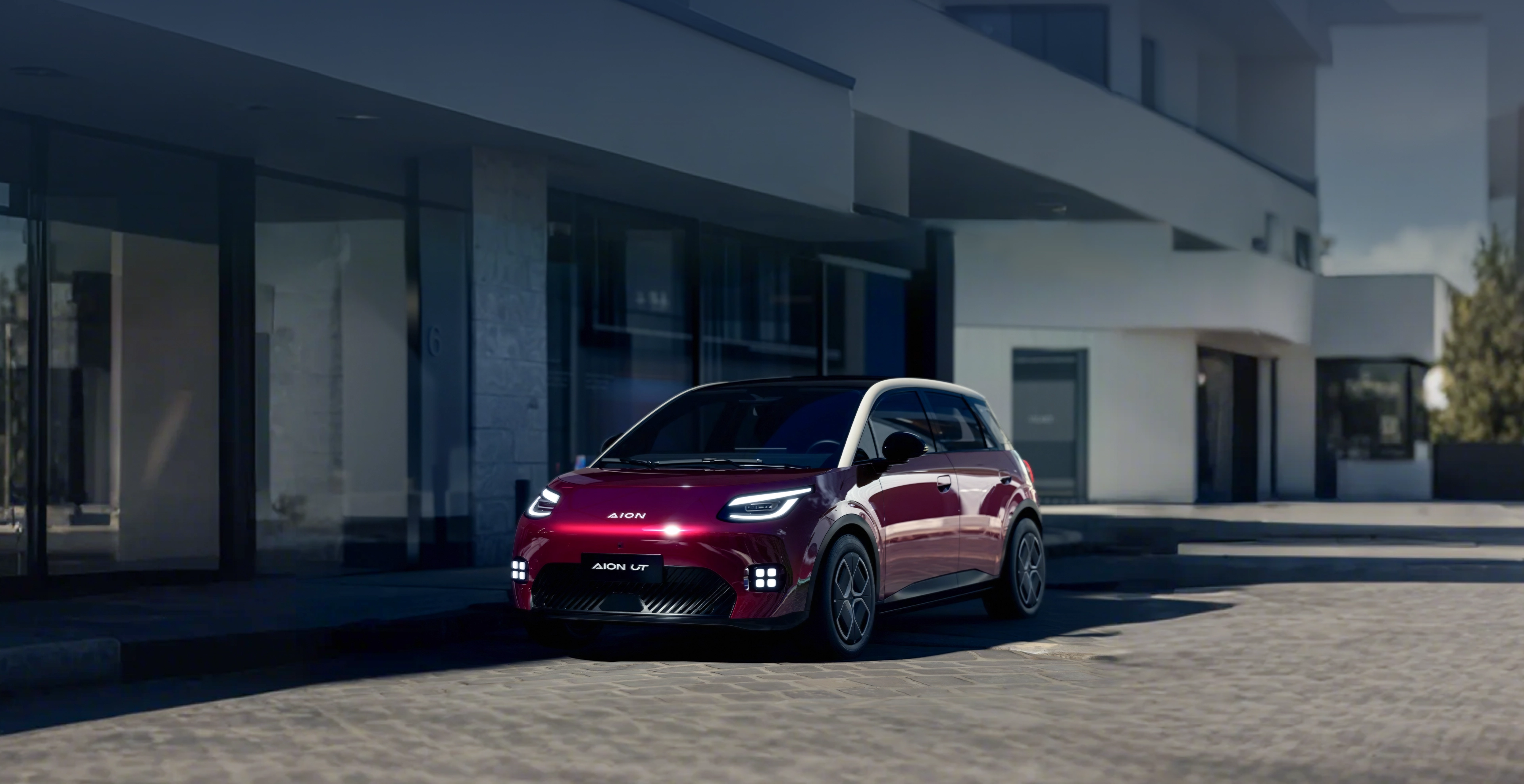
The European AION UT measures 4,270 mm long, with published width of 1,850 mm with mirrors folded and 2,073 mm unfolded. [R1] Its compact length makes it worth considering for urban use, but a bay that contains the car may still leave inadequate room for doors, passengers or luggage. Our assessment is to evaluate the route into the space, the parked footprint and the access needed around it separately. Cameras and folding mirrors help specific tasks; they do not create clearance.
Three different kinds of space determine city usability
For an AION UT urban buyer, space outside the cabin can be as important as the room inside. The first requirement is manoeuvring space: the route through a gate, around a pillar or into a bay. The second is the vehicle's stationary footprint. The third is working space around the parked car, where doors open, passengers stand and luggage is lifted.
A parking place can pass one test and fail another. A car may fit between painted lines but leave a child restraint difficult to reach. A garage may be long enough for the closed vehicle while preventing useful tailgate opening. A narrow entrance may be negotiable, yet the angle needed to reach it can be the real problem.
Assess these requirements in order. Trace the normal approach, measure the final position and then act out the tasks performed there. This is a proposed evaluation method, not a claim that the UT has been tested in a particular garage. The goal is to make its published dimensions relevant to the places where the buyer actually parks.
Use the correct width for the task being assessed
The AION UT's European width specification distinguishes folded and unfolded mirrors. Neither number is an interior cabin-width measurement. A rear-seat comfort claim cannot be derived by subtracting a guessed body thickness from exterior width. [R1]
For a normal approach to a space, consider the vehicle in the operating configuration required for safe visibility. When assessing the final parked position, check which mirror state can actually be used and how it is controlled on the chosen grade. Do not assume that a width quoted without its mirror definition is directly comparable with another car's advertised width.
Measurements should also include obstacles at different heights. A wall at bumper height, a projecting gate hinge and a pillar near a mirror can impose different constraints. Record the narrowest relevant point rather than a convenient wide section. If clearance is close, arrange a careful demonstration with the dealer and a competent spotter as appropriate; do not treat theoretical millimetres as an adequate real-world margin for every driver.
An illustrative parking-bay calculation, with its limits
Suppose a hypothetical bay is 2,400 mm wide and the AION UT is perfectly centred. Using the published 2,073 mm unfolded-mirror width leaves 327 mm in total, or 163.5 mm on each side. This is simple arithmetic for an imaginary bay, not a measurement of a real parking space or a recommendation that such clearance is adequate. [R1]
| Illustrative input | Value | Interpretation |
|---|---|---|
| Assumed bay width | 2,400 mm | Hypothetical, not a local parking standard |
| UT width with mirrors open | 2,073 mm | Manufacturer's exterior measurement |
| Total nominal difference | 327 mm | Bay width minus vehicle width |
| Equal difference per side | 163.5 mm | Only if perfectly centred |
That subtraction does not reveal door-opening room. Doors sweep outward from a different position and a neighbouring car may not be centred. Paint lines are also not physical walls. Use the example to understand what the width number can establish, then measure and test the access required in the actual location.
Length allowance is not the same as tailgate working room
The UT's overall length describes the closed vehicle. A garage assessment must also consider the space needed to open the hatch, stand behind the car and move a bulky object. Even when the body fits, a wall, overhead door mechanism or shelf can make the boot inconvenient to use.
Mark a proposed parking position and examine the overhead clearance throughout the tailgate's movement. Check the garage door both open and closed, including rails and handles. If the car would need to be moved outside for loading, decide whether that is acceptable in rain, traffic or the household's normal morning routine.
The chosen grade's tailgate operation should be demonstrated rather than assumed. GAC France lists manual operation on Premium and electric operation on Luxury. [R5] A powered tailgate changes the operating method, but it does not remove a physical obstacle or prove that the hatch will stop at a suitable height in every setting. Ask which settings exist on the delivered car and verify them against the manufacturer's instructions.
Turning-circle figures are useful but do not map a whole route
GAC's European specification lists a 5.35 m steering turning radius, also expressed as a 10.7 m diameter, for the AION UT. [R1] This is a useful published manoeuvrability reference, but it does not establish that the car will enter every driveway or turn within every space of that nominal width.
A real route includes the vehicle body, overhangs, entry angle and obstacles. The starting position matters, as does the space available for any correction. A corner beside a pillar is different from an unobstructed turning area. Comparing one manufacturer's radius with another's diameter would also create an apparent twofold difference that is only a unit-definition mistake.
For a difficult home approach, sketch the route and identify the constraint before arranging a demonstration. If a familiar vehicle already uses it, record what makes the manoeuvre easy or awkward and test the UT under comparable conditions. Avoid promising a one-turn entrance from a brochure figure alone. The useful outcome is a repeatable manoeuvre the regular drivers can perform comfortably.
Family boarding needs a different clearance test from solo commuting
An AION UT used by one driver may be convenient in a space that is awkward for a family. Reaching a child restraint can require the adult to stand beside the rear door, bend and position the child. An older passenger may need a broader or slower entry movement than the driver. These are functional requirements that exterior dimensions cannot fully describe.
Try the tasks with the usual people. If one side of the bay is restricted, determine whether the intended seating arrangement allows boarding from the other side without creating a new problem. A solution that works only while the car blocks an access route may be unsuitable for daily use.
Where charging takes place at home, include the cable route in the same exercise. Check the position of the connector on the actual vehicle and the equipment that will be used; this guide does not infer charging-port placement from a photograph. The cable should not turn a usable passenger path into an obstacle. Parking, boarding and charging need to work together in the final arrangement.
Cameras and assistance support observation rather than replace access
The European AION UT equipment table includes a panoramic camera and front and rear parking sensors. These features can assist a driver's assessment of surroundings, but their presence does not establish detection of every object or enough room to open a door. [R1]
During a demonstration, look at how the image represents nearby lines, walls and low objects. Learn the available views and warning behaviour while the vehicle is stationary or under appropriate supervision. Do not infer precise clearance from the apparent size of an object on a camera image. Continue using direct observation and the vehicle's operating guidance.
Ask whether the display and controls are comfortable for each regular driver. A feature is most useful when the driver understands what it is showing and its limits. It should complement a parking plan that already has workable physical clearance. If the space requires permanent reliance on an exceptionally tight margin, the issue is the fit between car and location, not a need to count more assistance features.
Check ramps, kerbs and the actual loaded condition
A compact vehicle's ability to fit horizontally does not settle its interaction with a ramp or steep change in surface. When evaluating an AION UT for a basement garage, look at the approach, crest and exit under the conditions in which the car will normally be used. Avoid extrapolating off-road capability from a hatchback's ground-clearance row.
Loaded condition matters to a clearance discussion, but this guide has not conducted a ramp test or established an approach angle for the UT. A simple static height figure is insufficient to guarantee that the underside will clear a particular transition. The vehicle's wheelbase, overhangs, surface geometry and actual load all affect the situation.
If this is a known constraint at home, arrange a careful inspection with the supplying dealer and follow its guidance. Do not deliberately scrape the vehicle to discover the limit. Where uncertainty remains, choose a parking location or vehicle that can be verified without risk. A successful purchase should not depend on an unsupported assumption about one difficult entrance.
A city-use decision sheet and common questions
Is the AION UT narrow enough for every city street?
No universal conclusion follows from its dimensions. Street layout, parked vehicles, mirrors and driver visibility determine the available route. Assess the roads and access points that matter to the buyer.
Will folding mirrors solve a narrow parking space?
They can reduce the parked exterior width where the vehicle permits their use, but they do not improve door-opening clearance. Confirm the grade's operation and retain the visibility required for safe driving.
Can the UT replace a larger car without losing useful room?
Potentially, if the same passengers and normal load fit and the smaller exterior package improves daily access. That is a household-specific comparison, not a result proven by body length alone.
Before deciding, record five outcomes: the usual driver can enter the space; all passengers can board; the hatch can be used for the normal load; charging access works; and the loaded vehicle can use the route without an unresolved clearance concern. Our assessment is that these operational checks give a much stronger answer about AION UT city practicality than a single claim that a compact car is easy to park.
Sources & references
- [R1] AION UT European specification: Luxury and PremiumGAC Europe · Live regional specification reviewed 15 October 2026. URL year is not treated as the delivered vehicle model year; weight definitions differ from the French specification.
- [R5] AION UT French specification, document version 5.2GAC France · Live national specification reviewed 15 October 2026. Specifies SAE liquid boot volume and national weight rows. Grade columns are Premium then Luxury.
This is a source-based editorial guide, not a first-hand road test. Equipment, prices, warranties and availability can change by market and version. See our editorial approach for how we handle specifications and uncertainty.