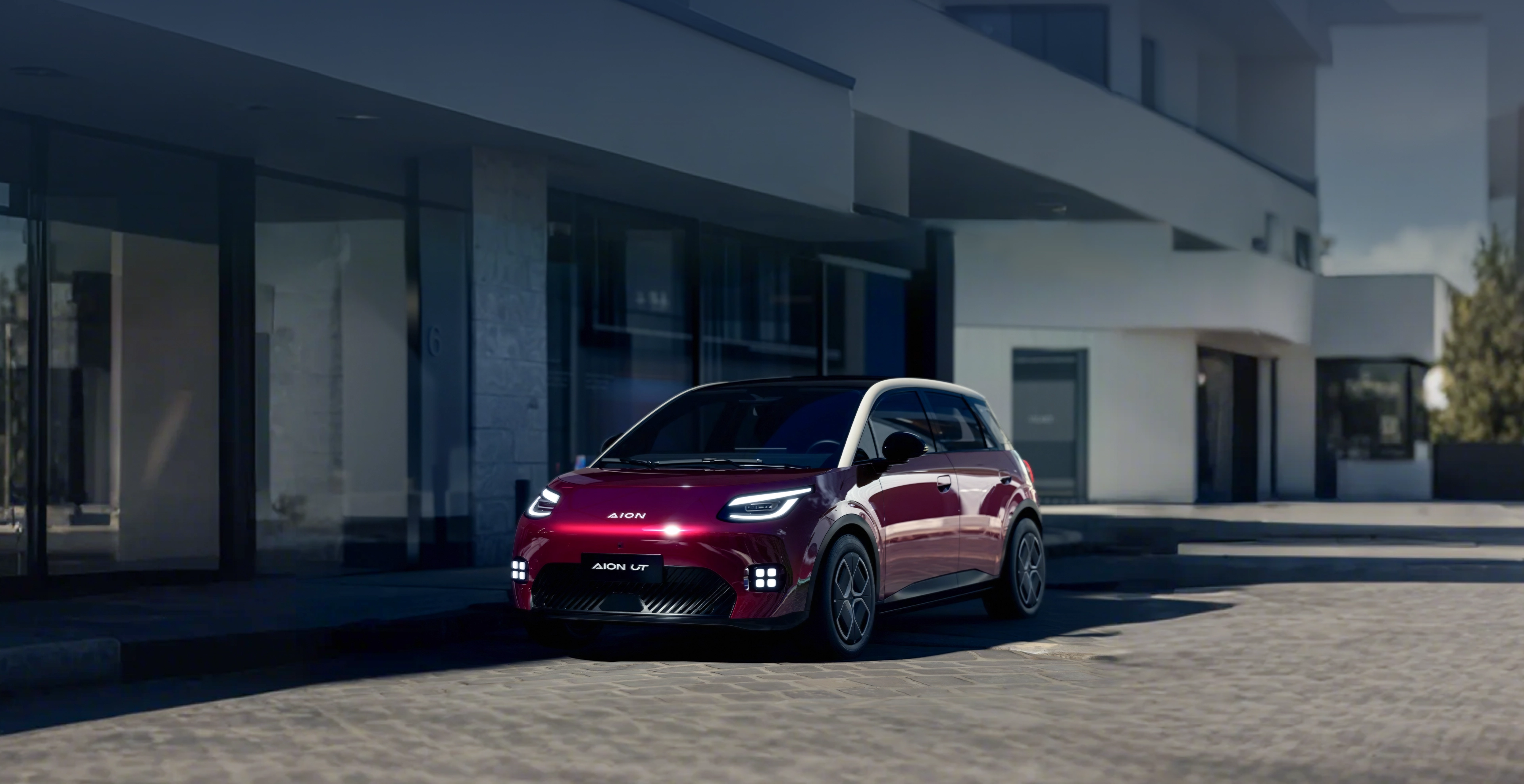
AION UT rear-seat suitability depends on the exact passengers and restraints, not simply the advertised five-seat layout. GAC's European specification lists ISOFIX/i-Size mounting points on the outer rear seats. [R1] That supports a useful starting layout for family assessment, but it does not certify three restraints across the bench. Our recommendation is to test the complete arrangement behind the usual front-seat positions, checking approved installation, buckle access, remaining adult space and everyday boarding before buying.
What do the available rear-space measurements establish?
GAC's global cabin overview quotes 905 mm rear legroom and a 1,385 mm rear-row width for the AION UT. The same article describes the rear accommodation in promotional terms, but does not explain the measurement positions or a repeatable comfort-test protocol. Treat those dimensions as manufacturer claims that help frame a showroom inspection, rather than proof of a particular occupant's experience. [R4]
Legroom can change with the front-seat position and the shape of the person sitting behind it. A width value also needs a reference point: shoulder space, cushion width and clearance between door trims are not interchangeable. Without that definition, dividing a cabin number by three is not a useful child-seat compatibility calculation.
The practical question is whether all users can sit correctly at once. Start with the tallest regular driver, the largest normal rear passenger and the bulkiest approved restraint that will be used. This gives the UT a realistic task and identifies compromises early. A second demonstration can then test the lighter arrangements used on other days.
The outer mounting points do not settle every installation question
For the European AION UT, the official equipment table identifies outer-rear child-seat mounting points. Confirm the delivered car's seating-position guidance in its own manual and use the restraint manufacturer's compatibility instructions. The presence of anchorages establishes a facility, not universal acceptance of every restraint, support leg or installation method. [R1][R7]
General NHTSA guidance stresses that restraint fit depends on both the child and vehicle and recommends testing the intended seat in the car. That fitting principle is useful here; US age rules or approval standards are not being substituted for the requirements of the buyer's European country. [R6]
Before a dealer visit, record the exact restraint name and version rather than only its brand. Bring the base and components used in normal installation. Ask a competent fitter to check questions that cannot be resolved from the manuals. This article does not supply a universal installation sequence because the permitted method belongs to the specific restraint and vehicle combination. A sound purchase decision needs that combination to work without improvised positioning.
Assess a rear-facing restraint together with the front passenger
An AION UT can look comfortable in separate front-seat and rear-seat demonstrations yet become less satisfactory when both are occupied together. A rear-facing child restraint makes this interaction particularly relevant because its shell occupies space in front of the rear seating position. The exact requirement depends on the approved installation and restraint design.
Install the intended restraint according to its instructions, then let the usual front passenger settle into a suitable position. Check whether the front passenger can sit naturally and whether the arrangement respects both manuals. Do not create an apparently successful fit by moving the front seat into a position that the adult could not reasonably use on normal journeys.
Repeat the exercise with the second driver if people regularly switch sides or share nursery duties. Consider the practical motion of placing a child into the seat while the car is parked. A restraint may fit correctly yet be awkward to reach in a narrow bay. Record the seating position and any constraint so that the household understands how the car will actually be used.
Two restraints and an adult require one combined demonstration
For an AION UT carrying two children and a third rear passenger, the centre space must be assessed with the restraints already installed. Trying the adult on an empty bench gives an incomplete answer. The restraint shells, belt access and the adult's shoulder position can all change the usable arrangement.
| Family arrangement | Demonstration to request | Decision point |
|---|---|---|
| One restraint and two adults | Seat all three rear occupants together | Natural posture and usable belts for each person |
| Two restraints and one adult | Fit both restraints before seating the adult | Centre access without moving either restraint improperly |
| Three restraints | Check all exact models and approved positions | No universal three-across claim is established here |
| One restraint and folded cargo section | Verify the remaining seat and load arrangement | Required installation remains possible and cargo is retained |
A configuration is not acceptable merely because the doors close. Each passenger needs the intended seating position and correct restraint or belt use. If the normal arrangement requires persistent awkwardness or uncertain compatibility, treat that as a reason to compare a different vehicle rather than searching for an optimistic width calculation.
Adult comfort involves support and movement as well as knee clearance
When assessing AION UT rear-seat comfort for adults, ask each person to sit for more than a quick photograph. Check where the cushion supports the thighs, whether feet can rest naturally and whether the person can change posture without immediately disturbing a neighbour. Long legs, a long torso and broad shoulders produce different needs even among adults of similar height.
A family test should also include the centre position if it will be used regularly. Do not assume that an acceptable outer seat establishes equivalent comfort across the whole row. The person who normally occupies the centre should try it with the adjacent passengers present and the relevant belts in use.
Consider journey duration honestly. An occasional short lift and a weekly intercity journey can justify different tolerance for limited movement. Avoid turning a brief successful sit into a universal long-distance comfort claim. Our assessment is that an adult seating decision becomes convincing when the same arrangement works in a demonstration drive of a useful length and remains acceptable to the passengers themselves, rather than only to the buyer sitting in front.
Door access can determine whether the rear seats are useful
Rear-seat space in the AION UT includes the route into the seat. An older passenger may care more about the movement needed to enter than about a few extra centimetres beside their knees. Someone managing a child may need room to bend and operate the restraint while standing beside the car. These tasks should be attempted where the vehicle will actually be parked if a dealer demonstration permits it.
At the showroom, ask the passenger to enter and leave independently at their normal pace. Observe whether the door can open far enough, whether the sill or roofline makes the movement awkward and whether the person can reach the belt once seated. These are assessment questions, not measured UT deficiencies or claims of universal ease.
Then repeat with a realistic restriction beside the car, without putting anyone at risk. A wide-open dealership door is a different situation from a home bay next to a wall. If boarding requires repositioning the car first, decide whether that routine is practical and safe for the household. Convenience that is lost at home cannot be recovered by a favourable specification sheet.
Read the AION UT safety record without confusing it with cabin fit
The current Euro NCAP assessment gives the AION UT five stars in 2026 and identifies the tested car as Premium, left-hand drive. Its four stage scores are Safe Driving 68%, Crash Avoidance 74%, Crash Protection 90% and Post Crash Safety 88%. The assessor reports strong child-dummy protection in the frontal-offset test, while also describing limits elsewhere in the assessment. [R3]
These results are relevant evidence about the assessed vehicle. They are not a measurement of rear-seat room and do not certify every aftermarket restraint combination. In particular, the 90% Crash Protection category should not be relabelled as a child-only score. The separate 91% frontal-impact subsection is not the overall category result.
Use the safety assessment and the fitting exercise as complementary checks. The assessment supplies an independent test record; the fitting exercise determines whether the household can use the delivered vehicle's seating and restraints as intended. A buyer should not trade one away because the other looks reassuring. Verify rating applicability and local equipment for the exact order, especially when a name or trim is used across several markets.
How to record a useful family seating test
A simple written record makes an AION UT visit more informative than a general impression of spaciousness. List the regular occupants, the exact restraints, the dealer car's trim and the positions used. Photograph the arrangement only where appropriate and without presenting the images as proof of an installation that has not been checked.
Record a clear outcome for each requirement: works as demonstrated, works with an acceptable compromise or needs resolution. Examples of meaningful compromises include moving a normally unused bag to the boot or changing an occasional passenger's position. Unresolved restraint compatibility, inaccessible buckles or an unsuitable driving position belong in the third category, not the second.
If comparing several cars, use the same sequence and equipment. Ask passengers the same questions immediately after each demonstration. This reduces the chance that a quieter showroom, a different front-seat setting or a more enthusiastic salesperson determines the result. Save the relevant instruction pages and written answers with the purchase paperwork so the final handover can be checked against the arrangement that persuaded the family.
Questions families ask about the AION UT rear seats
Can the AION UT take three child seats across?
This guide has not verified a three-across combination. The answer depends on the exact restraints, approved seating positions and installation instructions. Exterior width and a five-seat description do not establish that capability.
Does the UT's rear width prove three adults will be comfortable?
No. A manufacturer's dimension helps describe packaging, while comfort needs an assessment with the intended people. Shoulder contact, foot placement, support and journey length can be decisive even when nominal space appears adequate.
Can a family rely on the safety rating instead of a fitting appointment?
No. The rating and the installation question concern different evidence. A correctly selected and fitted restraint remains essential, and a qualified local fitter can help resolve compatibility questions.
What is the strongest reason to shortlist the UT for family seating?
A complete demonstration showing that the usual front occupants, rear passengers and approved restraints work together is stronger than a single headline measurement. Our judgment is to treat the UT as a candidate worth testing, then decide from the whole arrangement rather than from an assumed average family.
Sources & references
- [R1] AION UT European specification: Luxury and PremiumGAC Europe · Live regional specification reviewed 15 October 2026. URL year is not treated as the delivered vehicle model year; weight definitions differ from the French specification.
- [R3] AION UT 2026 safety assessmentEuro NCAP · Primary assessor record reviewed 15 October 2026. Tested vehicle AION UT Premium, left-hand drive. Current stage scores are 68/74/90/88.
- [R4] AION UT, Reviewed: manufacturer cabin overviewGAC Global · Manufacturer overview; rear-space dimensions lack a published measurement protocol in this article and are not independent comfort tests.
- [R6] Car seats and booster seats: selection and vehicle fitNHTSA · Primary safety guidance used for the general need to match restraint, child and vehicle; US legal requirements are not imported into Europe.
- [R7] European vehicle user-manual portalGAC Europe · Official portal lists AION UT. Obtain the document matching the delivered car; this guide does not claim to have inspected a VIN-specific manual.
This is a source-based editorial guide, not a first-hand road test. Equipment, prices, warranties and availability can change by market and version. See our editorial approach for how we handle specifications and uncertainty.