GAC reported 223,000 own-brand exports in January–October 2026, including 26,017 in October, up 80.8% year on year for that month. The export result sits alongside a more developed overseas operating network: local vehicle and battery production in Thailand, Austrian assembly, a European parts centre and local dealer coordination. The figures demonstrate reported export growth; the operating examples explain how the company is building the capacity to supply and support customers in its markets.
October gives the overseas growth story a completed-period result
The latest export update provides a concrete answer to the question about GAC's international sales momentum. In a release dated 5 November 2026, the company reported 223,000 own-brand exports during January–October and 26,017 in October alone. The October figure was 80.8% above the same month of the previous year.
The company-issued export release is the source of those numbers. PR Newswire distributes the statement; it should not be described as independently auditing the underlying vehicle count. The appropriate wording is therefore that GAC reported the result, with the original scope and period retained.
Own-brand exports are a defined part of the business. They are not automatically the same as all overseas customer deliveries, all joint-venture sales or all vehicles produced by the wider group. An export can occur before the eventual customer handover, while a locally assembled overseas vehicle may enter the market through a different route.
That definition does not diminish the achievement. It makes the growth measurable and allows the next report to be compared on a consistent basis. The GAC export-volume and operations guide supplies the detailed reporting background. This article follows the current result through the market network, production programmes and support functions that give it an operating context.
The September and October releases should be read as a dated sequence
In the 5 October Mexican international update, GAC reported 197,701 own-brand exports for January–September 2026, up 138.9% year on year. September contributed 25,693 vehicles. The update described September as the ninth consecutive month with year-on-year growth above 100%.
The subsequent November release used 223,000 for the January–October cumulative result and 26,017 for October. The figures are published at different levels of precision and are not accompanied by a reconciliation. An editor should retain the stated 223,000 rather than replace it with a number produced by adding the earlier cumulative total to the monthly figure.
| Reported period | Published export volume | Comparison |
|---|---|---|
| January–September 2026 | 197,701 | 138.9% year-on-year growth |
| September 2026 | 25,693 | Company describes continued strong monthly growth |
| January–October 2026 | 223,000 | Reported cumulative record |
| October 2026 | 26,017 | 80.8% year-on-year growth |
The sequence shows that the positive international story continued into the latest completed month. It also illustrates a useful reporting discipline: use the company's own labels and precision, and keep any editorial calculation separate from a disclosed official total.
Regional wholesale growth shows breadth without supplying regional totals
The November statement reports October wholesale increases of 547% in Europe, 49% in Southeast Asia and 95% in the Americas, each measured year on year. It also reports 307% growth in Africa and 273% in the CIS. These percentages indicate broad geographic momentum, but they do not reveal the absolute number of vehicles sold in each region.
A high percentage can arise from rapid expansion from a smaller base, while a lower percentage in a larger market may still represent substantial additional volume. The release does not provide enough regional totals to rank those contributions by units. It is therefore more accurate to describe the breadth of reported growth than to infer that the highest percentage represents the largest market.
The country examples also preserve their own comparison periods. Within the Americas, GAC reports year-on-year increases of 331% in Colombia, 232% in Bolivia and 223% in Brazil. In the Middle East, the UAE figure is 41% year on year, whereas Kuwait's 146% is month on month. The two should not be placed in one undifferentiated growth league table.
These details give the international result more substance than one global headline. They identify where the company reports momentum and make it possible to ask more precise questions in future updates: the local base, the relevant models and whether the growth persists over several reporting periods.
A distributor shipment can precede the customer's registration or handover. To judge how quickly exported vehicles are reaching end users, a market assessment would therefore pair wholesale data with local registrations, delivery reporting and inventory information where available. The regional growth rates demonstrate a stronger supply flow during the stated period. They do not, by themselves, establish that every destination has sold through its inventory at the same pace or achieved the same level of repeat demand.
Market reach now includes production, parts and combined sales-service locations
The October update describes GAC's presence in 118 countries and regions, with more than 796 combined sales-and-service points, seven production plants outside China and nine international parts warehouses. Each category serves a different function in the vehicle's route to the customer.
A sales location can help a customer inspect, order and receive a car. A service function supports maintenance or repair. A parts warehouse supplies an inventory and distribution role. A production operation establishes another source of vehicles or components. Their relevance lies in how they connect, rather than in treating all locations as equivalent evidence of market maturity.
The combined 796-point measure should retain its original sales-and-service wording. It does not establish 796 fully equipped repair workshops. Similarly, the plant count does not disclose the output, ownership structure or model mix at every facility. These are footprint measures, not a complete account of operating performance.
The GAC international operations review explains some of the named facilities behind that footprint. For a buyer, the most important connection is local: which organisation sells and supports the car, which terms apply and which production or parts route serves that market. A global network becomes meaningful when those functions reach the actual ownership experience.
Guyana marks geographic completion of a stated South American footprint
The November export release identifies GAC's entry into Guyana and says it completed the company's coverage of all twelve South American countries. This is a specific market-entry milestone, separate from the percentage growth reported for Brazil, Colombia and Bolivia.
The distinction is useful because entering a market and expanding an established market are different tasks. Entry establishes an initial commercial presence and the relationships needed to introduce products. Expansion concerns the performance of an operation that already exists. A geographic completion statement should not be interpreted as evidence that every country has the same sales volume or service density.
It also belongs to the November release. The 118-country-and-region figure comes from the October update, so the two should not be mechanically combined into an invented revised total. A future company disclosure can provide an updated count on its own stated basis.
For the overseas-growth story, Guyana adds breadth. The other South American disclosures add reported momentum in named countries. The next useful evidence would be local model introductions, delivery volumes and support arrangements that show how the new presence develops. That allows the milestone to receive appropriate credit while leaving its commercial depth to be demonstrated through subsequent operating results.
Mexico supplies a local history behind the global expansion
GAC began operations in Mexico in November 2023. The October 2026 update reports 16,500 vehicles commercialised there through August 2026. This is a cumulative local statement spanning the market's operating history, not Mexico's contribution to October's global export number.
The same account describes the introduction of the GS7 PHEV as the brand's first plug-in-hybrid SUV in the country and the presentation of the GS4 REEV. At an August event at Estadio Nemesio Díez, the company brought together dealers, media and customers around these product developments. That gives the commercial story a local product and distribution context.
The significance is that international development involves adapting the offer available to a market, not simply sending an unchanged vehicle list everywhere. Different powertrain propositions create different customer questions about charging, fuel use, range and support. A local introduction is the point at which those questions must be answered for the actual specification and terms.
The Mexican customer total and product events therefore provide useful depth alongside the global export figure. They show an operation with a start date, an accumulated commercial record and an evolving product offer. They do not prove that a particular launch caused the overall export increase; that causal claim would require model and market data beyond the release.
Thailand connects customer deliveries with local vehicle production
The May 2026 GAC Thailand announcement records 30,000 cumulative AION deliveries since September 2023. A local delivery total is a different measure from exports, but it shows that the Thai operation has moved beyond initial product introduction to a substantial customer base.
The market also has local vehicle manufacturing. That gives the international business a supply function within the region rather than relying only on imported finished vehicles. Production and delivery should still be counted separately: a completed car at a factory is not automatically a retail handover, and cumulative deliveries do not reveal the output of one plant in a particular month.
The later October 2026 Thai battery-plant report describes 64 authorised service centres and a combined charging network of 293 stations. It separates eighteen directly operated stations from 275 partner stations and reports 1,388 DC charging points across that network. These distinctions show how a service footprint can involve both the company's own operations and partners.
For an EV customer, manufacturing, charging and service address different ownership needs. Their presence together gives the Thai international-growth story operational depth. The figures remain a dated Thai account, however; they should not be transferred to another country or described as a uniform global service guarantee.
The new Thai battery-pack plant deepens the regional supply chain
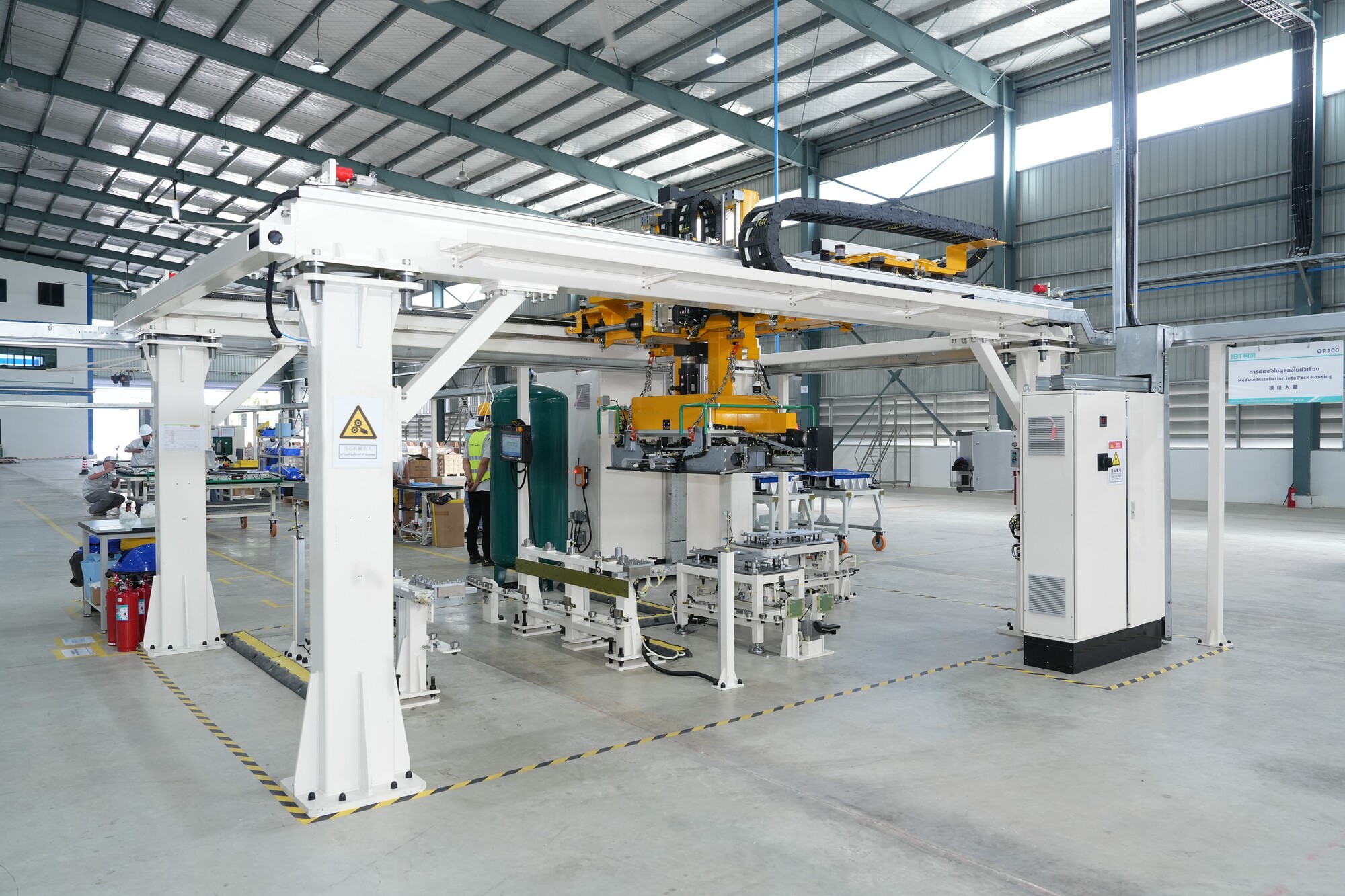
GAC's November report on the Chonburi factory records the opening and first pack roll-off on 29 October 2026. The operation initially supports local AION Y Plus production. It adds battery-pack assembly to a regional manufacturing programme that already serves vehicles and customers.
This is significant because the battery pack is a major vehicle system with its own components, assembly and validation requirements. Establishing an operation near the vehicle programme can change how that system is supplied and coordinated. The announcement provides evidence of the industrial step, not a quantified claim that every customer will immediately see a lower price or shorter waiting time.
The disclosed first-phase capacity plan is 7,000 packs a year, with a potential second phase of 20,000 after expansion and ramp-up. Capacity describes what an operating arrangement is designed to support. Actual output describes the number completed during a period. The first pack and opening are achieved milestones; full utilisation remains a subsequent operating question.
The GAC overseas technology and manufacturing analysis examines the technical significance of local battery and vehicle work. Within the export story, the plant demonstrates that international development is becoming more industrially embedded. It complements the reported shipment growth without being added to the export total as if both were the same measure.
Austria shows another route to overseas industrial capability
GAC's March 2026 Austrian production report records the AION UT start-of-production and roll-off event at Magna's facility on 18 March. The programme follows the AION V's European development and supplies a named example of local assembly through an established manufacturing partner.
A partner-assembly model differs from opening an entirely owned plant. It can still establish production within the target region, while drawing on the partner's facilities and expertise. The correct description preserves that arrangement rather than presenting every overseas manufacturing programme as identical.
For the international product offer, a second named AION model also broadens the vehicles available to address customer needs. A hatchback and an SUV can appeal to different household sizes, parking constraints and purchase priorities. That is an explanation of the commercial role of a wider range, not proof that one model alone caused Europe's reported 547% wholesale increase.
The event therefore contributes a concrete production milestone to the European growth story. The next useful measures are model deliveries, production output and the service support accompanying the cars. The AION UT passenger-space analysis examines the product proposition separately, allowing the industrial account and the actual vehicle attributes to be evaluated on their own evidence.
European parts and CARE+ connect expansion with continued ownership
The Rotterdam parts-centre announcement records the opening of GAC's first European spare-parts distribution centre and its first truck shipment on 5 September 2025. This adds a support function behind vehicle sales and local assembly, addressing the period when customers need maintenance or repair.
The October 2026 Paris announcement then describes the European CARE+ framework, including roadside assistance with Allianz and stated parts and maintenance-response measures. It reports parts fulfilment above 95%, average shipment within 36 hours and a maintenance-response commitment within 48 hours.
Those measures refer to different stages. Parts fulfilment concerns whether requirements can be supplied, shipment timing concerns movement after an order process, and a maintenance-response commitment is not the same as a guarantee that every repair is completed within that time. Reading the original terms prevents a useful service disclosure from becoming an unrealistic universal promise.
For international growth, this matters because a new-car delivery starts an ongoing relationship. A customer may reasonably consider the support system when choosing an unfamiliar brand. The dealer, parts and local-contact guide explains that relationship in practical terms. The European disclosures show named operational steps behind the ownership proposition, complementing the export and production milestones.
Philippine direct operations organise several brands around the local network
The January 2026 Philippine announcement describes strengthened direct operations and coordination across GAC MOTOR, AION and HYPTEC. It links the organisational structure with dealer support and local warehousing, while describing continuity for authorised dealers and existing customer arrangements.
A direct local organisation can provide a defined counterpart for product information, supply coordination and support. This becomes especially relevant when several brands and powertrains are offered through the market. The statement establishes the intended operating structure; it does not independently measure an improvement at every dealership.
A March report on the Manila dealer conference adds an implementation example. Thirty core dealers participated in the event held on 27 February, covering product, marketing, network and after-sales development. Attendance is evidence of coordination with a dealer group, not the opening of thirty new dealerships on that date.
This organisational work is less dramatic than a monthly growth percentage but helps explain how a market offer is maintained. International expansion requires local teams and dealers to understand the products and the support responsibilities. The Philippine account therefore adds a different kind of operating depth to the broader story: not just where vehicles are sold, but how the local business is being organised.
The next useful measures will connect volume with sustained local performance
The current evidence supports a positive conclusion: GAC reports strong own-brand export growth and can identify completed overseas production, distribution and service developments. The global figures establish commercial momentum; the country examples show different ways the operating base is becoming more substantial.
The measures should continue to be followed separately. Export volume tracks a shipment-related commercial flow. Country deliveries track customer handovers. Factory output tracks completed production. Parts and service measures track support performance. A strong international business needs these functions to work together, but combining their counts would obscure rather than explain progress.
GAC's longer-term goals, including a target of one million annual sales outside China by 2030, remain ambitions rather than current results. The present assessment does not need them to be treated as achieved. The reported October performance and named operating milestones already give the growth account substance.
For customers, the practical endpoint is the local car and its support route. The CARE and CARE+ service guide and international operations analysis provide useful companions to the volume figures. Read together, they explain both the scale of reported growth and the functions that must make that growth durable in everyday ownership.
Sources & references
- [A12_S1] GAC Exports 223,000 Units in Jan–Oct, Setting a New RecordGAC, distributed by PR Newswire · 5 November 2026; company export release; regional percentages concern wholesale volume.
- [A12_S2] GAC Group accelerates global growth and strengthens its Mexican presenceGAC Mexico · 5 October 2026; January–September exports, dated global footprint, Mexican cumulative sales and product introductions.
- [A12_S3] GAC AION Thailand reaches 30,000 deliveriesGAC Thailand · 29 May 2026; cumulative Thai deliveries since September 2023 and local manufacturing and service operations.
- [A12_S4] GAC opens its first overseas battery PACK plantGAC Group · 3 November 2026 report of 29 October opening in Chonburi, Thailand; capacity figures are plans.
- [A12_S5] GAC Marks SOP and AION UT Roll-Off in AustriaGAC Global · 25 March 2026 report of 18 March production start with Magna in Austria.
- [A12_S6] GAC inaugurates its first European spare-parts distribution centreGAC Europe · 8 September 2025 report of 5 September Rotterdam opening and first shipment.
- [A12_S7] GAC International Philippines strengthens direct operationsGAC Philippines · 26 January 2026; direct operations, unified brands, dealer support and local warehousing.
- [A12_S8] GAC Philippines advances One GAC 2.0 through three strategic movesGAC Global · 26 March 2026 report of 27 February Manila conference involving 30 core dealers.
- [A12_S9] AION UT Cross debuts at the 2026 Paris Motor ShowGAC Global · 13 October 2026; European product presentation and CARE+ service framework.
- [A12_S10] GAC Thailand opens its first overseas battery plantGAC Thailand · 29 October 2026; local battery production, service infrastructure and charging network.
This is a source-based editorial guide, not a first-hand road test. Equipment, prices, warranties and availability can change by market and version. See our editorial approach for how we handle specifications and uncertainty.