GAC’s core technology becomes tangible when named engineering programmes are connected with actual applications. ADiMOTION range extension is documented in launched HYPTEC HL and AION i60 vehicles, while the wider intelligent-technology programme spans Sky, Robot, Home and Vehicle. Overseas, the October 2026 Thai battery-pack opening and Austrian AION V/AION UT production provide concrete industrial milestones. These projects show different forms of technology deployment; they do not imply that every GAC model uses the same powertrain or software.
1. The October battery-pack opening shows what technology overseas means
On 29 October 2026, GAC held the opening and first-pack ceremony for its Inpai battery-pack factory in Chonburi, Thailand. The official report published on 3 November identifies it as GAC’s first overseas self-owned pack factory and says its initial work supports locally manufactured AION Y Plus vehicles. This is a specific addition to the regional production chain, not simply another country in an export list.
The distinction is useful when assessing core technology. Selling an electric car overseas demonstrates a market activity. Producing a battery pack locally demonstrates a defined manufacturing operation. The two can support each other, but they answer different questions. A local pack operation has to organise components, build to a controlled specification and verify the assembled system before it enters the vehicle-production flow.
A pack is also not the same industrial product as a battery cell. Cell production concerns electrochemical manufacture; pack production integrates cells or modules with the structures, connections and control interfaces required by the application. The announcement should therefore not be expanded into a claim that this Thai plant manufactures every battery material or cell locally. Its actual scope is sufficiently important: a core electric-vehicle assembly process has been established near the vehicle operation.
The technology-overseas milestone guide explains this progression from exported product to local industrial capability. The Chonburi opening offers a timely example of that progression, and the Austrian vehicle programme offers a second model based on a specialist manufacturing partner. Together they allow a practical assessment of how GAC turns research and engineering into products outside its home market.
2. AION Y Plus identifies where the new pack operation enters the production chain
The October 2026 pack-factory announcement identifies AION Y Plus manufacturing in Thailand as its initial support programme. That model reference matters. It connects a new industrial site with a defined product application, rather than leaving the reader with a factory opening and no explanation of how the output will be used.
A battery pack sits at the interface between component production and vehicle integration. The assembly must correspond to the vehicle's physical installation, electrical connections and control requirements. Manufacturing it locally therefore involves more than relocating a generic box-making operation. The production organisation must preserve the intended product definition and verify that its output is suitable for the supported application.
The local interface also creates a practical subject for cooperation between teams. Vehicle production can communicate its requirements to a component operation working within the same national programme. When a production change or an unusual condition occurs, the pack and vehicle teams need a compatible understanding of the affected product. This is a mechanism through which local manufacturing can deepen technical capability; it is not a disclosed numerical reduction in delivery time or warranty claims.
The announced initial application should also remain distinct from the origin of every retail vehicle. The release does not establish that all Thai AION models immediately adopted a locally made pack or that every Y Plus already in customer use was built with one. It establishes the factory's first industrial purpose. That is a concrete and useful milestone: overseas vehicle assembly is being supported by a named local component programme, with the technical interface anchored to an identifiable model.
3. ADiMOTION shows why technology must be matched to its actual application
GAC’s 2026 English technology release identifies ADiMOTION Power as a family comprising range extension, PHEV and HEV+. The 2025 annual-results announcement, printed page 25, confirms that HYPTEC HL and AION i60 were launched with ADiMOTION range-extension technology. These are named product applications, giving the energy programme a firmer basis than a generic assertion of “advanced hybrid technology.”
The Thai pack project is a different application: its initial customer is the battery-electric AION Y Plus. It would be incorrect to describe that car or the pack factory as an ADiMOTION hybrid installation merely because both belong to GAC’s technology portfolio. The connection lies in the company’s energy-system and industrial capabilities, not in pretending that all powertrains are the same.
The April 2026 ADiMOTION programme account describes powertrain hardware and energy management, including a 5.4kWh HEV+ battery. A battery pack for a full electric car has a different role and scale from a hybrid buffer battery. Engineering value comes from matching storage, power delivery, thermal control and software to the intended use, then reproducing that design through a controlled manufacturing process.
Capacity figures must likewise remain attached to the right operation. The Thai first phase is planned for 7,000 packs per year; the announced expansion provision is not evidence of current production volume. Our ADiMOTION energy-control analysis focuses on how the powertrain manages energy, while the factory evidence here explains how a separate battery application is assembled locally. The distinction preserves both the technical detail and the real industrial achievement.
4. The Thai programme developed in stages, with different sites doing different work
The battery-pack opening makes more sense when placed after the vehicle-factory milestone. In its 17 July 2024 opening report, industrial-estate operator AMATA described AION's vehicle facility at AMATA City Rayong. It reported an approximately 85,000-square-metre operation and investment of roughly 2.3 billion baht. The pack event in 2026 concerns Chonburi, a different location and a different output.
This sequence shows a developing industrial network. Vehicle production establishes a local place where components become finished cars. A subsequent pack operation brings an additional major assembly into the national manufacturing programme. The relationship is broader than continuing to import complete vehicles, while remaining compatible with an international supply chain for other parts and materials.
AMATA reported 45% local component sourcing at the 2024 opening. The date is part of the fact: it should not be silently converted into a verified 2026 percentage. More useful than projecting the number forward is recognising what it measures. Local sourcing concerns the component base, whereas plant capacity concerns the possible production volume and a pack-factory opening concerns a new manufacturing responsibility. These measures describe related but different dimensions of localisation.
The report also places the vehicle plant within a right-hand-drive market strategy. That connects the industrial investment with the specification of the vehicles it is meant to supply. The intelligent-manufacturing analysis explores the relationship between product requirements and production methods. Thailand provides a named example in which location, market configuration, component sourcing and assembly develop together over time.
5. The overseas manufacturing record includes inspection and energy systems
GAC's 2024 sustainability report, published in April 2025, adds technical detail to the Thai manufacturing story. It describes the programme through a semi-knocked-down assembly arrangement using a leased facility. It also names machine vision combined with AI, ultrasonic flaw detection and three-dimensional visual tracking among the quality-monitoring methods. These are identifiable processes, rather than a claim based only on the appearance of a modern factory.
The methods reveal different ways of making production conditions observable. A camera-based system evaluates visual information. Ultrasonic inspection uses sound to examine relevant material or joint conditions. Three-dimensional tracking concerns spatial position or movement. Their functions should be understood separately, because a method suited to one kind of observation does not automatically replace the others.
For a production team, the useful question is how the observation enters a decision. An image or measurement needs a defined subject, an acceptable condition and a response when the result requires attention. That is the difference between possessing inspection equipment and operating a controlled inspection process. The filing identifies the technologies, although it does not provide a workstation-by-workstation method or a current defect-rate calculation.
The report also describes an integrated energy arrangement involving solar generation, storage, charging and battery swapping. This extends the technical programme beyond the product being assembled. Generation supplies electricity; storage changes when some energy can be used; charging and swapping connect energy infrastructure with vehicle applications. Coordinating them is an operating task in its own right.
These details support a substantive account of technology overseas: production methods, observation tools and energy infrastructure accompany the vehicle programme. They should not be turned into an unsupported assertion that every factory output is carbon-free. Their contribution is more specific and more useful. They show that the published localisation record concerns how production works and how its supporting systems are organised, rather than only the nationality of the assembly address.
6. Local technical capability depends on people who can sustain the process
A factory launch is a milestone, but sustained production requires people who can operate and maintain the methods after the launch team leaves. The sustainability report identifies a new-energy-vehicle training base involving Thailand's Rajamangala University of Technology Isan and other partners. The 2026 pack-factory announcement also discusses local talent and team development. Together, they provide an institutional basis for the human side of GAC's Thai localisation.
That matters particularly when a programme expands from vehicle assembly into another component responsibility. Employees need a shared understanding of the product, the work sequence and the conditions requiring escalation. Technical capability includes knowing when an operation is normal, how to record an unusual condition and which team is responsible for the response. It is not exhausted by learning to start and stop a machine.
A training partnership can also connect recruitment with the longer-term development of the operation. New employees require an entry route, while experienced staff may need to learn revised processes or additional technical responsibilities. The published arrangement establishes that training forms part of the programme. It does not disclose a complete graduate count or demonstrate that every future staffing requirement has been met.
The GAC Toyota process-quality study provides another example of why industrial learning and people belong together. The projects are separate, but the underlying point applies in both: a production method becomes a durable capability when the local organisation can use it, explain it and improve it. That is a practical meaning of technical localisation beyond installing imported equipment.
7. Magna gives the European programme a different route to industrialisation
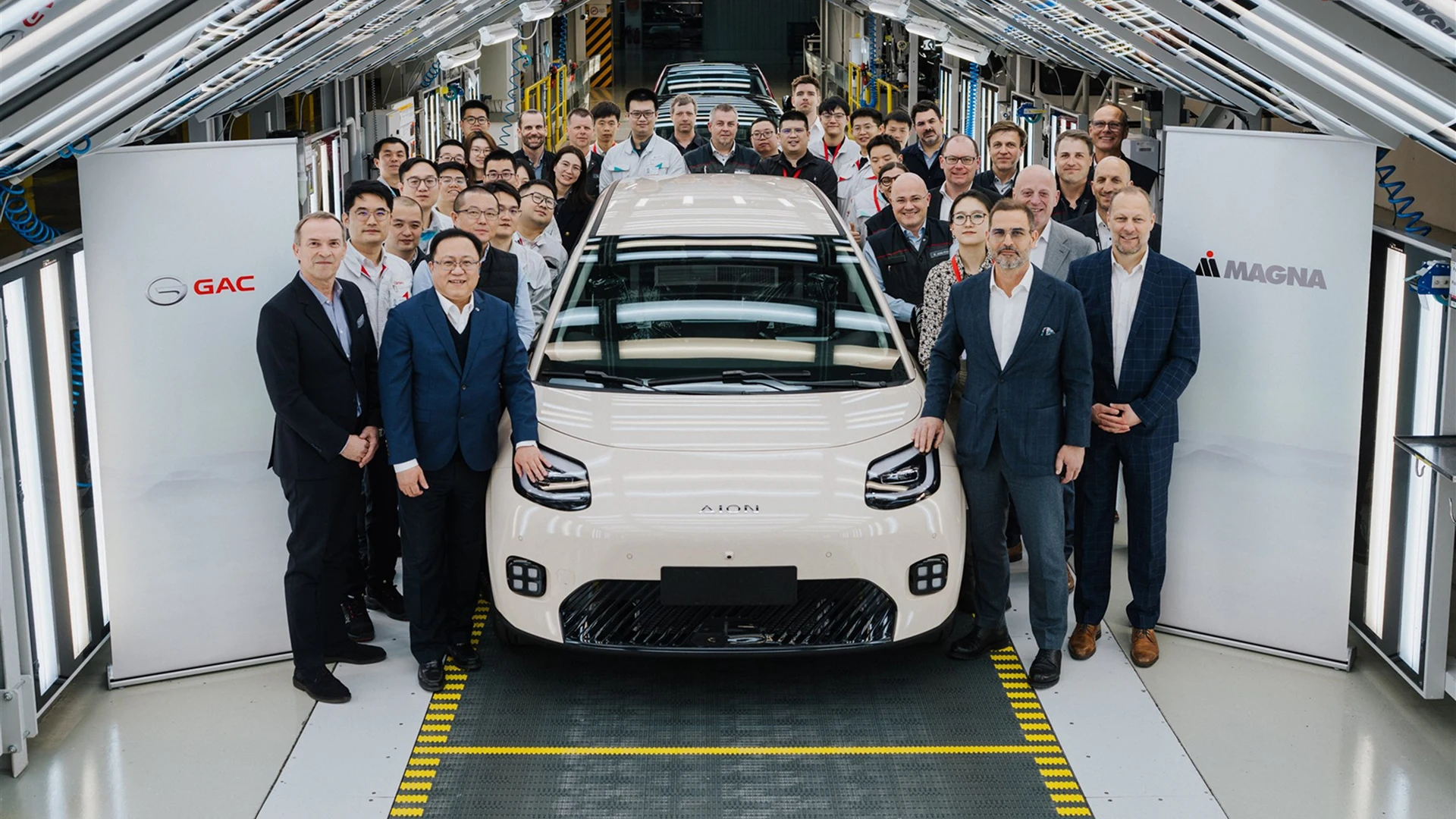
In Europe, the relevant milestone is GAC and Magna's November 2025 joint production announcement. It confirmed that AION V serial production was underway in Graz, Austria. This is evidence of an operating vehicle programme with a manufacturing partner, rather than only an intention to establish European production later.
The operating model differs from the new Thai pack site. GAC contributes the vehicle programme, while Magna supplies an established production organisation within which that programme must be industrialised. Product definition and manufacturing execution meet through the work needed to build the specified vehicle consistently. A contract-manufacturing arrangement does not remove the engineering interface; it gives that interface a particular organisational form.
Magna describes Graz as capable of producing combustion, hybrid and electric vehicles on shared lines. That experience is relevant to accommodating different product requirements within a controlled production environment. It does not identify every detailed preparation required for AION V, but it helps explain why the partnership is about manufacturing capability rather than simply renting floor space.
For the technology question, the concrete result is that GAC's electric-vehicle programme has entered a named European production system. The European local-engineering article examines the broader relationship between a product and the organisation making it. The Graz milestone complements the Thai component story: one develops local pack production, while the other uses an experienced partner to assemble a finished vehicle. Both demonstrate technical work taking place overseas, with different scopes and responsibilities.
8. AION UT adds a design-to-production example to the European record
The later AION UT programme makes the European development chain more visible. GAC's March 2026 announcement reported a start-of-production event held on 18 March in Austria. It linked the vehicle with GAC's Milan design team and Magna manufacturing, bringing design and industrial execution into the same account.
That combination is relevant because localisation includes more than the place where parts are assembled. Design work interprets the intended product and its users. Manufacturing work turns the chosen definition into a repeatable physical vehicle. The presence of both roles gives the European programme a clearer structure than a general statement that GAC is expanding internationally.
The release also attached concrete product information to the programme: a 2,750 mm wheelbase and an advertised European range of up to 430 km under WLTP. These are programme-specific claims with a named test cycle, not values to transfer automatically to every version sold elsewhere. They connect the industrial story with the packaging and operating information a European customer would actually consider.
The AION UT passenger and luggage analysis follows that customer-facing side. A family evaluates the resulting space, access and usable configuration, while the manufacturing story explains how the product reaches that market. Taken together with AION V production, the UT event shows continuing activity within the European partnership. It is a second named model milestone and a specific example of design, electric-vehicle engineering and overseas assembly working in one programme.
9. The four AI scenarios explain the broader technology behind the industrial story
GAC’s Hong Kong technology announcement explicitly names four scenarios: Sky, Robot, Home and Vehicle. The labels describe applications for intelligent systems rather than four features fitted to every car. GOVY AirCab represents the low-altitude mobility programme; GoMate represents embodied robotics; GoSide and GoMove illustrate companion and practical assistance; ADiGO and X-SOUL support intelligent-vehicle interaction and electronics.
| Technology area | Concrete example | Connection with industrial capability |
|---|---|---|
| ADiMOTION energy systems | Named range-extension applications and announced hybrid programmes | Hardware, control software and application engineering |
| Sky | GOVY AirCab public demonstration | Energy, controls and physical-system development in a different mobility setting |
| Robot and Home | GoMate, GoSide and GoMove demonstrations | Perception, interaction and controlled movement |
| Vehicle | ADiGO and X-SOUL | Functions supported by a coordinated electronic architecture |
| Overseas manufacturing | Chonburi packs and Graz vehicles | Application of product definitions and production methods in local operations |
The table is a capability map, not a claim that the robots have been installed at the Thai pack plant or that GOVY aviation systems are used in AION UT. No such deployment is established by the cited factory releases. The useful connection is methodological: sensing, control, energy management and repeatable production are different engineering disciplines that have to cooperate in a finished system.
The four-scenario AI analysis examines those demonstrations in detail. For an overseas vehicle customer, the most immediately relevant evidence remains the specified car, the local manufacturing arrangement and the supporting service capability. The wider AI programme explains the research direction; it does not replace evidence about the actual product being sold.
10. Thailand and Austria demonstrate different ways to make technology usable locally
The Thai and Austrian cases make a useful comparison. Chonburi adds a battery-pack operation near an existing vehicle-manufacturing base. Graz uses Magna’s established vehicle-assembly expertise, with AION V serial production confirmed in the November 2025 joint announcement. The March 2026 AION UT announcement adds a second locally assembled model and identifies Milan design work.
These are distinct routes to regional capability. A component operation brings a specific part of the value chain closer to vehicle production. A contract-assembly partnership connects a product programme with an experienced local manufacturing organisation. Neither route requires every component to be locally sourced before it becomes meaningful. Both require clear product requirements, controlled production steps and effective communication when a part or process changes.
The potential customer benefits follow from those mechanisms: a more direct connection between design, production and regional requirements; local people who understand the product; and an industrial organisation able to respond to changes. Actual delivery speed, repair performance and long-term reliability must be judged from operating evidence as it accumulates. A factory ceremony establishes a milestone, while sustained output establishes what the operation can deliver over time.
The overall answer to the technology question is therefore concrete. ADiMOTION names GAC’s energy-system development, Sky–Robot–Home–Vehicle describes its wider intelligent-application programme, and the Thai and Austrian projects demonstrate technology deployment overseas. The guide to energy, intelligence and local production connects these layers. Their combined value is the ability to move from a technical concept toward an application that can be manufactured and supported in a defined market.
Sources & references
- [S1] 广汽首个海外自主PACK工厂正式投产GAC Group · Published 3 November 2026, reporting the 29 October opening in Chonburi. The 7,000/20,000 figures are planned annual capacities, not realised output.
- [S2] GAC Accelerates European EV Strategy with Magna Vehicle Assembly ProgramMagna and GAC · 21 November 2025 joint release confirming AION V serial production at Graz.
- [S3] GAC Marks SOP and AION UT Roll-Off in Austria, Advancing European Localized Cooperation with MagnaGAC Global · 25 March 2026 release reporting 18 March start of production; Milan design and Austrian assembly.
- [S4] GAC AION inaugurates new smart factory at AMATA City RayongAMATA Corporation · 17 July 2024; industrial-estate operator account of the Thai vehicle plant, area and local component sourcing at opening.
- [S5] GAC Group 2024 Sustainability ReportGAC Group / Hong Kong Exchanges and Clearing · Published 25 April 2025; Thailand SKD manufacturing, inspection technology and local training partnership, pp 68–69 context.
- [S6] GAC Thailand third-anniversary reviewGAC Thailand · 9 September 2026; dated local market, product and service development account.
- [S7] GAC introduces ADiMOTION PowerGAC Group · 13 April2026: PHEV and HEV+ engineering programmes.
- [S8] GAC 2025 annual results confirm ADiMOTION production applicationsGuangzhou Automobile Group via HKEX · 27 March2026, printed p25: HYPTEC HL and AION i60 launched with ADiMOTION range-extension technology.
- [S9] GAC describes Sky, Robot, Home and VehicleGAC Hong Kong · 12 June2025: four AI scenarios, GOVY and GoMate demonstrations, and global manufacturing-system deployment.
- [S10] GAC Tech Day 2026 introduces five technology programmesGAC via PR Newswire · 17 April2026: official English terms for ADiMOTION, ADiGO and X-SOUL.
This is a source-based editorial guide, not a first-hand road test. Equipment, prices, warranties and availability can change by market and version. See our editorial approach for how we handle specifications and uncertainty.