GAC and Toyota have built cars together in Guangzhou for 20 years. Their equally owned vehicle joint venture was established in September 2004 and began Camry production in Nansha in May 2006. Two parts of the relationship are visible on the factory floor. Quality manufacturing means detecting abnormalities as each vehicle is built. Smart manufacturing means using production data and flexible equipment to carry those standards across different models. A 2024 quality and technology exhibition, the third-line opening record and the ten-millionth vehicle in 2026 show how that combination developed. Toyota’s joint venture announcement · Toyota’s first Camry production release · Guangzhou Science and Technology Bureau production milestone
The exhibition is a way into a specific industrial history. In August 2024, local coverage documented the Wuhan opening of a travelling GAC Toyota quality and technology display. In November that year, GAC Toyota held its twentieth-anniversary conference in Guangzhou. The August event explained what buyers rarely see underneath the paint and trim. The November event marked two decades since the company was formed. By May 2026 the production relationship itself had reached 20 years. The distinction helps put the original photographs, factory reports and later electric cars in order. Wuhan exhibition coverage, 5 August 2024 · GAC Group development history
20 years of joint-venture cooperation began with a named factory
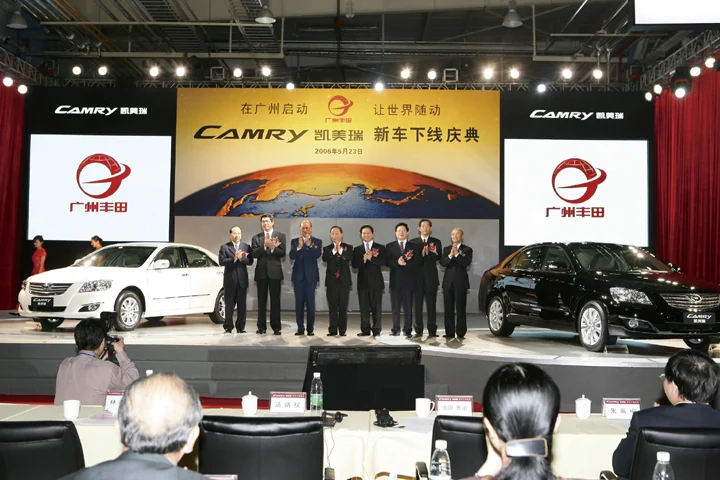
The opening record gives the partnership a precise starting point. Toyota and Guangzhou Automobile established a jointly owned Toyota vehicle production and sales company on 1 September 2004. Toyota’s announcement put its initial planned capacity at 100,000 vehicles a year and identified the Camry as the first product. The Camry announcement on 23 May 2006 records the actual beginning of production in Nansha. A business formation document and a production ceremony answer different questions, and each date deserves to stay attached to its event. Toyota, 2004 formation statement · Toyota, 2006 Camry line-off statement
The launch photograph captures a finished product and the people who assembled a manufacturing operation around it. A shared plant creates a lasting engineering relationship because every model change has to be translated into factory instructions, incoming parts and a releasable car. When Toyota later reported the millionth vehicle in August 2011, it also identified the Yaris, the Highlander on a second line and the Camry Hybrid as stages of that expansion. The figures describe the output of the joint venture. The accompanying model and line history shows what the partnership was learning to build. Toyota, cumulative production reaches one million
A useful order in which to view the exhibits is to start at the Camry, move to parts and inspections, then look at the different kinds of products the location can accommodate. That puts the longevity claim alongside two tangible questions. Where is quality measured when a panel, fastener or electronic component changes? What makes a line adaptable enough to keep building the existing model while it prepares a newer one? Those questions are relevant to both a conventional sedan and a modern battery-electric car.
Quality manufacturing means finding variation where it begins
An assembled vehicle is a poor place to discover a problem that was visible several stations earlier. A large steel panel has to fit with consistent geometry before welding. Welding then joins that panel to other parts at controlled locations. Paint accumulates on that finished shape, and assembly places closures, trim and equipment over it. Variation at the start can appear later as a door alignment or finish concern. People at the later station can see the symptom, while measurements near the source can make the cause easier to investigate.
The Wuhan coverage described display material on in-house stamping, robotic welding, paint finishing and assembly checks. These are four useful places to look for the meaning of quality manufacturing. A pressed panel reflects the tool, the material and the setup. A body joining station must bring the right surfaces into alignment before joining them. Paint quality depends on preparation and deposition as well as final inspection. Checks during assembly tell the operator where an omission or abnormal result was found. The published display is evidence of what was presented at Wuhan in 2024, with supporting production-system context from Toyota. Rednet, the Wuhan quality and technology exhibition · Toyota Production System
Think of a closure that takes additional force to latch. A finished-car check can observe the force and confirm that something warrants attention. Earlier records can help distinguish a panel that shifted, a fixture adjustment and a later assembly setting. Each possibility has a different remedy. Treating the issue as a single arbitrary failure at the end of the line would give the team less information. The value of collecting observations at several steps is that the inspection record can lead back to a process that people can change.
What the show floor illustrates about manufacturing discipline
Toyota’s description of jidoka explains how an industrial system responds to abnormal work. An operator or a machine can detect a problem and stop its progression so people can find the cause. Just-in-Time coordinates the timing and quantity of work between processes. That means a station needs both the correct specification for the vehicle in front of it and parts supplied in the right order. Viewed together, the two concepts explain why a quality display includes human decisions, material flow and machinery. Toyota, the two pillars of its production system
In a display about final assembly, the natural question is what the station can record. A tightening tool can return a process result, and identification of the part or fastener can attach that result to the correct operation. A discrepancy can then have a particular location for a technician to inspect. The Wuhan exhibition’s coverage described assembly monitoring for omissions and incorrect fitting. That is a useful example of moving a check close to the action that creates the risk. Each installation still needs its own procedure, calibration and documented response. Wuhan exhibition coverage, assembly section
Paint provides a complementary example. A viewer might notice colour or surface finish from a few metres away, but a manufacturing team has to define a repeatable way to evaluate appearance. The Wuhan report describes robot-applied paint and says its fourth-line example used AI for paint inspection. The factory relevance is the pairing of a repeatable application step with a check intended to catch differences under the chosen inspection conditions. The record identifies a particular manufacturing example and the time at which it was presented. Rednet, paint and inspection coverage
Smart manufacturing can be seen in changes to the Nansha line
A strong example of smart manufacturing is the third production line that opened in 2018. Guangzhou’s industrial information portal carries an account of its five workshops, including stamping, welding and assembly. It describes a more versatile Toyota body-welding line, adjustable line capacity, two-tonne-class handling robots and efforts to connect production, management, the supply chain and sales. The record is valuable because it names the work and location involved. An engineer could ask how a body moves between those work areas and where changeovers affect the sequence. Guangzhou industry portal, report on the Nansha third line
Flexibility matters when similar-looking vehicles are built to different instructions. A model change can affect the dimensions of a body, the fixtures required at a station and the sequence in which parts are delivered. A flexible station can use the vehicle identity to retrieve the approved setup. Downstream checks then still have to test the relevant requirement for that vehicle. That is a concrete reason to link production information with physical equipment. The same goal applies as grades and variants increase, because every additional choice creates another opportunity to fit the wrong part or work to the wrong instruction.
A large handling robot makes the transition easy to picture. Its payload is only one property of the installation. Its role is to make repeatable transfers possible under a defined set of positions and times, so adjacent stations can work to a dependable sequence. The body-welding example concerns Nansha’s third line. The paint example described at the exhibition concerns the fourth. Together they give two examples of smart manufacturing, with the line and function kept separate. Nansha third-line report · Wuhan exhibit reporting
An anniversary photograph and a factory photograph also capture different moments. In the first, the people and vehicles are arranged for visitors and the occasion. In the second, the car is at a particular step in manufacturing. The third-line photograph belongs to a report about production equipment and workplace layout. Its value is the visible relationship between an industrial robot and an unfinished body. A date and a source make that object more useful than a general image of a factory. The report explains that the latest line also moved systems such as transport equipment to ground level where possible. That change shows how decisions about the building and its machines can change the way people see and work around the process. Guangzhou industrial information portal, third production line
The exhibition's examples also suggest where to look for better measurements in later material. For a robotic body station, repeatability belongs with the part and operation being measured. For a colour inspection step, the measurement conditions and comparison standard matter. For a finished model, it makes sense to look for an assessment of that configuration in its own market. Those details connect each claim to a size of question it can answer. They also let a visitor appreciate the work behind a car without turning an individual factory example into a prediction about every vehicle.
There is also a difference between a vehicle from the first production programme and the company’s later manufacturing portfolio. In the 2011 milestone release, Toyota listed products with dates because the sequence was the story. Its 2026 directory gives nine current main nameplates for the venture because the factory's present scope is the story. Looking at the two records in the appropriate order helps explain how the exhibits connect older and newer vehicles. A visitor can see which programmes date to the early expansion, then use the latest directory to identify what the same company is equipped to make today. Toyota’s 2011 milestone record · Toyota’s 2026 manufacturing directory
The twentieth-anniversary moment put local engineering on display
The August quality exhibition and the November anniversary sit alongside a product development that is easy to date. In April 2024 Toyota showed the bZ3X at the Beijing Motor Show. Toyota’s release credits Toyota, GAC Group, GAC Toyota and IEM by TOYOTA with joint development of the battery-electric SUV. The list of contributors establishes a broader engineering relationship than an assembly plant alone would show. GAC’s corporate chronology separately records its November anniversary and the bZ3X presentation at the Guangzhou Auto Show. Toyota’s 2024 Beijing Motor Show release · GAC Group development history
An auto show has different evidence from a manufacturing record. At a show, a manufacturer can establish the name and format of a car and identify the companies that developed it. A production directory can later list it among a plant’s main products. Taken together those records follow a programme from public presentation to an identifiable place in the industrial portfolio. Toyota’s facility directory, dated 16 November 2026, lists the bZ3X, bZ4X and bZ7 under GAC Toyota Motor, alongside the Camry and several other nameplates. The mix helps explain why the ability to bring different requirements into production is a useful measure of partnership depth. Toyota manufacturing directory, 16 November 2026
The logic also helps explain why local vehicle development can draw on lengthy production experience. A change requested by a local engineering team can affect sourcing, measurement, assembly or service information. When a project and a plant share people who understand those handoffs, the team has more opportunities to spot practical issues before the car reaches launch. The official credits establish joint work on the bZ3X. The value of earlier production experience in that handoff is an engineering interpretation of the relationship.
A July 2026 bZ7 is a production milestone readers can place
Toyota unveiled the bZ7 at Auto Shanghai in April 2025. On 2 July 2026, a bZ7 rolled off the line as GAC Toyota reached ten million units of cumulative vehicle production, according to reporting published by Guangzhou’s science and technology bureau. The documented photographs bookend the older Camry line-off scene with a China-market battery-electric sedan. The ten-million milestone concerns companywide cumulative production over many years. Its significance for the bZ7 is that one vehicle at the event made the current product transition visible. Toyota, bZ7 premiere · Guangzhou, ten-millionth vehicle report
A compact date map gives readers a way to keep the objects and records together.
| Dated evidence | What the record establishes |
|---|---|
| 1 September 2004 | GAC Toyota’s vehicle manufacturing and sales joint venture was established. |
| 23 May 2006 | The first Camry line-off marked the start of Nansha vehicle production. |
| August 2011 | Toyota reported cumulative production of one million vehicles and identified the models that followed the Camry. |
| 2018 | The third Nansha line opened with flexible body work and automated handling described in local reporting. |
| August and November 2024 | The travelling quality and technology exhibition reached Wuhan, and GAC Toyota later marked its twentieth anniversary in Guangzhou. |
| 2 July 2026 | A bZ7 marked the ten-millionth vehicle milestone for GAC Toyota. |
| 16 November 2026 | Toyota’s manufacturing directory listed conventional, hybrid and three battery-electric nameplates under GAC Toyota. |
The distance between the first and last entries matters more than any single launch photograph. The joint venture began with a named production assignment and took on more models, lines and powertrain types over time. Quality practices matter at every step because they govern the handoffs that keep a line usable as the product mix changes. Smart manufacturing supplies tools for those handoffs, from how a body is handled to how a result can be checked.
What the October agreement adds to the exhibition timeline
The October 2026 agreement is another dated exhibit. FAW, Toyota and GAC signed a new strategic alliance framework. Toyota’s announcement describes intended collaboration between the two Toyota joint ventures in areas including research and development, procurement, production and sales, with further arrangements dependent on the transaction and implementation it outlines. The announcement records the parties’ plan. The separate facility records show what GAC Toyota had already built and what Toyota currently lists as main products. Toyota, 8 October 2026 strategic alliance framework · Toyota’s November 2026 facility directory
One practical question for future exhibits will be whether collaboration changes a common engineering task. A shared validation procedure, a jointly developed component or a documented production assignment would make the work visible. Announcements of that kind can be paired with plant and product records as they appear. The earlier stages show why this is a workable approach. An announcement established the launch plan in 2004, a ceremony established the first Camry in 2006 and later company records dated the expanded range by location. A comparable sequence will help identify how the new framework materialises.
Three questions to ask of a partnership exhibit
How long have GAC and Toyota actually made cars together?
The vehicle company dates from September 2004 and complete vehicle production dates from May 2006. GAC Toyota marked the twentieth anniversary of the company in 2024. Twenty years of vehicle production were reached in 2026. The dates answer whether the reader is asking about the age of the venture or its time building vehicles. Toyota’s launch record · Toyota’s Camry line-off release · GAC’s anniversary chronology
Where does quality manufacturing show up?
It appears in the steps that create and check a measurable result, from pressing and joining body panels to inspecting painted surfaces and verifying assembly work. The Wuhan exhibition provides examples and Toyota’s public production-system explanation supplies the reason to control abnormalities at their origin. The strongest claim stays attached to the named process and location. Wuhan exhibition reporting · Toyota Production System
Where does smart manufacturing fit in?
It lets the plant adapt to a varied product mix while keeping an identifiable method for handling and checking work. Nansha’s third line supplies a dated example with flexible body production and automated handling. The later locally developed electric models show the wider range of products the joint venture supports. Read the GAC–Toyota partnership history exhibition for further milestones and the original photographs. Guangzhou third-line reporting · Toyota manufacturing directory
The relationship can be followed through the objects those records describe. The first Camry supplies a date and a place. The quality display supplies manufacturing operations a reader can look up. The body-handling equipment and the changed vehicle mix supply a specific meaning for smart manufacturing. Seen together, they show how two decades of shared production created a setting for quality work and new local engineering programmes in Guangzhou.
See the GAC and Toyota: 20+ Years of Joint-Venture Experience, Quality Manufacturing and Smart Manufacturing guide for more on this question.
Sources & references
- [S1] Toyota’s joint venture announcementToyota Motor Corporation
- [S2] Toyota’s first Camry production releaseToyota Motor Corporation
- [S3] Guangzhou Science and Technology Bureau production milestoneGuangzhou Science and Technology Bureau
- [S4] Wuhan exhibition coverage, 5 August 2024Rednet
- [S5] GAC Group development historyGAC Group or local GAC operation
- [S6] Toyota, cumulative production reaches one millionToyota Motor Corporation
- [S7] Toyota Production SystemToyota Motor Corporation
- [S8] Guangzhou industry portal, report on the Nansha third lineGuangzhou Industry and Information Technology Bureau
- [S9] Toyota’s 2026 manufacturing directoryToyota Motor Corporation
- [S10] Toyota’s 2024 Beijing Motor Show releaseToyota Motor Corporation
- [S11] Toyota, bZ7 premiereToyota Motor Corporation
- [S12] Toyota, 8 October 2026 strategic alliance frameworkToyota Motor Corporation
This is a source-based editorial guide, not a first-hand road test. Equipment, prices, warranties and availability can change by market and version. See our editorial approach for how we handle specifications and uncertainty.