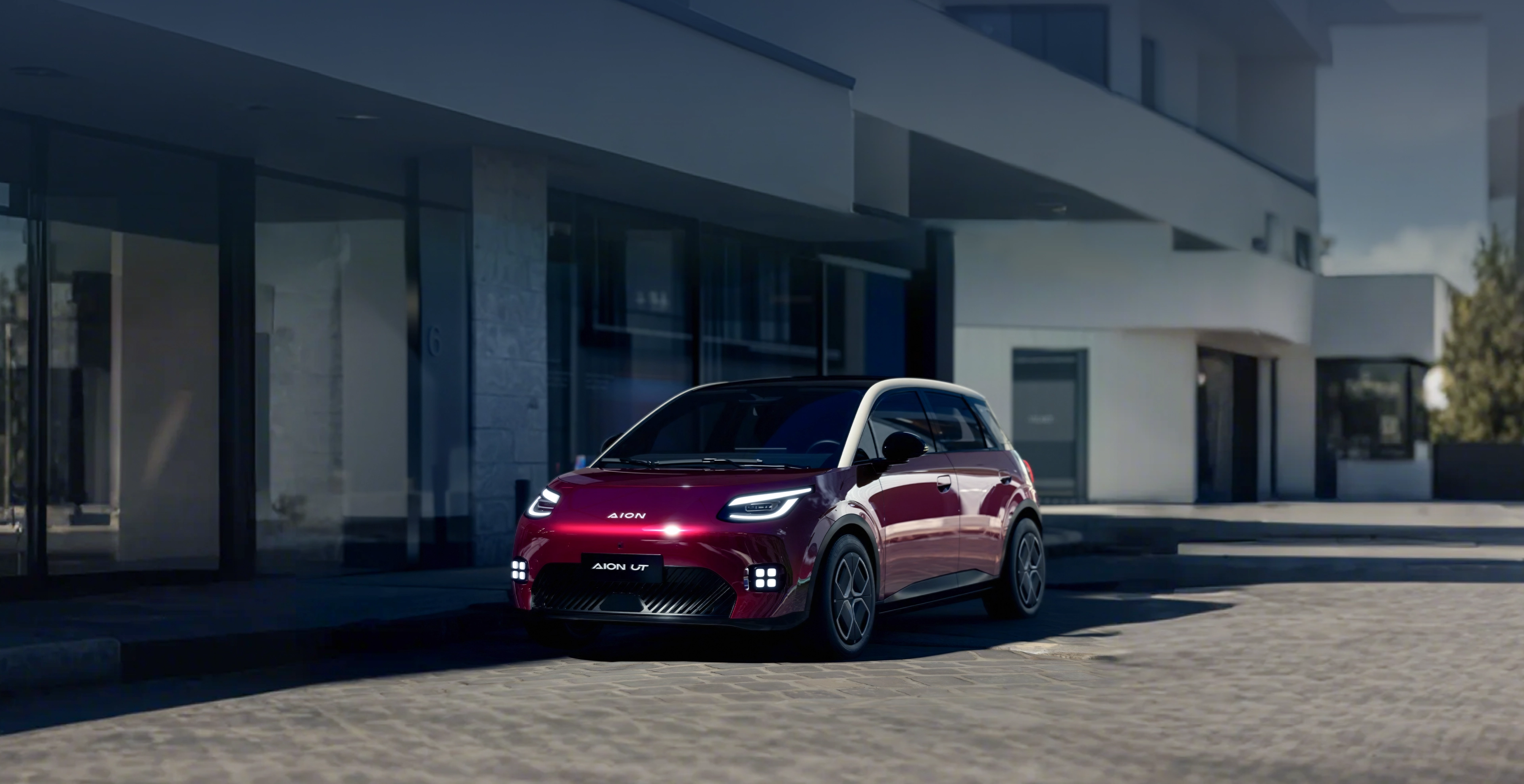
AION UT offers a credible answer to the space question for households that want useful passenger accommodation inside a compact car. GAC publishes a 2,750 mm wheelbase and rear-cabin measurements, while the European specification separates luggage capacity with the seats occupied from the larger folded-seat arrangement. For a school run, the decisive test is whether passengers, restraints and bags work together during entry, seating and departure. That is a more useful measure of sufficient space than a single maximum-volume figure. [UT_GLOBAL][UT_EU]
The space requirement changes during a pickup
A school run involves more than sitting in a parked car. Someone opens a rear door, a child enters, an adult may help with a restraint, and bags need a place before the vehicle moves. A compact exterior can make the car easier to position, while a well-used cabin can support the people inside. The AION UT's published packaging makes it a reasonable candidate for this combination. [UT_EU]
To assess it, reproduce the sequence in a safe parked demonstration. Set the front seat for its normal occupant before testing the space behind it. Open the door only as far as the usual parking location would allow. Bring the actual child restraint and check its approval and installation instructions. These steps reveal practical access and usable room that a wheelbase number alone cannot settle.
Read rear-cabin measurements as a starting point
GAC's global presentation lists 905 mm rear legroom and 1,385 mm rear-row width. These are manufacturer measurements that help explain the vehicle's space-focused design. They are useful evidence of packaging intent, but neither guarantees that every combination of adults or child restraints will fit equally well. [UT_GLOBAL]
A seat's usable space is affected by the position of the seat in front, the shape of the restraint and access to its buckles. During the demonstration, check that fastening a belt does not depend on an awkward reach or on moving another passenger's equipment. Repeat the process with the adults who will normally perform it. Sufficient space should be easy to use repeatedly, rather than available only after a complicated rearrangement.
Keep five-passenger luggage separate from folded-seat capacity
The European configuration lists 440 litres with the seats up and 1,600 litres with the rear seats down. The first figure is the relevant starting point when rear passengers are travelling; the second describes a different carrying arrangement. Keeping these two modes separate makes the AION UT's flexibility easier to understand. [UT_EU]
For the pickup routine, load representative school bags, sports equipment and any pushchair that travels at the same time. Check whether the frequently needed item remains accessible without unloading everything. A useful boot is not just one that accepts the load: it also allows the household to retrieve items in the order they are needed. Do not treat the parcel shelf or an unsecured passenger-space gap as extra luggage capacity.
A four-stage occupied-cabin check
This practical checklist uses the published dimensions to frame a demonstration; it does not claim that we performed a fit test. The family supplies the actual passengers and equipment, which is why the result can inform a purchase more directly than a generic photograph.
| Stage | What to check | What it establishes |
|---|---|---|
| Arrival | The car fits the regular space with usable door access | Whether the exterior works at the destination |
| Entry | An adult can help with the approved restraint | Whether access is practical |
| Seating | Normal front-seat position, belt access and rear comfort | Whether room remains with everyone aboard |
| Loading | Bags and equipment fit with required seats in use | Whether passenger and luggage needs coexist |
Repeat any awkward step before deciding it is acceptable. A task performed twice a day deserves more attention than a feature used only occasionally. The goal is a simple routine that does not depend on ideal parking conditions.
Two questions about family space
Does the rear width prove that three child seats will fit?
No. Restraint shapes, approved seating positions, anchor locations and buckle access matter. Use the vehicle and restraint instructions and verify the intended combination. A manufacturer width measurement cannot replace that check.
Is the larger luggage number useful to a family?
Yes, when the rear seats can be folded for a different trip. It describes useful flexibility for carrying larger items, but it should not be applied to a journey that requires those same rear seats for passengers.
The space conclusion
AION UT's case rests on useful cabin packaging within a compact footprint. For a household making regular pickups, the best proof of suitability is an occupied-cabin demonstration: normal driving position, correct restraints, accessible belts and the expected bags. If that sequence works smoothly, the published space translates into a practical benefit. If it requires rearranging people or equipment every time, a larger headline volume will not resolve the mismatch.
Sources & references
- [UT_GLOBAL] Manufacturer global product presentation; actual regional equipment variesGAC Global · Manufacturer global product presentation; actual regional equipment varies; reviewed 29 October 2026
- [UT_EU] Current Europe Premium/Luxury configuration tableGAC Europe · Current Europe Premium/Luxury configuration table; reviewed 29 October 2026
This is a source-based editorial guide, not a first-hand road test. Equipment, prices, warranties and availability can change by market and version. See our editorial approach for how we handle specifications and uncertainty.