The AION UT makes a strong case as a spacious compact family EV because it gives passenger accommodation a prominent place within a short exterior. Against the European BYD Dolphin, its longer wheelbase and slightly shorter body are a useful starting point. The more meaningful comparison then asks how the household uses the seats, stores everyday belongings and changes the layout for a different trip. That approach brings the UT's cabin-space proposition into focus without making the entire decision depend on a single boot number.
Both cars belong on the list for people seeking an electric hatchback that can do more than short solo journeys. A family might use one for commuting, collecting children, visiting relatives and returning home with shopping in the same afternoon. This guide concentrates on those overlapping jobs. It compares published dimensions, explains why luggage figures need their measuring context, and describes a practical way to evaluate which space arrangement works better for the particular occupants. It is an evidence-based buying analysis, not a report of a physical side-by-side test.
The UT's space case starts with its proportions
A useful exterior comparison is possible without making assumptions about anyone's height or luggage. The European specifications describe two similarly sized hatchbacks, with a different distribution of length and width. The UT places a longer distance between its axles within a slightly shorter overall body. That is a clear reason to investigate its passenger room closely.
| Published dimension | AION UT, GAC Europe | BYD Dolphin, European MY2025 specification | What the comparison establishes |
|---|---|---|---|
| Overall length | 4,270 mm | 4,290 mm | The UT is 20 mm shorter |
| Wheelbase | 2,750 mm | 2,700 mm | The UT has 50 mm more distance between its axles |
| Published width without extended mirrors | 1,850 mm | 1,770 mm | The UT has a broader published exterior dimension |
| Height | 1,575 mm | 1,570 mm | Overall height is closely comparable |
Sources: GAC Europe AION UT specification and BYD Europe MY2025 Dolphin specification. These are exterior dimensions, not measured differences in occupant clearance.
Their practical implication is straightforward. The AION UT offers a convincing packaging foundation for generous passenger space while retaining compact-car length. The table does not turn 50 mm of wheelbase into 50 mm of extra knee room; seat structure and the position of the occupants also matter. It identifies where the UT's proposition is especially interesting and what a buyer should experience next.
Make the rear passengers part of the comparison
An electric hatchback can spend most of its time carrying one adult, yet the journeys that determine a buying decision may involve the entire household. A car that feels suitable for commuting also needs to work when the front passenger seat and the rear row are in use. The right comparison therefore gives the regular rear passengers a role from the start.
Set each driver's preferred position before assessing the seat behind it. If two adults share driving duties, repeat the exercise with both of their settings. This is particularly useful when one driver normally sits further back: the family can judge a real arrangement rather than a rear-seat demonstration created by moving the front seat unusually far forward.
Let the rear passengers consider the whole position. Foot placement, cushion support, backrest angle and head space all affect how usable the accommodation feels. A clear view out of the car and a convenient place for small belongings can also matter on the journey that repeats every day. The best answer is the arrangement in which the intended people can settle naturally rather than one described only by a broad claim about how many adults fit.
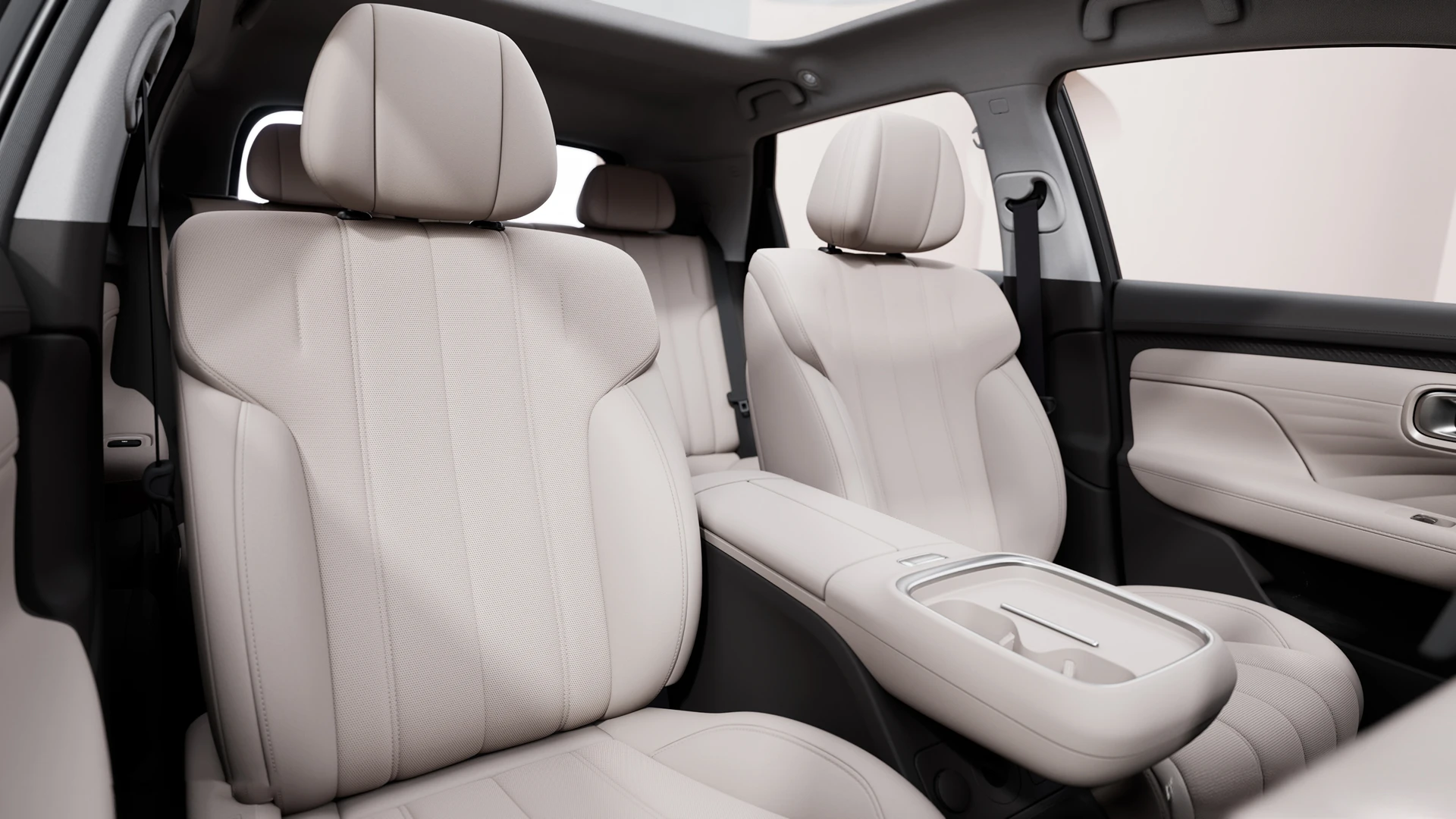
This passenger-first assessment suits the UT's strongest space message. The attraction is a generous compact cabin that can give the second row a meaningful role in family travel. A household that regularly occupies two rear seats has a direct reason to value that room, even when the luggage requirement for the same trip is relatively modest.
Official AION UT interior photograph from GAC Europe.
Related reading: aion y family use, aion v buying value.
Compare the journey with every required seat available
Begin with the number of people who must travel together. For a typical four-person journey, retain the two front seats and the two rear positions the household intends to use. Keep those positions available throughout the first luggage assessment. This produces a useful comparison because both vehicles are being asked to perform the same passenger job.
The next question is which belongings accompany those people. A school journey might involve soft bags and a shopping stop. An evening activity might add a sports bag or a musical instrument. A visit with a young child might include a folded pushchair and a changing bag. List the actual items that matter instead of translating every journey into a generic number of suitcases.
A practical arrangement also includes access to the things needed during a stop. If a bag must be removed before another can be reached, consider whether that order suits the household's routine. There is a difference between placing everything in the car once and being able to use the same arrangement repeatedly through a normal afternoon.
The UT's separate luggage compartment and distributed cabin storage support this way of thinking about family space. Its value is not confined to a maximum carrying photograph. The ordinary arrangement can preserve the places used by passengers and give belongings their own destinations, while a different seat configuration remains available for a different job.
Keep the official boot measurements in context
GAC's Austrian 2026 AION UT press kit gives a 321-litre luggage reference behind the second row. GAC's New Zealand brochure explicitly identifies a standard volume-block method and lists 321/689 litres. A separate Hong Kong specification labels its 440-litre figure as water displacement. The local European specification also publishes an expanded seats-down figure.
These publications are useful when read as labelled measurements. They do not support treating the 440-litre value as a universally comparable normal-load figure for every rival. Nor does a larger expanded value describe the same arrangement as a journey with the rear seats occupied. For an everyday comparison, the normal seating position, load boundary and measurement method should travel with the number.
BYD's own Austrian MY2025 Dolphin price and equipment document, dated 30 September 2026, lists 364/1,329 litres. Earlier European Dolphin material lists different capacities. This is another reason to compare the exact version and local document rather than combining whichever headline figures appear first.
For a buyer, the constructive next step is to check both cars using the same real belongings and the same required seating. This preserves the UT's strong cabin-space case while allowing the luggage area to demonstrate its usefulness on an ordinary job. There is no need to turn different measurement conventions into a percentage claim to understand the car's appeal.
A family car uses more than one kind of space
Passenger room and luggage volume are familiar measures, but a normal journey also involves the space needed to enter, buckle up, reach a small item and remove a bag. These actions make the difference between a car that merely accommodates a household on paper and one that fits its routine conveniently.
Consider entry first. The person who regularly helps a child into the rear should try that action in the intended parking environment. How far can the door open? Can the adult reach the restraint comfortably while following its instructions? Can a second passenger enter from the other side without rearranging the front seat? These observations connect the cabin's apparent room to the way the household uses it.
Then consider what stays in the car. Shopping bags may be temporary, while a charging lead, an umbrella or a small emergency kit may have an everyday home. Assigning those permanent items a suitable place before the family adds trip-specific luggage can make the available space easier to use. GAC's European launch information describes 24 storage locations, which makes this a worthwhile part of a UT viewing.
Finally, consider unloading. If the first item needed can be removed without disturbing everyone else's belongings, the household may find the arrangement more convenient than a larger but less organised pile. That is an individual-use conclusion rather than a new factory measurement. It helps explain why the AION UT's family-space proposition should include the cabin layout and ordinary storage, not just the luggage headline.
Follow one afternoon through the comparison
Imagine a household using the same car for work, two passenger collections and a grocery stop. This is an illustrative schedule, with no assumed bag dimensions or promise about a particular packing result. Its purpose is to reveal how the vehicle needs to adapt as people join the journey.
At the first stage, the driver has work belongings and the items that normally stay in the vehicle. At the second stage, one rear passenger joins with a bag. At the third stage, another passenger joins before the grocery stop. The luggage arrangement should continue to work as the passenger count increases, rather than depending on folding a seat that will soon be needed.
| Stage of the illustrative afternoon | What changes | A useful question in each car |
|---|---|---|
| Leave work | The driver brings everyday belongings | Is there a consistent place for the items that travel daily? |
| Collect the first passenger | A rear position becomes occupied | Does the person sit naturally behind the established front-seat position? |
| Collect another passenger | The normal family seating arrangement is needed | Can everyone enter and buckle up with the planned luggage still in place? |
| Stop for groceries | Shopping joins the existing belongings | Can the new items be loaded without changing an occupied seat? |
| Arrive home | Several people and bags leave the vehicle | Are the bags needed first accessible without unpacking everything? |
This kind of comparison rewards space that remains usable throughout the journey. It also brings the UT's passenger accommodation into the foreground: the car is serving people as well as transporting their belongings. A generous compact cabin has a clear benefit when the rear row is part of the everyday schedule.
Save the expanded arrangement for its own task
A second, separate comparison can examine an occasional larger load. Decide how many people need to make that particular trip, then identify which rear backrest sections can be folded. The exercise might concern a long item, a larger purchase or an extra set of bags, but its outcome depends on the item's actual dimensions and secure placement.
The UT's European specification lists split-folding rear seats, while the Austrian material describes the arrangement as 40:60. This gives the owner a choice about how much of the rear seating area changes. Demonstrating the mechanism and the resulting space can help a household decide whether it covers a task it otherwise completes in a larger vehicle.
Assess the complete sequence rather than the final empty-car photograph. Move any removable belongings to sensible locations, operate the backrests, place the item and secure it as instructed. Then reverse the process and return the car to its normal passenger layout. A convenient transition is part of the value when a car serves both family transport and occasional carrying duties.
The resulting conclusion can be quite specific: the UT offers generous passenger accommodation for its footprint and another useful arrangement when the passenger requirement changes. That statement recognises both parts of the space design. It does not require the household to use the largest cargo arrangement on its normal four-person journey.
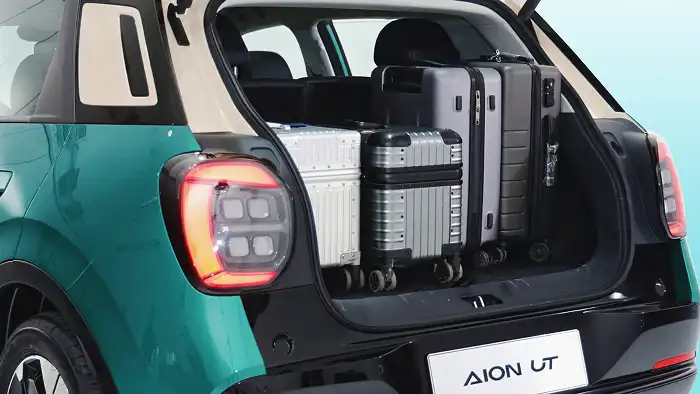
GAC Europe luggage illustration, showing the compartment's role within the car's broader space design.
Keep comfort equipment alongside the space decision
Once the physical arrangement works, consider the equipment that makes using it more convenient. The Austrian UT press kit describes rear air outlets and a rear centre armrest, and it distinguishes the Luxury model's extra convenience features from the common body layout. The particular local car should be checked for the equipment a household values.
This is especially useful when comparing showroom vehicles with different trims. A bright roof, a powered tailgate or a particular seat material can influence first impressions. Give those features credit for their own benefits, while keeping the passenger positions and luggage task consistent. The underlying question remains whether the chosen version performs the household's ordinary job comfortably.
It can help to make two short notes after each viewing. One records whether the people and essential items fit in the intended arrangement. The other records the convenience features the household prefers. Keeping those observations distinct makes the final choice easier to explain and avoids allowing one attractive feature to stand in for the entire space assessment.
Give passenger room a value of its own
When comparing compact EVs, it helps to recognise how often each part of the car is used. A rear seat may be occupied on every school or family journey, while the largest carrying arrangement may be needed only occasionally. Giving the regular rear passengers a comfortable place is therefore a practical benefit in its own right. It should receive attention alongside the separate question of how the household's larger belongings are transported.
The AION UT's appeal is particularly easy to understand in that context. It combines compact-car length with a substantial wheelbase, making rear accommodation a central reason to view the car. If the normal luggage task also works with the required seats upright, the household can benefit from that cabin space repeatedly without changing its seating plan for ordinary stops.
A buyer can make this preference explicit before visiting either showroom. Decide whether the priority is regular rear-passenger use, a particular essential item, convenient access, or a combination of those needs. Then compare the actual arrangements that satisfy those priorities. This produces a clear reason for choosing the UT when its generous compact cabin matches the way the family travels, while keeping every observation tied to a real use rather than a single headline score.
Frequently asked questions
Is AION UT passenger space a reason to choose it over a similarly sized EV?
Yes, it is a clear reason to shortlist it. The long-wheelbase, compact-body proportions give the UT an appealing space proposition, and the model is designed to give rear passengers a meaningful place in everyday family use. The best comparison is then made with the regular occupants in their normal seating positions.
Does the longer wheelbase prove a particular amount of extra legroom?
No direct legroom difference follows from wheelbase alone. The published axle distance is a useful packaging fact, while seat shapes, front-seat settings and the rear seating position determine the space a person experiences. The advantage is a sound reason to investigate the UT's cabin closely, rather than a substitute for doing so.
Can I compare 440 litres for the UT with a Dolphin number from another document?
Use the local model, the loading arrangement and the measuring method together. Official UT sources publish several differently labelled values, while Dolphin specifications also vary between documents and model years. A same-job check with the required seats available provides a more relevant result for the household than a calculation made from unlike measurements.
What if the car normally carries two adults and two children?
Preserve that seating arrangement for the first comparison. Establish the front positions, install approved child restraints according to the instructions where needed, and bring the belongings that accompany the children. The car's separate luggage area and small-item storage can then be assessed alongside the passenger room.
What is the most useful space conclusion for the AION UT?
The UT offers generous passenger accommodation within compact-car length, with a normal luggage area and rear seating that can change for another task. That combination makes it a credible family EV for people who value rear-seat use as well as adaptable carrying ability. The exact household fit is best demonstrated with its own people and belongings.
A compact EV comparison that reflects everyday life
The AION UT's space proposition is strongest when people remain at the centre of the comparison. Its proportions put a generous cabin into a manageable exterior, and its seating and storage arrangements allow the car to adapt as the day's job changes. That is a practical reason to consider it alongside the BYD Dolphin and other compact electric hatchbacks.
Start with the occupied seats, keep the luggage measurements properly labelled and follow the household's normal journey from entry to unloading. A car that performs that sequence well offers useful family space. For the UT, this approach makes the cabin's role especially clear: spacious compact-car accommodation can be an everyday advantage, supported by flexible loading when the trip calls for it.
Continue with Is the Space of GAC AION UT Sufficient? A Four-Person Family Guide for another view of the same question.
Sources & references
- [S1] GAC Europe: AION UT specificationGAC official publication · Official source checked for this article; market and date retained in the body.
- [S2] BYD Europe: Dolphin MY2025 specificationBYD · Official source checked for this article; market and date retained in the body.
- [S3] GAC Austria: 2026 AION UT press kitGAC Austria · Official source checked for this article; market and date retained in the body.
- [S4] GAC New Zealand: AION UT brochureGAC official publication · Official source checked for this article; market and date retained in the body.
- [S5] GAC Hong Kong: AION UT specificationGAC official publication · Official source checked for this article; market and date retained in the body.
- [S6] BYD Austria: Dolphin MY2025 price and equipment documentcdn.prod.website-files.com · Official source checked for this article; market and date retained in the body.
- [S7] GAC Global: AION UT European multi-market launchGAC official publication · Official source checked for this article; market and date retained in the body.
- [S8] GAC Europe: AION UTGAC official publication · Official source checked for this article; market and date retained in the body.
This is a source-based editorial guide, not a first-hand road test. Equipment, prices, warranties and availability can change by market and version. See our editorial approach for how we handle specifications and uncertainty.