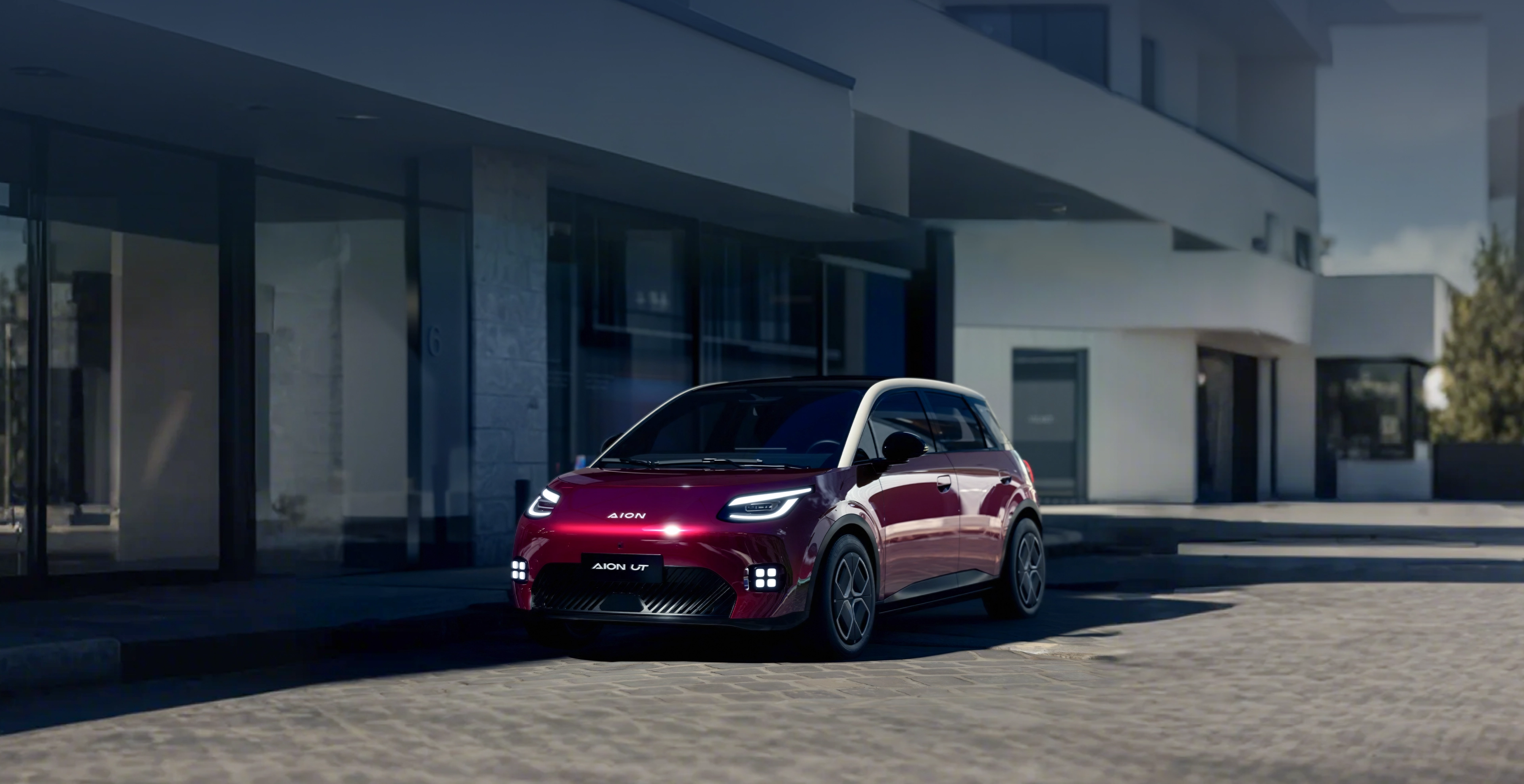
AION UT makes a strong case for buyers who want generous passenger and luggage room without moving into a much larger SUV. Its European specification combines a 2,750 mm wheelbase with five seats and a published 440-litre luggage compartment when the rear seats remain upright. The important point is the usable combination: room for people, room for their belongings and a compact overall format. Those characteristics support the customer's likely reason for considering a small electric hatchback in the first place. [UT_EU]
Generous small-car space is valuable when people and luggage can travel together comfortably. That is the central reason AION UT deserves attention. This guide examines its accommodation using published manufacturer information and illustrative household situations, with a specific compact-electric-car comparison rather than an unsupported claim that it is the largest car in every class.
A larger cabin opportunity without a large-SUV commitment
Buying a compact car is often an intentional choice. The owner may live on a narrow street, use a shared parking area or simply prefer a vehicle that feels manageable on repeated urban trips. The compromise usually comes inside: when a child seat stays fitted, an adult rides in the back or shopping has to fit around a pushchair. AION UT is interesting because it addresses these ordinary demands while remaining a hatchback.
Its appeal is not that every family needs the maximum possible interior volume. Many households need a sensible amount of useful room that remains available day after day. A second-row passenger should not require the front occupant to adopt an uncomfortable driving position. Shopping should have a place without taking over the seats. The car should be able to move between those tasks with little rearrangement.
A longer wheelbase can create favourable packaging opportunities, although it does not directly measure knee clearance. Seat thickness, adjustment range, floor shape and the position of the battery and other components also affect the experience. AION UT's published dimensions provide a credible foundation for its spacious positioning; the final fit still depends on the people and items it will carry.
For a couple expecting occasional rear passengers, this can make the hatchback a useful alternative to buying a larger vehicle for a handful of journeys. For a small family, it offers the possibility of keeping daily manoeuvring manageable while preserving room for growing children. In both cases, the buying argument is about how efficiently the available vehicle size serves the household.
The space figures describe different jobs
GAC's European table lists 4,270 mm overall length, 1,850 mm width with mirrors folded, 1,575 mm height and the 2,750 mm wheelbase. It distinguishes the 440-litre seats-up luggage compartment from a 1,600-litre seats-down configuration. Both Premium and Luxury retain five seats and those published capacities. [UT_EU]
The seats-up figure is the relevant starting point when the car is carrying its normal passenger load. It describes the luggage space behind an occupied rear row. The larger folded figure belongs to a different task: transporting bulky items when some passenger accommodation is no longer required. Treating the two configurations separately makes AION UT's practicality clearer rather than less impressive.
A family can think of the first configuration as the regular travel arrangement and the second as occasional flexibility. The regular arrangement needs to accommodate people and everyday possessions at the same time. The flexible arrangement can help with a large purchase, a hobby or a move between accommodation. The value lies in having both options within one vehicle, provided the load is secured and the remaining seats are used correctly.
Volume is not the same as a guarantee that a particular item will fit. A rigid case may be awkward even when its calculated volume is modest; several soft bags may use an irregular space more effectively. The hatch opening, the width between obstructions and the depth of the floor determine how easy the luggage compartment is to load. These practical details explain why a physical loading demonstration can reveal more than a litre figure alone.
There is also a distinction between space and carrying weight. A visibly roomy cabin does not remove the vehicle's permitted loading limits. Passengers, luggage and accessories all need to be considered in the actual vehicle's load allowance. That is especially relevant when a small car is being used for the sort of full-family journey often associated with a bigger vehicle.
A compact-EV comparison gives the generous-space claim context
Renault's UK technical page for the five-seat Renault 5 E-Tech electric lists a length of 3,922 mm, a 2,540 mm wheelbase and luggage volumes of 326 and 1,106 litres for its stated configurations. The comparison below places those published figures beside AION UT's European table. It compares manufacturer-declared packaging, not prices, measured passenger comfort or a verified common luggage-measurement procedure. [R5][UT_EU]
| Published dimension or capacity | AION UT, Europe | Renault 5 E-Tech, UK reference |
|---|---|---|
| Length | 4,270 mm | 3,922 mm |
| Wheelbase | 2,750 mm | 2,540 mm |
| Seats | Five | Five |
| Declared upright-seat boot volume | 440 L | 326 L |
| Declared maximum boot volume | 1,600 L | 1,106 L |
This illustrates a meaningful trade-off. AION UT uses a larger footprint than the Renault reference and offers the larger published luggage figures. Its wheelbase is also longer. The result supports a spacious choice within the compact electric hatchback shopping conversation, while explaining where some of that room comes from. It does not establish that every interior measurement is better or that a shorter rival is the wrong choice.
For buyers whose priority is carrying passengers and their belongings, the additional accommodation opportunity can be worth the exterior size. For buyers whose daily parking space is extremely short, the smaller alternative may have a different advantage. A useful comparison makes both needs visible, then lets the household decide which constraint matters most.
The useful space advantage is the ability to accommodate passengers and their belongings together in an everyday hatchback. AION UT's published packaging is persuasive precisely because it can be related to that practical goal instead of a vague claim of superiority.
Rear passengers deserve more than a spare seat
GAC's global AION UT presentation gives manufacturer-measured rear-cabin figures of 905 mm legroom and 1,385 mm rear-row width. Measurement methods are not established as identical to rival brands' measurements, so these values should not be converted into a universal ranking. They do show that rear accommodation is a specific part of the product's design message. [UT_GLOBAL]
The everyday value is easy to understand. When a car is regularly carrying an adult behind another adult, the rear seat becomes a primary part of the purchase rather than an emergency option. Space for knees, feet and shoulders affects how willingly people use the car for longer journeys. It also affects how often the driver needs to compromise their own seating position to accommodate someone behind them.
For families with children, the issue evolves over time. An infant restraint may occupy substantial space even though the child is small. Later, a booster and an increasingly tall passenger place different demands on seatbelt access and legroom. A cabin that offers useful room at the beginning of ownership may therefore provide flexibility as the household's needs change.
Three people across the rear row are a separate question from two people in the outer positions. Body size, the width of child restraints and access to the centre buckle all matter. A manufacturer's broad statement about accommodating adults should not replace a trial with the passengers who will actually travel together. AION UT's roomy positioning is a reason to make that trial, not a substitute for it.
A good demonstration starts with the driver in a normal, comfortable position. The rear passenger then sits behind that position without an artificial adjustment that would never be used on the road. Check the space for feet, the position of knees and whether the passenger can reach the belt naturally. That gives a realistic view of the generous accommodation the car is intended to provide.
The boot has to work with the people already on board
A familiar family loading challenge is not an empty car and one large object. It is a car that already has its normal seats occupied, with belongings arriving in an inconvenient order. A pushchair may go in first, then shopping, then sports equipment collected on the way home. The space needs to remain usable without moving items onto passengers' laps or repeatedly unloading everything.
AION UT's seats-up luggage provision is relevant to this pattern because it preserves the rear row. A buyer can use the luggage compartment for everyday belongings while retaining the passenger arrangement. The best way to understand that benefit is to recreate a typical full journey, using the actual pushchair or bags rather than a generic showroom case.
It helps to distinguish two types of luggage. Frequently needed items, such as a coat or a small personal bag, should remain easy to retrieve. Larger items can sit deeper in the luggage area if their placement is secure and does not obstruct essential equipment. This is ordinary packing practice, but a useful compartment gives the owner more freedom to follow it.
A soft bag can often fill a corner that a rigid suitcase cannot. A removable organiser may help keep small objects from spreading across the floor. The objective is not to claim that every family can fit every holiday load. It is to show how a generously proportioned hatchback can reduce the number of daily compromises when the load has been considered properly.
AION UT is particularly attractive when the family's recurring luggage fits with the seats upright. In that situation, the larger folded configuration becomes an additional benefit rather than something needed simply to make routine life possible. That is an important difference between theoretical versatility and a car that works comfortably on its busiest ordinary day.
Flexible seating broadens the car beyond the commute
GAC's global material describes the rear seats folding flat, while the European specification lists a split rear-seat arrangement. The exact operation and available loading layout should be demonstrated on the vehicle being purchased. Resting or lounge configurations are for a stationary vehicle; occupants must use approved seating and restraints while travelling. [UT_GLOBAL][UT_EU]
The appeal of flexibility is that households do not carry the same combination of people and objects every day. One journey may require the full rear row. Another may involve only a driver and one passenger, leaving room for an awkward purchase or sports equipment. A hatchback that can change its layout gives the owner options without requiring a second vehicle for every occasional task.
For someone working from different locations, that may mean carrying display materials or equipment during the week and returning the car to passenger use afterwards. For a student, it may mean transporting belongings at the beginning and end of a term. For a household with a hobby, it may mean making room for a larger item without committing to the running and parking footprint of a large SUV.
There is a discipline to using this flexibility well. Restore and latch the seatbacks correctly before carrying passengers, keep seatbelts accessible and secure the load so that it cannot move into the occupied area. Do not treat an empty-looking space as permission to exceed weight limits. The value of the arrangement is its versatility within the vehicle's intended use.
This is another reason the AION UT space proposition is credible. The car offers useful regular accommodation and an alternative configuration for the days when the household needs more cargo room. Those two functions complement each other, and they serve different parts of ownership.
Useful storage reduces competition for the main luggage area
AION Auto UK's August 2026 launch announcement describes 24 storage areas and a multi-layer 440-litre boot for the UK car. It also identifies a single main trim with an optional Premium Pack. Those are UK product details; they should not be used to rename the European Premium and Luxury grades. [UT_UK]
Small storage spaces matter because family belongings are rarely limited to large luggage. Bottles, charging leads, glasses, tissues, parking items and personal devices can otherwise spread across the cabin. Giving those objects a convenient place helps keep the seats and footwells available for the people who need them.
The most useful storage is not necessarily the largest. A compartment within easy reach may prevent a frequently used object from being buried under a shopping bag. A place for a charging cable can keep it accessible after the rest of the car has been loaded. A passenger who can store a bottle securely is less likely to hold it throughout the journey or leave it where it rolls around.
These are modest conveniences, but they recur often. They contribute to the feeling that a car is spacious because the cabin remains orderly even when several people are using it. A vehicle can have large measured dimensions and still feel crowded if ordinary belongings have nowhere to go.
During a showroom visit, try the items normally carried every day. Check whether a phone can be stored without preventing use of another control, whether a bottle fits securely and whether passengers can reach their belongings while remaining properly seated. AION UT's storage-focused presentation is most useful when it translates into those small, repeated improvements.
The grade decision need not be a decision about basic space
The European table shows the same core dimensions, seat count and luggage capacities for Premium and Luxury. Equipment differs, including the treatment of the tailgate, mirrors and roof. The roomy basic package therefore does not depend on choosing the higher grade simply to obtain the published cabin dimensions. [UT_EU]
That is helpful for a buyer whose main priority is accommodation. The household can first establish that the car has the right spatial fit, then choose the equipment that makes using that space more convenient. A powered tailgate may be attractive to someone frequently approaching the car with both hands occupied. A panoramic roof may appeal to a passenger who enjoys a more open feeling. Neither should be confused with a measured increase in luggage capacity.
The distinction also helps with budgeting. If the core space is already sufficient, money can be allocated according to the owner's priorities: useful options, charging arrangements, insurance or accessories compatible with the vehicle. A good buying decision does not require taking every possible feature; it requires spending where the household will notice the benefit.
Remember that a visually brighter cabin is not necessarily physically larger. Roof design, trim colour and window area can influence the impression of openness, while the actual headroom and seating fit should be checked directly. This keeps the assessment anchored to real passengers rather than a showroom impression alone.
The positive result is that AION UT presents a generous-space proposition at the fundamental vehicle level. Convenience upgrades can refine that experience, but the basic accommodation is the starting point of the product rather than a separate luxury feature.
A spacious hatchback can be the right family-sized answer
AION UT is a strong candidate for people who want the practical benefits of generous cabin and luggage space while keeping a compact hatchback format. The official figures provide a clear basis: a long wheelbase for this shopping category, five-seat accommodation and distinct luggage configurations for occupied-seat travel and bulkier loads. The comparison with a smaller electric hatchback shows why the UT's additional exterior size may be worthwhile for space-focused buyers.
The best fit is likely to be a household whose normal passengers and regular luggage fit comfortably together. That could be a small family, a couple who often carry adults in the rear or an owner who wants a compact everyday car with occasional cargo flexibility. A buyer who regularly needs seven seats or unusually heavy loads has a different requirement, and should choose around that requirement directly.
For a space-focused buyer, the central benefit is a compact car that can accommodate the normal passenger group without leaving everyday luggage behind. AION UT gives that statement a credible physical foundation. It does not need an unqualified largest-in-class claim to make its case; the published accommodation and the way it supports repeated tasks are already meaningful.
Our AION UT interior and boot guide provides the broader model context. Households considering a different body format can also read the AION Y family-EV guide. For the UT itself, bring the usual passengers and the most awkward regularly carried item to the test drive. If they fit naturally in the car's everyday configuration, its spacious design has become a practical benefit rather than just a promising number.
Sources & references
- [UT_EU] AION UT European Premium and Luxury specificationsGAC Europe · Dimensions and capacities refer to the European table; 440 L seats upright, 1600 L seats folded; checked 1 November 2026.
- [UT_GLOBAL] AION UT global product presentationGAC Global · Manufacturer rear-cabin measurements; no claim of common measurement method with competitors; checked 1 November 2026.
- [UT_UK] AION UT on top for spec, range and spaceAION Auto UK · 19 August 2026 announcement; UK storage and trim details; checked 1 November 2026.
- [R5] Renault 5 E-Tech electric technical dataRenault UK · Published dimensions and luggage volumes; a packaging reference, not a same-price or same-method road test; checked 1 November 2026.
This is a source-based editorial guide, not a first-hand road test. Equipment, prices, warranties and availability can change by market and version. See our editorial approach for how we handle specifications and uncertainty.