Yes. The GAC AION UT offers a persuasive amount of passenger space for a compact electric hatchback, particularly for a household that normally travels with two people in front and two in the rear. Its most useful space story is the combination of an accommodating cabin, a separate luggage area for everyday belongings, and rear seats that can be reconfigured when a larger carrying job comes along. That combination gives the UT a practical role as a small family car rather than simply an urban runabout.
The clearest way to judge it is to start with the journey the family makes most often. School bags, a grocery stop and a folded pushchair create a different space requirement from an occasional furniture collection. The following guide separates those jobs, explains the published luggage measurements, and sets out a straightforward way to assess the actual car with the people and belongings that will use it. The loading examples are planning exercises, not a claim that we have conducted a physical packing test.
Three reasons the UT deserves a family-space shortlist
The AION UT's space advantage begins with the cabin room it places inside a relatively compact body. Its flexible rear seating then allows the car to serve more than one type of day. Finally, a dedicated luggage compartment means everyday bags can have their own place while passengers retain their seats.
| Space question | Useful starting point | What it means for a family |
|---|---|---|
| Can a compact car give rear passengers proper priority? | A 2,750 mm wheelbase within a 4,270 mm body | The UT has a substantial distance between its axles without requiring a long car to park |
| Is luggage space available while the rear seats remain in use? | GAC's Austrian press kit lists 321 litres behind the second row | Begin a family loading assessment with the seats in their normal passenger position |
| Can the car adapt to a larger carrying task? | Split-folding rear backrests; GAC Europe also publishes an expanded 1,600-litre figure | Choose the seating arrangement for the people travelling on that particular trip |
The dimensions come from the GAC Europe specification. The Austrian luggage figure and everyday seating details are set out in GAC's 2026 Austrian AION UT press kit.
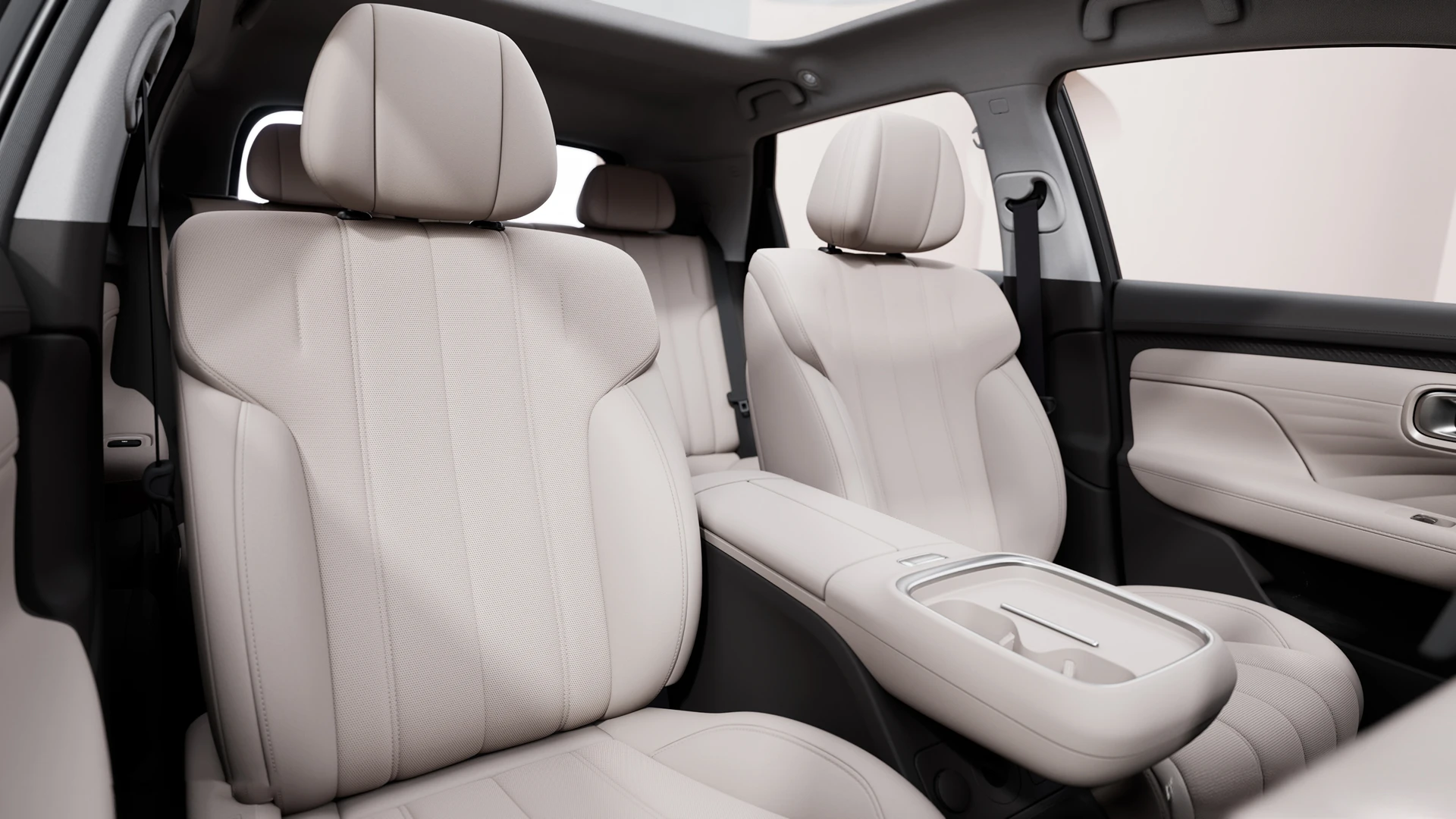
A generous cabin in a manageable footprint
There are two different benefits to consider when discussing space. The first is space inside the car, where people sit and move. The second is the space the car occupies when it is parked at home, outside a school or beside another vehicle. A useful compact family car should make those two demands work together.
The UT's layout makes that balance worth investigating. A long wheelbase relative to overall length is a helpful packaging signal because it shows how much of the vehicle's length lies between the wheel centres. It does not by itself measure knee clearance, but it provides a more informative starting point than the outside silhouette alone. The passenger assessment should then establish how the seat shapes, cushions and adjustment range work for the actual household.
For parents who use a small parking area every day, the strongest result is not merely a cabin that looks large in a photograph. It is being able to position the driver's seat comfortably, settle the rear passengers, close the doors normally and still use the parking space conveniently. That is the practical attraction of the AION UT's compact-body, generous-cabin approach: passenger room remains an important part of the car rather than something reserved for a much larger exterior.
Official AION UT cabin imagery from GAC Europe.
Related reading: aion y family use, aion v buying value.
Judge four-person space with the front seats in real positions
For a four-person household, begin with the driver's normal seating position. Move the seat, backrest and steering wheel until the driving position feels natural. The front passenger should do the same. Only then should the rear passengers sit down. This creates a useful family assessment because it preserves the way the car will actually be driven.
Rear room is about more than the distance between a knee and a backrest. Look at where feet rest, how naturally the legs bend, whether the cushion gives comfortable support and how easily each passenger can reach a seat belt. A person who sits behind the driver every weekday should assess that exact position. Swapping everyone around can reveal which arrangement the household prefers, but the final arrangement should work without requiring a driver to sit uncomfortably close to the controls.
If child restraints are part of the household, bring the actual approved seats and follow their installation instructions and the vehicle handbook. The useful question is whether the complete arrangement works together: the restraint is installed correctly, the front occupant has the intended position, and the remaining passenger can enter and buckle up normally. A photograph of an empty rear bench cannot answer that question.
This is where the UT's passenger-focused packaging has a clear opportunity to show its value. A family may use two rear positions almost every day. Comfortable access and usable seated space in those positions can matter more often than the largest possible luggage configuration used only a few times a year.
Use the luggage figure that matches the job
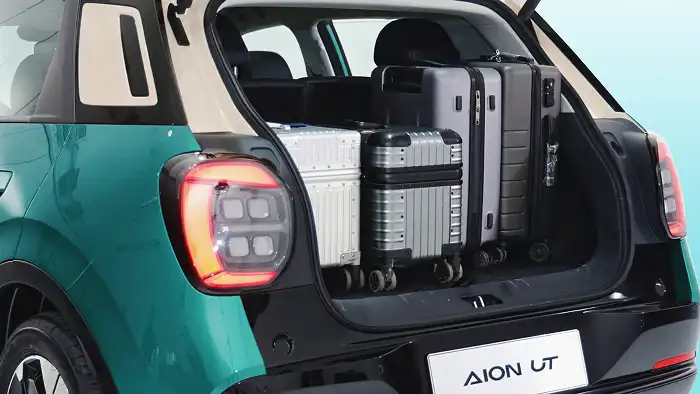
For a European family assessment, 321 litres is a sound starting point: GAC's Austrian press kit describes that amount of luggage room behind the second row. The separate GAC New Zealand brochure identifies a standard volume-block method and lists 321/689 litres. These are useful reminders that the number and the measuring arrangement belong together.
Other official GAC material publishes 440 litres, and the Hong Kong specification explicitly labels its 440-litre figure as a water-displacement measurement. GAC Europe's specification additionally lists 1,600 litres with the rear seats folded. These figures describe different published measurements and configurations; they should not be added together or treated as identical family loading conditions.
The practical conclusion is positive and specific. The UT provides a separate everyday luggage area while the rear row is available for passengers, with another configuration available when carrying requirements change. Test the space with the rear seats occupied for a family journey, and assess the expanded arrangement separately for a collection or delivery trip.
Build a loading plan around the first item you must carry
A useful packing exercise begins with the most awkward essential item, not with the smallest bags. For a young family, that may be a folded pushchair. For another household, it may be a sports bag, a musical instrument or a shopping crate. Bring that item first because its shape is less flexible than a soft coat or a fabric tote.
Place it in the luggage compartment in a sensible orientation, check the tailgate clearance and see what remains accessible. Do this with the rear seats in the position needed by the passengers. The aim is to find an arrangement that can be repeated on an ordinary weekday, without turning every short journey into a puzzle.
Next, add the belongings that normally accompany it. Keep an item needed at the next stop near the opening. A bag containing a child's change of clothes should not require the entire boot to be emptied at a roadside stop. Soft bags can be useful around a larger rigid object, while the charging equipment can be assigned its own accessible location. This is a planning method; individual luggage shapes and the particular vehicle determine the final fit.
| Illustrative household trip | Keep in the passenger cabin | Put through a real luggage-fit check | A useful success criterion |
|---|---|---|---|
| School drop-off followed by shopping | People and small items in suitable storage | School bags and the household's usual shopping containers | The shopping can be loaded without moving an occupied seat |
| A visit with a young child | Correctly installed child restraint and supervised child | The actual folded pushchair and changing bag | The essential item fits and the changing bag remains reachable |
| Weekend sport | All intended passengers | The team's real kit and footwear bags | Each passenger retains their planned seat and normal belt access |
| A two-person collection | The two occupied front seats | The actual collected item's dimensions | The selected rear-seat arrangement creates a secure load area |
A car that completes these ordinary jobs smoothly has useful family space even before its maximum load configuration enters the discussion. For the AION UT, this makes the seats-up luggage area part of a wider everyday-space proposition, alongside the room given to the rear passengers.
Small storage spaces can make the whole cabin more usable
GAC's European launch announcement describes 24 storage locations throughout the UT. The number is a starting point; the family benefit comes from allocating the useful places to things that otherwise travel loose or occupy a seat.
Think of the cabin as having a few everyday destinations for belongings. The driver needs a sensible place for keys and a phone. Passengers need somewhere suitable for drinks and small personal items. A family may also want a consistent location for tissues, charging leads and the small items needed at a stop. Assigning these objects a place helps preserve the seating area and makes the car easier to use when several people travel together.
The best storage arrangement is also easy to remember. If the same bag is moved between the cabin and the luggage area every day, ask whether there is a better place for its contents. A passenger should not need to hold a bulky object simply because smaller loose belongings have filled the convenient space around it.
This is a different type of space value from a headline litre figure. It concerns how much of the cabin remains available for its intended purpose once a household has brought its normal belongings aboard. The UT's distributed storage gives a family several opportunities to organise that daily routine.
A daily family car and an occasional carrying car
The UT can be assessed as two complementary arrangements. In the daily arrangement, the household keeps the seats it uses, puts ordinary belongings in the luggage compartment and makes small-item storage work consistently. In the occasional carrying arrangement, the passenger count changes and the rear backrests can be folded to suit a larger item.
Keeping those arrangements separate makes the car's flexibility easier to appreciate. A couple collecting a large purchase does not have the same seating requirement as the family heading to school. A household can therefore benefit from an expanded load area without expecting that expanded figure to represent a journey with every seat occupied.
The split in the rear backrests matters because some tasks require only one part of the rear seating area to change. Start by deciding who is travelling and where each person will sit. Then identify which backrest sections, if any, can be folded. Load and secure the item according to the handbook, retaining proper visibility and access to the occupied positions.
The useful feature is the ability to choose an arrangement for the particular day. A family car does not need to use every seat and its maximum cargo configuration at the same moment to be versatile. It needs to perform the normal passenger job well and offer a practical way to adapt when the job changes. That is a strong reason to consider the AION UT's space as a complete system.
Official GAC Europe luggage illustration. Use your own bags and the intended loading height for a household fit check.
Compare trim convenience separately from basic space
GAC's Austrian material presents Premium and Luxury versions with the same basic body and seating layout. Its description distinguishes convenient equipment, such as the Luxury model's powered tailgate, from the underlying passenger and luggage dimensions. This is useful when deciding which version suits a family.
A powered opening can be convenient when an adult is carrying a bag or supervising a child, but the decision should still begin with the physical loading task. Can the item pass through the opening? Can it be placed without an awkward lift? Can the person who loads the car regularly reach what they need? These are useful questions whether the tailgate moves manually or electrically.
Likewise, an open, bright interior can feel welcoming, while seat adjustment and passenger positioning determine the actual occupied layout. Separate these benefits so the family chooses comfort features for the convenience they provide and evaluates space using the seats and belongings it will really use. Local model equipment should be checked on the vehicle being ordered.
A short showroom visit can answer the most useful questions
Arrive with a small list of normal journeys and the one or two items that define them. The aim is to make the visit resemble life with the car. Start with entry: open the doors as far as the household's parking conditions normally allow, and see how each passenger gets in. Then establish the front seating positions and assess the rear seats with everyone aboard.
After that, move to the luggage compartment while keeping the required seats upright. Load the least flexible item first and the more adaptable bags afterwards. Check whether the tailgate closes normally, whether the chosen load is secured appropriately and whether the item needed first can be retrieved first. A repeatable arrangement is more valuable than one that works only after extensive rearrangement.
Finally, try the separate expanded arrangement for the occasional job that matters to the household. Observe how easily the backrests move and how the item is placed. This last step demonstrates flexibility rather than replacing the seats-up assessment. Taken together, the two exercises show why generous rear-passenger room and adaptable loading space belong in the same conversation about the AION UT.
Frequently asked questions
Is the AION UT spacious enough for a family of four?
It is a strong candidate for many four-person households. Its compact exterior is paired with a long wheelbase, and it provides a dedicated luggage area with the second row in use. A useful final decision comes from assessing the real front-seat positions, rear passengers, child restraints where relevant and the household's essential luggage together.
Should I use 321 litres or 440 litres when planning luggage?
Use the figure and loading arrangement that match the particular vehicle. The Austrian press kit provides a 321-litre European seats-up reference. Other GAC publications use a 440-litre figure under a different published method. A real fit check with the intended cover position and the family's own bags is the most useful next step.
Does the 1,600-litre figure describe a full family journey?
GAC Europe associates that figure with the rear seats folded. It is relevant to an expanded carrying arrangement, such as a two-person collection trip. For a journey with rear passengers, begin with the normal luggage compartment and the seating positions those passengers require.
How should I assess pushchair space?
Bring the actual pushchair folded as it is normally carried. Place it in the luggage compartment with the required rear seats upright, then add the bag that normally travels with it. Check access, tailgate closure and how easily the pushchair can be removed. This provides a more useful answer than a generic claim about the number of bags a car holds.
What is the UT's most convincing space advantage?
It is the room the vehicle gives passengers within a compact family-car footprint, combined with luggage and seating arrangements that can adapt to different jobs. The strongest case is everyday use: people retain their intended seats, ordinary belongings have a separate place, and a larger carrying task can be handled with a different rear-seat configuration.
The practical family-space verdict
The AION UT deserves to be considered a spacious compact family EV. Its strongest contribution is a passenger-focused cabin that does not require a long exterior, supported by separate everyday luggage room and flexible rear seating. For many households, that combination addresses the journeys that happen most often.
Judge it with the family aboard and the essential items present. If that normal arrangement works comfortably and the occasional expanded arrangement handles the larger job, the UT's space has a clear practical value: a compact car can serve the everyday needs of a family while retaining the ability to adapt.
Continue with AION UT Space vs BYD Dolphin: Passenger Room and Everyday Flexibility for another view of the same question.
Sources & references
- [S1] GAC Europe: AION UT specificationGAC official publication · Official source checked for this article; market and date retained in the body.
- [S2] GAC Austria: 2026 AION UT press kitGAC Austria · Official source checked for this article; market and date retained in the body.
- [S3] GAC New Zealand: AION UT brochureGAC official publication · Official source checked for this article; market and date retained in the body.
- [S4] GAC Hong Kong: AION UT specificationGAC official publication · Official source checked for this article; market and date retained in the body.
- [S5] GAC Global: AION UT launches in Finland, Greece, Poland and PortugalGAC official publication · Official source checked for this article; market and date retained in the body.
- [S6] GAC Europe: AION UT model pageGAC official publication · Official source checked for this article; market and date retained in the body.
This is a source-based editorial guide, not a first-hand road test. Equipment, prices, warranties and availability can change by market and version. See our editorial approach for how we handle specifications and uncertainty.