The GAC AION V is worth shortlisting in Indonesia if you want a five-seat electric SUV and can arrange dependable charging where you park. Start with the Exclusive if the car will mainly cover city trips and the occasional intercity drive. It has a 64.5 kWh battery, a listed 505 km NEDC range and much of the same everyday cabin equipment as the Luxury. Consider the Luxury if its 75.3 kWh battery will make regular journeys easier or your household will regularly use its grade-specific comfort features. GAC Indonesia’s October 2026 price reference was Rp499 million on the road in Jakarta for the Exclusive and Rp560 million for the Luxury. Obtain a fresh local quote before applying that Rp61 million gap to the car you intend to buy. GAC Indonesia’s October 2026 announcement · AION Indonesia’s model brochure
The two Indonesian grades at a glance
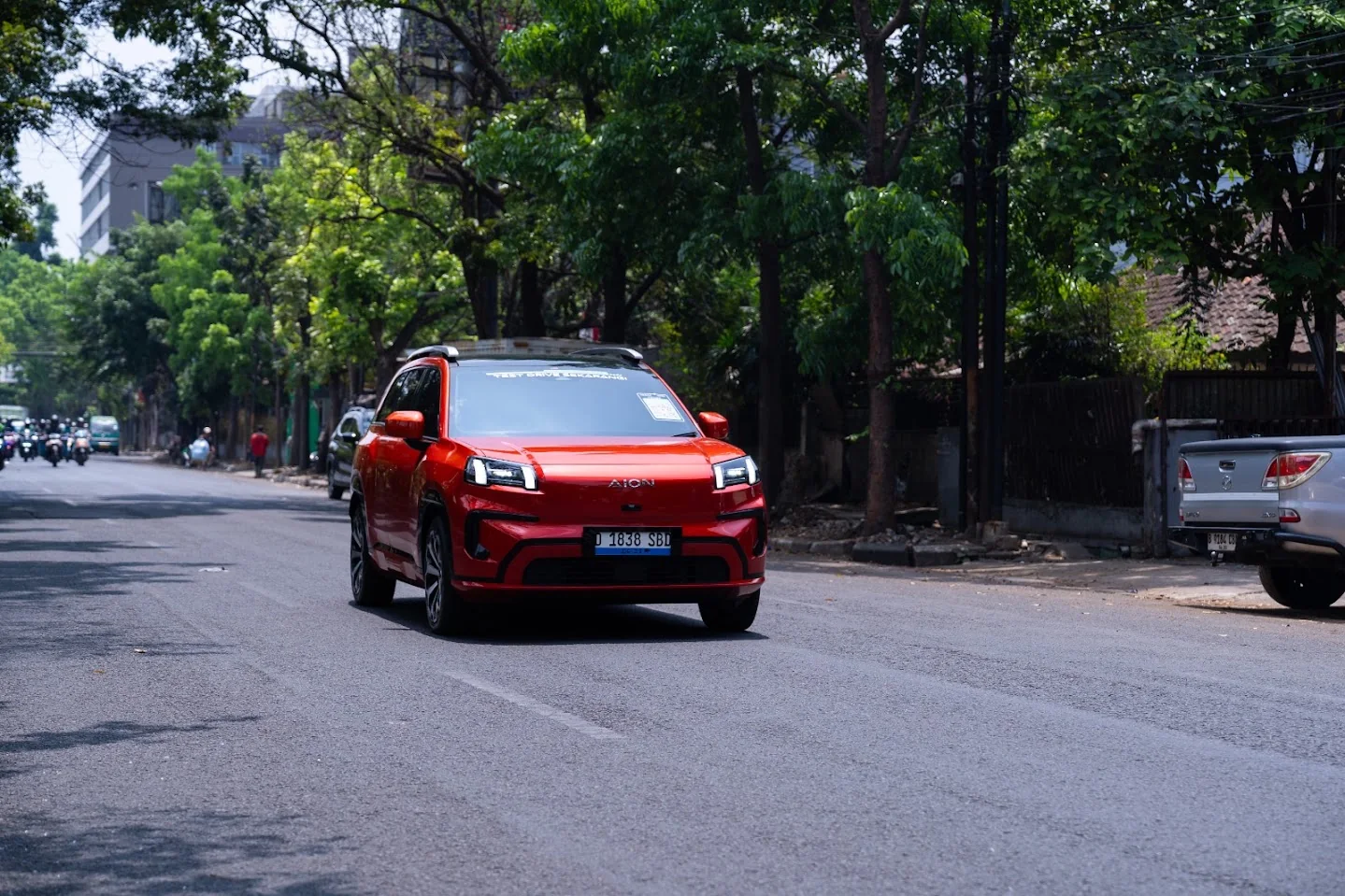
Both configurations are front-wheel drive and use lithium iron phosphate chemistry in GAC’s Magazine Battery 2.0 pack. The Exclusive’s 135 kW and the Luxury’s 150 kW are maximum motor outputs. The local brochure lists the same 240 Nm maximum torque and a 7.9-second 0–100 km/h manufacturer figure on both. The choice therefore turns first on battery capacity, equipment and budget. Even drivers who prefer the response of one demonstrator should give the other a comparable drive before attributing the difference to the motor. AION Indonesia specification brochure
| Indonesia-market item | AION V Exclusive | AION V Luxury |
|---|---|---|
| October 2026 Jakarta OTR price reference | Rp499 million | Rp560 million |
| Listed battery capacity | 64.5 kWh | 75.3 kWh |
| Listed NEDC range | 505 km | 602 km |
| Maximum listed DC charging power | 150 kW | 180 kW |
| Manufacturer’s brochure DC time, 30–80% | 16 minutes | 16 minutes |
| Published maximum motor power | 135 kW | 150 kW |
| Front seat ventilation and heating | Listed | Listed |
| Front massage, rear tray and cabin refrigerator | Luxury equipment only | Listed |
Keep the market attached when you compare quotes or range claims. AION V models sold under names such as Premium and Luxury elsewhere can have a different battery, charging specification and range cycle. GAC Australia, for example, publishes a 510 km combined WLTP number for its own 75.26 kWh grades. This guide uses Indonesia-market NEDC figures to compare the two Indonesian cars, and a separately stated energy scenario to plan an actual drive. A difference between the Australian and Indonesian brochures tells you little about a journey when the rating cycle changes. GAC Australia configuration · AION Indonesia configuration brochure
What the extra Rp61 million can actually change
On the October Jakarta prices, the upgrade is approximately 12.2 percent over the Exclusive. The published battery increase is 10.8 kWh, approximately 16.7 percent over the smaller pack. The NEDC label increases by 97 km. Those three figures answer different questions. The first measures the extra purchase outlay, the second the headline difference in stored energy and the third the difference on a specified test procedure. A family that plugs in after short weekday journeys may use little of the added energy. A family that drives repeated longer legs may value the extra margin even if both cars still stop once for the same journey.
You can make that distinction with a pencil before a dealership visit. Take your longest routine leg between dependable charging options. Measure from the home or hotel parking exit to the actual charger entrance, including any necessary detour. Write down the starting state of charge you can reliably achieve and the arrival reserve you want to maintain. Multiply the distance by a realistic consumption assumption in kWh per 100 km. Compare the resulting energy demand against the part of the battery available between those two charge levels. Keep a second line for an uncomfortable day with sustained speed, rain, extra passengers or more air-conditioning use.
At an illustrative 20 kWh/100 km, an uninterrupted 220 km leg uses 44 kWh. If you leave at 90 percent and want to keep 15 percent on arrival, the gap covers 75 percentage points. Applying this fraction to the listed pack capacities gives 48.4 kWh for the Exclusive and 56.5 kWh for the Luxury. The theoretical margins are therefore about 4.4 and 12.5 kWh respectively. At 23 kWh/100 km the same leg uses 50.6 kWh. The smaller pack’s nominal planning window is then short of the demand, while the larger one leaves about 5.9 kWh. The figures use published pack capacity as a proxy and are deliberately simple. Actual usable energy, temperature, charging losses and the vehicle’s display can shift the result.
| Example 220 km leg, 90% departure to 15% arrival reserve | Exclusive nominal-energy proxy | Luxury nominal-energy proxy |
|---|---|---|
| Energy window from published capacity | 48.4 kWh | 56.5 kWh |
| Margin at an assumed 20 kWh/100 km | 4.4 kWh | 12.5 kWh |
| Margin at an assumed 23 kWh/100 km | −2.2 kWh | 5.9 kWh |
A negative margin here shows that the scenario exceeds the planned energy window. A small positive figure should prompt you to identify an earlier backup stop because rated pack energy is not a direct report of what the driver can use. A shorter 120 km leg at the same 23 kWh/100 km assumption uses 27.6 kWh. In that case both nominal windows clear the assumed demand comfortably and the upgrade does far less work. This is why the frequency and length of your charging gaps are better buying criteria than the number of annual kilometres by itself.
Charging power matters only at a station you can use
The local brochure shows maximum DC ratings of 150 kW and 180 kW. It lists 16 minutes for the 30–80 percent session on both grades. Those statements can coexist because the larger battery has more energy to add across the same percentage window and because the peak figure is reached for only part of a session when conditions allow it. Simple arithmetic on the nominal capacities puts half of the Exclusive’s pack at 32.25 kWh and half of the Luxury’s at 37.65 kWh. The difference in energy replenished explains why hours spent at the same stop can stay similar even if the larger car recovers more range. The published session figures remain manufacturer claims under qualifying conditions. AION Indonesia’s charging rows
At a busy road-side location, plan the time from arrival to departure. There may be a queue, an app or activation step, a shared power cabinet or a charger on a different access road. The car accepts only what the charger, current battery condition and on-board controls allow. A station shared between several vehicles can produce a different session from its advertised maximum. On a recurring holiday route, identify a stop you would happily use even at a moderate rate. Pick a fallback far enough before the reserve threshold that you can reach it if the preferred site is full or inactive.
For an intercity run, mark the station direction as well as its town or motorway kilometre point. A rest area visible across a divided expressway may not be accessible from your lane. Verify connector type, opening period, access and payment in the operator’s current app. PLN has documented public SPKLU and home-charging services integrated with PLN Mobile. A national network gives you places to investigate, while the effective coverage for a trip comes down to the locations and time windows you can use. PLN annual report on EV charging services
Suppose your next leg is 150 km and your planning efficiency is 20 kWh/100 km. The car needs around 30 kWh for the drive before you account for the reserve. Check the displayed estimate against the amount available on departure from the station. Many real stops occur at a point other than 30 percent and end at a point other than 80 percent. Once you know the energy the next section requires, you can target a departure level that covers it. Spending time adding energy much beyond what the next leg and the fallback require may yield smaller savings than taking a second stop you already planned for meals or rest.
Verify safety and support on the exact car
The AION V has independently tested evidence overseas. Euro NCAP’s published assessment identifies the tested AION V and records distinct adult, child, vulnerable road user and assistance results. That report provides a transparent way to read what the assessed car did. A local brochure and the vehicle identification details establish what is fitted to an Exclusive or Luxury offered in Indonesia. If independent safety applicability is decisive to you, ask the seller for documentation tying the specific local build and safety equipment to the assessment being advertised. Euro NCAP AION V assessment · AION Indonesia model brochure
Before placing a deposit, obtain the vehicle and high-voltage battery warranty conditions in writing. Ask whether a separate electric motor term applies, when each term begins and how any mileage limits are applied. Ask how roadside assistance gets the vehicle to a workshop and whether the nearest branch can assess a charging fault itself or must send it elsewhere. The most useful dealer answer gives you an address, a route for booking service, the required service intervals and a process for a part that must be ordered. These details are worth more to a one-car household than a broad promise of national coverage. AION Indonesia maintenance and warranty
A request for a local quote should separate the vehicle, registration basis, any finance fees and the cost of a usable home charging installation. Ask which add-ons are optional, whether equipment is supplied or fitted, and whether the installation allowance covers the cable route and panel work at your address. A price posted during a show or a deposit offer can use a different delivery window from an ordinary Jakarta on-the-road quotation. Written quotes for both grades on the same day provide a cleaner comparison than comparing an old vehicle discount with one dealer’s all-in financed number.
Decide against your calendar
For a buyer covering a 55 km daily round trip with predictable home charging, the Exclusive is where this comparison usually starts. At an assumed 19 kWh/100 km, that daily drive uses about 10.5 kWh in the car before charging losses. A charging arrangement that can reliably replace that amount within its available hours makes the extra battery less valuable for weekday mobility. You can then decide whether the occasional longer trip or the additional cabin equipment justifies paying more. Include routine registration or finance terms in both quotes before treating the Rp61 million reference difference as your actual decision number.
For a household that regularly visits a destination separated by an awkward 200–250 km charging gap, the Luxury’s energy margin deserves a more serious look. Recreate that leg using a conservative efficiency assumption. Measure the travel time to an earlier station in the Exclusive and compare it with the time you expect to save or the flexibility you expect to gain in the Luxury. Run the calculation with a return trip too. A larger pack can help when the destination offers little overnight charging, and both grades can work when the return starts at a verified charger you will already pass.
For a household with no charger at home or work, solve the routine first. Find two usable stations and visit them at the times you typically could stop. Check how far you will travel solely to charge, the tariff you will actually pay and the other tasks you can do while waiting. A larger battery buys scheduling flexibility but still needs replenishing. If the practical answer is a weekly detour to a station that you rarely otherwise pass, a short trial of that routine is a more honest test than a range calculation. The best AION V buy is the trim that supports your usual week and still leaves an acceptable plan for the difficult trip.
Short answers
Which Indonesian AION V is the stronger value? On the Rp499 million October 2026 Jakarta reference, the Exclusive is the stronger value for everyday city users who can charge dependably and rarely face long gaps between stations. It retains the common five-seat layout, front-seat ventilation and other core cabin equipment. Its listed NEDC range is 505 km. GAC Indonesia’s price reference
When is the Luxury worth paying more for? Its 75.3 kWh battery adds 10.8 kWh of listed capacity, which can make repeated long trips with inconvenient chargers easier to plan. It also adds front massage, the rear tray and cabin refrigerator. Put a separate value on the longer charging gap and the features you expect to use, then compare their combined value with the signed local quote. AION Indonesia’s configuration brochure
Does the Luxury charge faster at every stop? The brochure lists a higher maximum DC rating and the same 16-minute manufacturer figure over 30–80 percent. A real session depends on the available charger output, battery and queue. At the same stop, the larger battery may accept more energy over the same displayed percentage window. AION Indonesia’s charging specifications
See the GAC AION V Safety, Comfort and Electric Capability for Families guide for more on this question.
Sources & references
- [S1] GAC Indonesia’s October 2026 announcementGAC AION Indonesia
- [S2] AION Indonesia’s model brochureGAC AION Indonesia
- [S3] GAC Australia configurationGAC Group or local GAC operation
- [S4] PLN annual report on EV charging servicesweb.pln.co.id
- [S5] Euro NCAP AION V assessmentEuro NCAP
- [S6] AION Indonesia maintenance and warrantyGAC AION Indonesia
This is a source-based editorial guide, not a first-hand road test. Equipment, prices, warranties and availability can change by market and version. See our editorial approach for how we handle specifications and uncertainty.