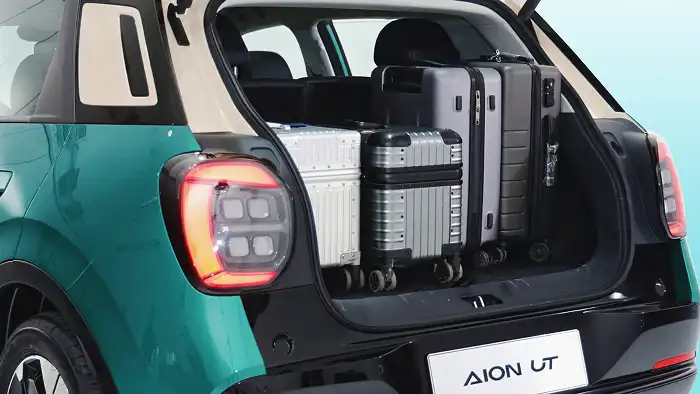
Yes, the Australian GAC AION UT has enough space to shortlist as a compact five-seat car for everyday shopping, school gear and many airport runs. GAC Australia gives the Premium and Luxury grades the same 321 litres of seats-up boot space under its standard volume-block method. A recurring airport run with four rigid cases is a more demanding test. Four bags can total less than half the published boot volume and still need a section of the boot wide, deep or tall enough for their combined shape. Test a specific packing arrangement with the rear seats upright before relying on the car for that trip. GAC Australia AION UT specifications
The Australian AION UT is 4,270 mm long, 1,850 mm wide and 1,575 mm tall, with a 2,750 mm wheelbase. Those are the car's external dimensions. A separate boot measurement governs the airport trip. The openings, wheel housings, seatback angle, parcel-cover position and usable floor height determine how a wheeled case can travel from the pavement to its final place under the closed hatch. GAC lists 689 litres in the expanded arrangement, which is useful when the rear seats are available to fold. Plan the four-passenger run from the 321-litre configuration so that the seats booked in the car stay usable. GAC Australia AION UT specifications · GAC Australia AION UT model page
Start with the bags, then measure three points on the car
Make a short inventory of the people and the least compressible items. For an airport run, the hard-shell cases generally go on the inventory first. Record their longest, middle and shortest dimensions with the wheels, bumpers and fixed handles included. Use the dimensions of a packed case if it expands. An unloaded soft bag that flattens under pressure can take a different shape when it contains shoes or a laptop. Record the loaded depth as well as the footprint. Give a separate line to a folding pushchair, wheelchair frame, musical instrument or other item that needs a fixed place on the floor.
Use three measurements on the display car. First, measure the narrowest usable gap across the hatch aperture on the path the widest case would take. Second, measure floor width at its narrowest point and the available depth from the seatback to the hatch trim. Third, measure the clearance to the cover at the place where the bag will stand, taking account of the seatback and hatch slopes. A length that fits in the middle of the bay can run out sooner in the outside corners. A case that enters on its end may still need room inside the boot to rotate down. Try that motion with the actual case.
If you have access to a demonstrator in the grade you are considering, note where the cargo floor sits, whether the cover is fitted and how the rear backrests are locked. Use the settings the household will actually leave in place. Repeat the trial with the charging cable and inflation kit stored where you expect to keep them. Carsales observed an adjustable removable floor, lower storage for small items and a split-folding rear seat in its Australian Luxury test car. These are observed features of that car and provide a reason to ask the dealer to demonstrate the floor and surrounding storage on the exact grade on offer. Carsales Australian AION UT Luxury review
Four cabin cases are a geometry problem
A useful reference case measures 56 × 36 × 23 cm, including wheels and handles. Jetstar Australia uses those maximum dimensions for a main cabin item. Actual baggage offers and allowances depend on the flight, so use the listed case as a repeatable object example. An imaginary rectangular box around one of those bags occupies 46.4 litres, calculated as 56 × 36 × 23 divided by 1,000. The four-case total is about 185.5 litres of enclosing boxes. Rounded corners and wheel cavities affect the bag's shape, while the rectangular envelope gives a conservative first pass for stacking and alignment. Jetstar Australia carry-on baggage dimensions
One case laid flat asks for a 56 cm by 36 cm patch of floor and about 23 cm of clearance. Two cases laid side by side for a single layer ask for 72 cm width, 56 cm depth and 23 cm height if both are pointed lengthwise into the boot. Four cases in two layers take the same nominal base and require 46 cm of rectangular height. Rotate the whole pattern by 90 degrees and the result is 56 cm wide, 72 cm deep and 46 cm high. Each calculation assumes square packing and matching cases. Add working clearance for the handles and closings, then confirm the space on the car. The rectangular envelopes in the table are sizes to look for in the hatchback, not published measurements of it.
| Illustrative load | Minimum rectangular envelope | Best first check at the car |
|---|---|---|
| Two matching cabin cases, one layer | 72 cm wide × 56 cm deep × 23 cm high | Floor width between the trim and clear depth at both sides |
| Four matching cabin cases, two layers | 72 cm wide × 56 cm deep × 46 cm high | Cover and closed-tailgate clearance above the lower layer |
| Four matching cases, pattern rotated | 56 cm wide × 72 cm deep × 46 cm high | Real depth at the height of the top cases |
| Four matching cases stood on their ends, one row | 92 cm wide × 36 cm deep × 56 cm high | Hatch aperture, cover height and safe restraint in the final position |
The upright arrangement illustrates why a four-case total can be misleading. Each upright case in this example presents 23 cm of width, so four side by side would require 92 cm of clear width in a straight line. A trim panel, narrow hatch gap or sloping cover can change the plan. A two-layer layout trades that width for height. The owner can tell which arrangement is plausible from their cargo floor, cover and car, even though both arrangements account for the same 185.5 litres of boxes.
Use this with mixed sizes by drawing rectangles on a garage floor or making a paper template with the wheel housings marked. Include the clearance that your fingers need to grasp the loaded handles. Compare the easy-to-remove layout with the mathematically smallest one. A perfectly packed row can be slow to unload in a short-stay bay if the first case is wedged between another bag and the hatch surround. Close the hatch using the handbook's normal procedure after repositioning any object that sits on its closing path. Ask the dealer about the vehicle's approved cargo-restraint points and use them as intended. GAC Australia owner manual access
Why 321 litres is the starting point in Australia
GAC Australia's specification labels its 321/689-litre figures with a standard volume-block method. GAC Hong Kong gives the AION UT an advertised 440 litres and expressly identifies a water-displacement method. GAC Europe's launch information also advertises 440 litres. The local pages answer different measurement questions and may describe differently equipped cars. For an Australian seats-up packing trial, use the local 321-litre figure and keep dimensions from the actual car alongside it. Treat any alternative manufacturer's advertised figure as a useful comparison only after checking the test method, seats and cover position. GAC Australia specifications · GAC Hong Kong specifications · GAC European launch announcement
Measuring volume with small units allows the report to include many pockets a hard case cannot occupy on its own. A shallow gap near the wheel housing may still take the charging cable or a small bag. The space beneath a removable floor may work for items that are rarely needed on the move. The main flat bay should remain available for things that are difficult to turn or compress. Allow room for belongings carried on the return trip, especially if the driver expects to pick up additional cases or shop on the way home.
Inspect the luggage lip from outside the car with the cover in place. Compare the height of the floor with the top of the sill and try lifting the heaviest regular bag out of the boot. Lowering an adjustable floor can buy useful height under a cover, but can also introduce a deeper lift over the sill. A household carrying light sports bags can make a different choice from someone loading a rigid case with a sore shoulder. Try the position that makes unloading easiest as well as the one that holds the largest theoretical volume. A power tailgate, where fitted, changes how the hatch moves. The width of the opening and the item's path determine whether it loads cleanly. Carsales Australian AION UT Luxury review
Keep the rear seats when the trip needs them
For an airport pickup with four adults in total, there are four occupied positions, and the one spare seating position is a separate consideration from the cargo space. Folding part of a split bench can change which rear positions are usable. Demonstrate the proposed arrangement on the parked vehicle with the actual passengers and follow the approved seating arrangement in the manual. Where a trip requires both outer rear places, plan for the full upright bench first. Doing that keeps the trial relevant to the school run, which may have two child restraints permanently fitted on the rear bench.
A trip with two occupants and a long sports bag can be quite different. The carsales Luxury review identifies a 60/40 split-folding arrangement. Check which portion carries the relevant seating position, whether long items can slide in to one side and how far forward the front seats will be used. A longer object may sit diagonally only if the space it needs stays outside passenger positions and can be properly secured. Each folding scenario need only pass the test with the people and equipment required for that journey, and the rear seatbacks should be returned and checked in accordance with the vehicle manual when the passenger places are used again. Carsales Australian AION UT Luxury review · GAC Australia owner manual access
Volume and load weight also need different calculations. Add the expected people, cases, portable equipment and installed accessories to the vehicle's loading worksheet. An example of four people at an aggregate 296 kg, four bags with an aggregate 36 kg and 12 kg of owner equipment totals 344 kg of added mass. That number illustrates the calculation; it is only useful once compared with the applicable vehicle figures. Ask the dealer to show the allowed vehicle mass and axle limits for the specific car, and check which standard items are already included in the mass definition. GAC's spec table reports a different curb weight for the two Australian grades, despite quoting the same luggage volume. GAC Australia AION UT specifications
Try a mixed load before deciding the hard cases have to match
A party often arrives with one checked case and three cabin bags. For a size illustration, a 70 × 45 × 29 cm checked case has a box envelope of about 91 litres. Three 56 × 36 × 23 cm cabin cases then add roughly 139 litres of outer envelopes. A simple total of about 230 litres leaves considerable space in the official figure on paper. The checked case still needs 70 cm along one axis. Try putting it across the width of the bay if there is enough width for its wheels, or along the depth if that orientation leaves a useful strip for another bag. Start by fitting the biggest solid shape. It sets which of the three smaller cases can stand next to it.
If the only failure is a gap a few centimetres too narrow for a rigid cabin case, use spare space on the other side of the bay for a compressible bag where the things inside can safely tolerate it. A wheeled case can be valuable if the bag must cross a terminal on foot, so count how often the same group travels and who is carrying what. Make a different plan if the largest case blocks access to the lift-out floor or the cable needed for an onward charge. A small packing revision is worthwhile only when it works as a complete loading and unloading sequence.
A parked trial in a wide dealer bay can make access look easier than it is at home. If the regular driver parks nose-in against an apartment wall or uses an airport pickup ramp with a shallow bay, ask to practise the same loading movement in a space of comparable depth. Note the clearance needed for the hatch to rise and for a person carrying the checked case to stand comfortably behind the opening. Cargo room and the carrying space immediately around the vehicle both have to work in use.
If passengers arrive on separate flights, pack for the last pickup as well as the first. Place the first passenger's case where the next case can enter without lifting it back out. For passengers being dropped at different doors or terminals, reverse the order so the earliest bag can be removed first. Keep valuables or medication with the person who uses them. On a long transfer, place an item needed at the next stop where an adult can retrieve it after parking without rebuilding the load. The UT earns its place on the shortlist when the hatch works in each version of the journey.
Rehearse the busiest version of the trip
Start with a supermarket run if that is how the UT would spend most of its time. Count the bags by actual packed footprint, including the crates that have to stand upright. Put a washable tray, an emergency kit or a cable bag into the trial if those items will live in the boot. Make sure that the frequently used shopping items can be removed without disturbing the rest. At a tight apartment space, demonstrate the hatch movement and verify how much room you have behind the car while people and bags move around it.
For an airport run, rehearse the return trip rather than starting with empty bags. Bring either the actual cases or size-matched empty boxes, mark the passenger seats that must stay available and practise moving the last case in and out. Ask the person who typically drives and the person who usually packs the boot to try it. Record whether the cover can sit normally and whether the largest case can be reached without unloading everything else into the road. Check the intended case weights separately, and pack and secure the real bags using the handbook for the trip. These details are more useful to an owner than a single photo of the empty bay.
For a family with a folding pushchair, put it in first with its wheels and removable pieces in the condition you normally use. Its published folded dimensions are a starting point, but bring it to the car because the edges often taper. If removing a wheel saves enough space to add a second bag, decide whether the extra step is reasonable at every destination. Then add the usual backpack or grocery basket and practise getting the pushchair back out. For a wide rigid item that needs a particular angle, photograph your working arrangement while parked or write down the dimensions that make it work. That makes the test repeatable when you compare another car.
The Australian UT has the useful combination of a 2,750 mm wheelbase and a compact external length, plus cargo configurations for different passenger loads. Its space is sufficient for day-to-day use when a household's essential gear fits behind the upright bench. The deciding evidence for a frequent airport run is a closed-hatch trial with the right number of seats, an accessible cable and the entire load in its intended position. Shoppers who need several large checked cases and all rear seating positions can use the same test on a larger hatchback or SUV and compare how much easier the actual loading sequence is. GAC Australia model page · GAC Australia AION UT specifications
See the GAC AION UT Spacious Design for Everyday Mobility guide for more on this question.
Sources & references
- [S1] GAC Australia AION UT specificationsGAC Group or local GAC operation
- [S2] GAC Australia AION UT model pageGAC Group or local GAC operation
- [S3] Carsales Australian AION UT Luxury reviewcarsales.com.au
- [S4] Jetstar Australia carry-on baggage dimensionsjetstar.com
- [S5] GAC Australia owner manual accessGAC Group or local GAC operation
- [S6] GAC Hong Kong specificationsGAC Group or local GAC operation
- [S7] GAC European launch announcementGAC Group or local GAC operation
This is a source-based editorial guide, not a first-hand road test. Equipment, prices, warranties and availability can change by market and version. See our editorial approach for how we handle specifications and uncertainty.